What began as a simple family moment quickly became one of the most unexpected political conversations of the year.
When Usha Vance appeared beside her husband in a warm Father’s Day video celebrating their growing family, few people expected her outfit to become national news. The video itself was gentle and personal, focusing on family, parenthood, and the anticipation of welcoming another child. But a fitted coral maternity dress worn by the future mother soon became the center of a debate that stretched far beyond fashion.
To many viewers, the dress looked exactly like what it was: a comfortable, affordable maternity outfit chosen by a pregnant woman preparing for a busy day. Yet to others, it became something much larger.
Suddenly, a simple wardrobe choice was being discussed in political columns, social media debates, and television segments.
The controversy began after commentary suggested that Usha Vance’s appearance represented more than personal style. Some observers argued that her visible pregnancy, traditional family image, and public appearance reflected broader cultural and political messages about family life, motherhood, and women’s roles in modern America.
For critics, the moment seemed symbolic.
For supporters, it felt absurd.
The debate quickly moved beyond clothing and entered the larger conversation surrounding politics, family values, and public expectations placed upon women in political life.
At the center of it all was Usha Vance herself.
Unlike many political spouses who remain silent during public controversies, she responded with humor.
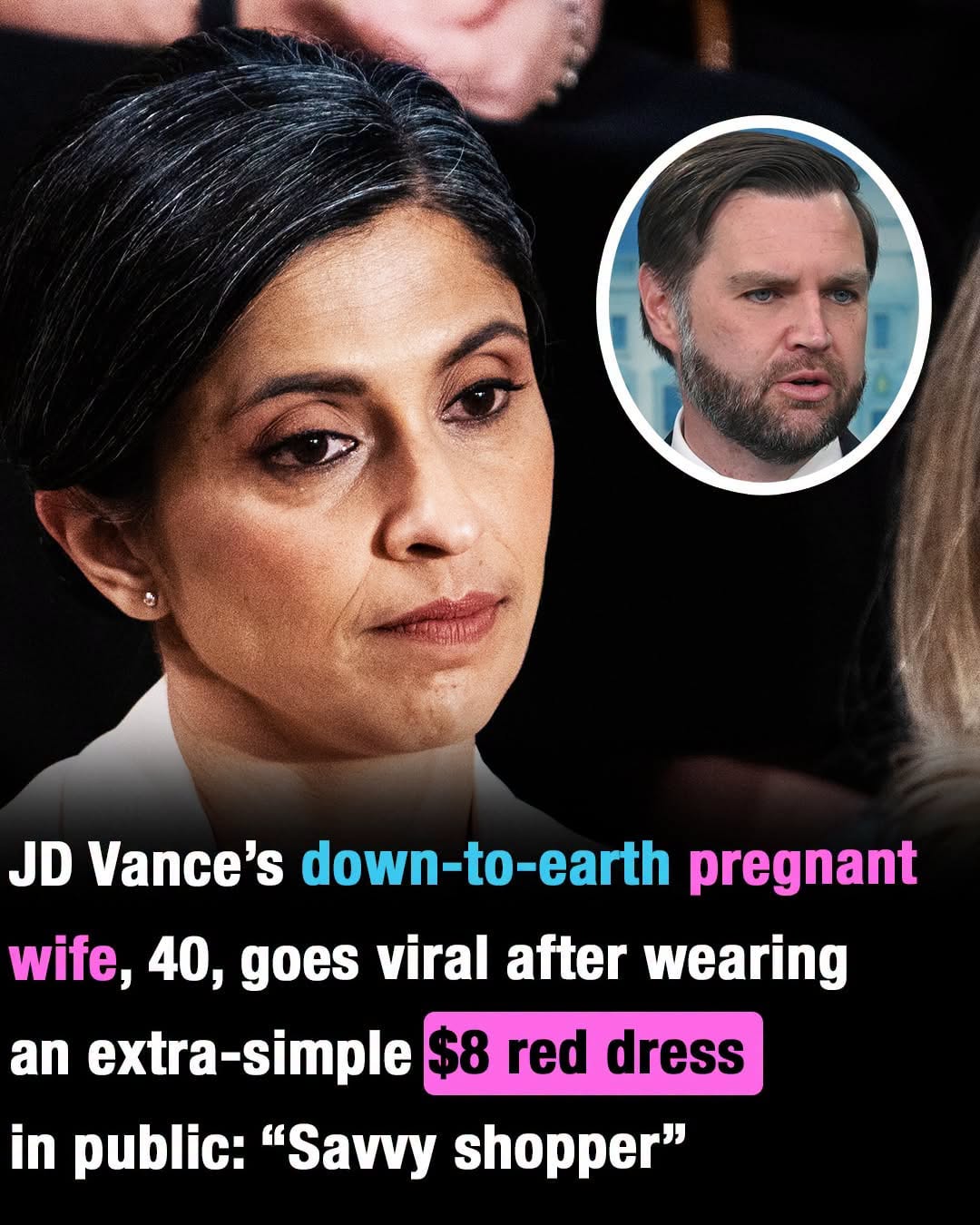
She revealed that the much-discussed dress cost only $8.75 and had been purchased from Old Navy.
The revelation immediately changed the tone of the conversation.
The image of a carefully selected political statement suddenly became the story of a bargain purchase by a pregnant mother simply trying to find comfortable clothing.
Her response resonated with many Americans.
Rather than engaging in a lengthy political argument, she joked about the idea that every maternity dress, elastic waistband, or compression sock might somehow carry hidden ideological meaning.
Her comments highlighted the growing tendency to analyze every public appearance through a political lens.
For many women, pregnancy already attracts attention, advice, and judgment from strangers. Public figures often experience this on a much larger scale.
What one person sees as fashion, another sees as messaging.
What one person sees as comfort, another sees as symbolism.
The discussion surrounding Usha Vance illustrates how difficult it has become to separate personal life from politics, especially for individuals connected to national political figures.
Throughout American history, the spouses of politicians have often faced intense scrutiny.
Their clothing, hairstyles, family choices, parenting decisions, and public appearances frequently become subjects of discussion.
Some First Ladies and political spouses have intentionally used fashion to send messages.
Others have simply chosen clothing based on practicality, comfort, or personal taste.
The public often decides afterward whether those choices carry deeper meaning.
Usha Vance entered this debate unexpectedly.
As the wife of Vice President J.D. Vance, she has attracted growing public attention. Her background differs significantly from many previous political spouses.
An accomplished attorney and Yale Law graduate, she built her own professional career before entering the national spotlight.
Observers have frequently noted her intelligence, professionalism, and relatively private approach to public life.
Unlike many political figures, she often appears understated.
This may explain why the reaction to the maternity dress became so surprising.
Many supporters viewed her appearance as relatable rather than symbolic.
Pregnant mothers across the country immediately recognized the reality behind her explanation.
Maternity clothing is often purchased for comfort.
Budget matters.
Practicality matters.
Finding something that fits properly during pregnancy can be challenging enough without considering whether a dress carries political significance.
The revelation that the dress cost less than ten dollars only increased public interest.
Almost immediately, reports suggested that the item sold out.
This phenomenon is not uncommon.
Political figures and their families frequently influence consumer trends.
Clothing worn by First Ladies, royal family members, and public figures often experiences sudden increases in demand.
But in this case, the appeal may have stemmed from something deeper.
The dress represented accessibility.
It showed that even individuals connected to the highest levels of government sometimes shop at ordinary stores and make practical choices.
For many Americans facing rising costs and economic concerns, the affordability of the dress became part of the story.
The controversy also highlighted how quickly social media can transform everyday moments into political events.
A family video intended to celebrate Father’s Day became a national discussion about motherhood, ideology, and symbolism.
Every photograph, every gesture, and every clothing choice can now become part of larger cultural debates.
Some commentators argued that public figures inevitably become symbols whether they intend to or not.
Others insisted that constantly assigning political meaning to personal decisions creates unnecessary division.
Usha Vance’s reaction appeared to reject both extremes.
Her humor suggested that not every decision deserves political analysis.
Sometimes a maternity dress is simply a maternity dress.
At the same time, the discussion revealed how deeply Americans remain divided over cultural issues surrounding family, gender, and public life.
For some people, highly visible family imagery carries political implications.
For others, it simply reflects ordinary life.
The disagreement itself demonstrates how personal experiences increasingly intersect with national conversations.
The story also raises broader questions about the expectations placed upon women connected to politics.
Female public figures often face scrutiny that extends far beyond their professional accomplishments.
Their appearance, clothing, and family roles frequently receive more attention than their education, careers, or expertise.
Usha Vance’s experience reflects this reality.
A successful attorney and accomplished professional found herself at the center of a debate not because of her work, but because of a maternity dress.
Yet her response may explain why the story resonated so strongly.
Rather than becoming defensive, she reminded people of something simple.
Not every public appearance contains a hidden message.
Not every outfit is a political statement.
Not every moment requires interpretation.
Sometimes a woman preparing for motherhood simply chooses a comfortable dress, records a family video, and continues living her life.
In the end, the dress itself became less important than the lesson it offered.
The public often projects meaning onto people who may never have intended to send any message at all.
And while politics can shape many aspects of modern life, some moments remain deeply personal.
For Usha Vance, what began as an ordinary purchase became an unexpected national conversation.
But for millions of mothers watching, it was something much simpler.
It was proof that even in the middle of politics, family, and public attention, a woman can still walk into a store, find an affordable dress, and discover that sometimes the most ordinary choices become the stories people remember most.