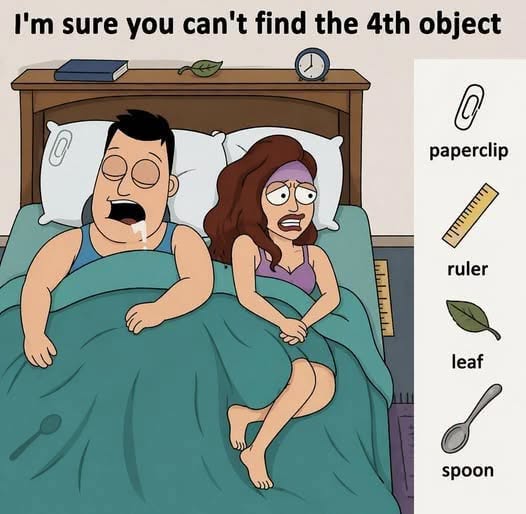
At first glance, the image appears simple.
A collection of shapes.
A few familiar objects.
Perhaps a hidden item or two waiting to be discovered.
Most people approach these viral optical illusion challenges with confidence, convinced they will solve the puzzle within seconds. After all, the missing paperclip, the concealed spoon, or the hidden leaf cannot be that difficult to find.
But then something unexpected happens.
Seconds become minutes.
Eyes dart across the image.
People zoom in.
They tilt their phones.
They stare harder.
And somehow, the answers remain invisible.
What makes these puzzles so fascinating is not simply the hidden objects themselves. The true mystery lies inside the human brain.
The viral challenge that has recently captivated thousands of people online asks participants to locate several ordinary objects carefully concealed within a seemingly straightforward illustration. The items are not especially small. They are not technically invisible.
Yet many viewers miss them repeatedly.
Some eventually give up.
Others become frustrated.
Many insist the objects simply are not there.
Then someone points out the answer.
Suddenly the hidden item appears.
And once it does, it becomes almost impossible to understand how it remained hidden for so long.
This strange experience reveals something remarkable about the way human attention works.
Our brains do not process every detail we see.
Instead, they constantly filter information.
Every second, the human brain receives enormous amounts of visual data. Colors, shapes, movement, shadows, textures, and patterns compete for attention simultaneously.
If the brain attempted to process every single detail equally, daily life would become overwhelming.
Instead, it creates shortcuts.
It decides what matters.
It ignores what appears unimportant.
Psychologists sometimes describe this process as selective attention.
Your brain acts like an editor.
It removes information.
It fills gaps.
It creates expectations.
And it often shows you not everything that exists, but what it believes you need to see.
Optical illusions exploit this system.
They use familiar shapes, patterns, and expectations against us.
When we look at an image, our minds immediately begin organizing information.
This is a tree.
This is a face.
This is a room.
This is a table.
Once the brain settles on a particular interpretation, it often becomes difficult to see anything else.
Hidden objects remain invisible because the brain has already decided they do not matter.
The paperclip blends into a branch.
The spoon becomes part of a shadow.
The ruler disappears into a background pattern.
Nothing is actually concealed.
The brain simply overlooks it.
This is why two people can examine the same image and have entirely different experiences.
One person spots the object instantly.
Another cannot see it even after several minutes.
Neither person is more intelligent.
Their brains are simply focusing on different information.
What makes these challenges especially powerful is the emotional reaction they produce.
Frustration.
Disbelief.
Excitement.
Relief.
Many people experience a moment of genuine shock when the answer is revealed.
They stare at the hidden object sitting plainly in front of them and wonder how they missed it.
The answer is surprisingly simple.
They were looking.
But they were not observing.
Modern life often encourages this same kind of hurried attention.
People scan rather than notice.
They glance rather than examine.
They move quickly from one task to another.
Notifications appear.
Messages arrive.
Screens compete for attention.
Conversations happen while people check phones.
Meals are eaten while scrolling.
Days pass in a blur of unfinished thoughts.
The brain adapts by filtering even more information.
Efficiency becomes survival.
But something important may be lost.
The deeper lesson behind these optical illusions extends far beyond the image itself.
The hidden paperclip is not the true challenge.
The ruler is not the point.
The leaf, spoon, or object concealed inside the illustration merely serves as a demonstration.
The real revelation is understanding how much our minds quietly remove from our experience every single day.
The same mental shortcuts that cause us to miss objects in a puzzle may also influence the way we experience life.
Small acts of kindness.
Subtle changes in relationships.
Opportunities.
Warnings.
Beauty.
Moments of joy.
Signs of stress.
Important details.
All can disappear beneath the brain’s constant effort to simplify reality.
People sometimes overlook support because they expect criticism.
They miss opportunities because they expect failure.
They ignore warnings because they expect safety.
The brain often sees what it predicts.
And what it predicts can become what we experience.
Fortunately, the optical illusion also offers a solution.
The moment people stop rushing, the image begins to change.
Instead of scanning quickly, they slow down.
They soften their focus.
They stop forcing the answer.
They become curious.
Gradually, hidden shapes emerge.
The object suddenly appears.
Nothing in the picture has changed.
Only the observer has changed.
This same principle applies outside the puzzle.
When people slow down, details return.
Conversations become richer.
Expressions become clearer.
Moments become more meaningful.
Attention creates depth.
A walk becomes more than exercise.
A conversation becomes more than words.
An ordinary day becomes something worth noticing.
Researchers studying attention often emphasize the importance of mindfulness and deliberate observation.
The human brain naturally seeks efficiency, but it also benefits from periods of focused awareness.
These moments help reduce stress, improve memory, and strengthen emotional well-being.
The growing popularity of optical illusion challenges may reflect something larger.
People are not merely searching for hidden objects.
They are searching for experiences that force them to stop.
To pay attention.
To see differently.
In a world filled with endless scrolling and constant distraction, these puzzles offer a rare opportunity to pause.
To look carefully.
To notice.
The greatest surprise is not that the hidden objects exist.
It is realizing how easily the mind can convince us that something directly in front of us does not exist at all.
Perhaps the most important lesson is this:
Reality often contains far more than we notice.
The world does not always need to change.
Sometimes our attention does.
The hidden object was there from the beginning.
The answer was never truly concealed.
Our minds simply needed permission to slow down long enough to see it.
And perhaps life works the same way.
The beauty.
The warnings.
The opportunities.
The connections.
The moments that matter.
They may already be right in front of us.
We simply need new eyes to notice them.