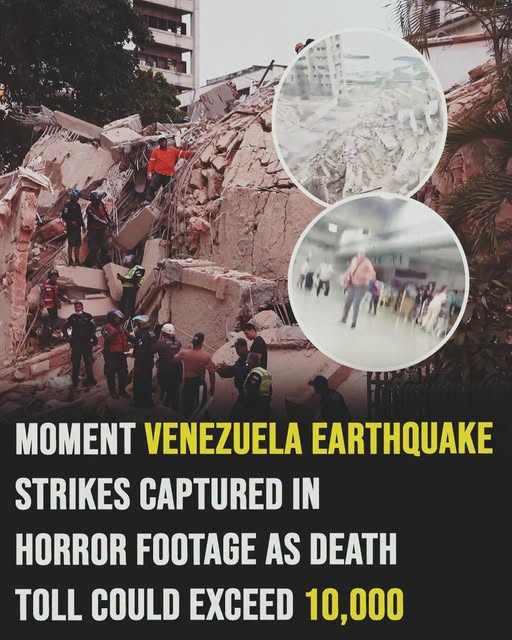
Panic spread across Venezuela’s northern coast within seconds as two powerful earthquakes struck back-to-back, sending residents running into the streets and leaving entire communities struggling to understand the scale of the disaster unfolding around them.
The first tremor shook buildings violently, causing people to flee homes, offices, and businesses. Before many could reach safety, a second and even stronger earthquake struck, creating scenes of chaos across several regions. Witnesses described walls cracking, ceilings collapsing, and streets filling with dust as buildings swayed under the force of the seismic activity.
According to preliminary reports from geological monitoring agencies, the earthquakes measured approximately 7.2 and 7.5 in magnitude. The powerful sequence was felt across large portions of the country, including Caracas and numerous coastal communities, making it one of the strongest seismic events Venezuela has experienced in decades.
The offshore epicenter was reported near the Caribbean coastline, close to heavily populated areas west of La Guaira and near coastal communities that depend heavily on tourism, transportation, and commercial activity. Because of the location of the earthquakes, the seismic waves traveled rapidly through both coastal regions and inland cities, amplifying the impact.
Residents described the experience as unlike anything they had ever felt.
Many said the ground seemed to roll beneath their feet.
Others reported hearing loud cracking sounds before buildings began to shake.
Several eyewitnesses stated that they had only seconds to react.
Social media quickly filled with dramatic videos showing people running through streets, car alarms sounding simultaneously, and clouds of dust rising from damaged structures. Some footage showed frightened residents gathering in open spaces while aftershocks continued to shake the ground.
The back-to-back nature of the earthquakes created additional danger.
Normally, people have time to react after a major earthquake. In this case, many individuals who had just escaped buildings were caught in the second tremor while attempting to reach safety.
Emergency services were immediately dispatched to the hardest-hit areas.
Rescue teams began searching damaged buildings while firefighters and medical personnel established emergency zones near collapsed structures. In some neighborhoods, heavy debris blocked roads, preventing vehicles from reaching affected locations.
Rescue workers were forced to continue their operations on foot.
Local authorities reported significant structural damage in several districts, particularly among older residential buildings that were not designed to withstand powerful earthquakes. Apartment complexes, commercial buildings, and public facilities suffered varying degrees of damage.
Some buildings experienced cracked foundations.
Others partially collapsed.
Several structures became unsafe to enter.
The situation became even more complicated as aftershocks continued to strike throughout the day, forcing rescuers to repeatedly suspend operations due to safety concerns.
One of the most important facilities affected by the disaster was Simón Bolívar International Airport near La Guaira.
Airport operations were temporarily suspended after reports of damage to sections of the terminal and surrounding infrastructure. Authorities evacuated passengers and employees while engineers conducted safety inspections.
The closure of the airport created additional challenges for emergency operations.
Aid deliveries.
Medical evacuations.
Rescue coordination.
All became more difficult as officials searched for alternative routes to transport personnel and supplies.
Across the affected regions, emergency shelters were quickly established inside schools, sports facilities, community centers, and government buildings. Thousands of residents left their homes out of fear that weakened structures could collapse during aftershocks.
Many families carried only essential belongings.
Others left with nothing at all.
Parents attempted to comfort frightened children while sleeping on temporary beds and waiting for news about their neighborhoods.
Hospitals and medical centers quickly became overwhelmed.
Doctors, nurses, and emergency personnel worked continuously to treat injuries ranging from cuts and fractures to more serious trauma. Some facilities experienced power interruptions, placing additional pressure on already strained medical services.
Mobile medical units were reportedly deployed to assist areas where hospitals had sustained damage or become overcrowded.
Authorities have emphasized that casualty numbers remain preliminary.
Officials continue to gather information from affected communities, and rescue operations are still underway in numerous locations. Several areas remained difficult to access due to damaged roads, debris, and communication failures.
As a result, the full extent of the disaster remains unclear.
Speculation regarding potential casualty figures has circulated widely online, with some reports suggesting extremely high numbers. However, authorities have repeatedly urged the public to rely on verified information while rescue teams continue their work.
Emergency officials stress that final casualty figures cannot be determined until search operations have been completed.
International assistance has already begun to mobilize.
Several countries and humanitarian organizations have expressed their willingness to support Venezuela during the crisis. Search-and-rescue specialists, medical teams, and humanitarian aid organizations have reportedly prepared to assist local authorities.
International cooperation is expected to play an important role during the recovery phase.
Engineers and infrastructure experts have also been deployed to assess damage to bridges, schools, hospitals, water systems, and transportation networks.
Restoring electricity and clean water has become an urgent priority.
In some regions, residents remain without power.
Communication services have been interrupted.
Water distribution systems have suffered damage.
Technical teams continue working to restore essential services as quickly as possible.
Government officials have urged residents to avoid damaged buildings until formal safety inspections can be completed. Structural engineers are examining buildings to determine which structures can be repaired and which may require demolition.
The continuing aftershocks remain a major concern.
Even moderate aftershocks can cause severely weakened buildings to collapse, placing both residents and rescue workers at risk.
Psychological trauma has also begun to emerge among survivors.
Many people spent the night outdoors, afraid to return inside their homes. Families gathered in parks, parking lots, and open spaces while emergency announcements played over radios and loudspeakers.
Parents comforted frightened children.
Neighbors shared food and blankets.
Strangers helped one another.
In the midst of the destruction, communities began supporting each other.
Local volunteers assisted rescue workers.
Businesses donated supplies.
Residents organized shelters and food distribution points.
These acts of solidarity provided moments of hope during an extremely difficult time.
Government leaders have called for national unity as the country confronts one of its most significant natural disasters in recent memory.
Officials continue to emphasize that saving lives remains the highest priority.
Search operations continue.
Medical teams remain on emergency status.
Aid supplies are being distributed.
Engineers continue their assessments.
The coming days will likely determine the true scale of the disaster.
As rescue teams reach previously inaccessible areas and communication systems are restored, a clearer picture of the damage will emerge.
For now, Venezuela faces a long and difficult recovery.
Entire communities remain uncertain about the future.
Families continue searching for loved ones.
Emergency workers continue digging through debris.
And millions of people across the country remain focused on a single hope: that more survivors can still be found beneath the ruins left behind by one of the most powerful earthquakes the nation has experienced in generations.