Barack Obama has spent much of his post-presidency avoiding direct political combat. Even as criticism and attacks continued to follow him years after leaving the White House, he often responded with humor, distance, or silence.
But during a recent appearance, the former president delivered a remark that quickly captured public attention and reignited one of American politics’ longest-running rivalries.
Without raising his voice or mentioning Donald Trump directly for much of his comments, Obama offered what many viewed as one of his sharpest assessments of the former president’s continuing focus on him.
His words were simple.
Yet they landed with remarkable force.
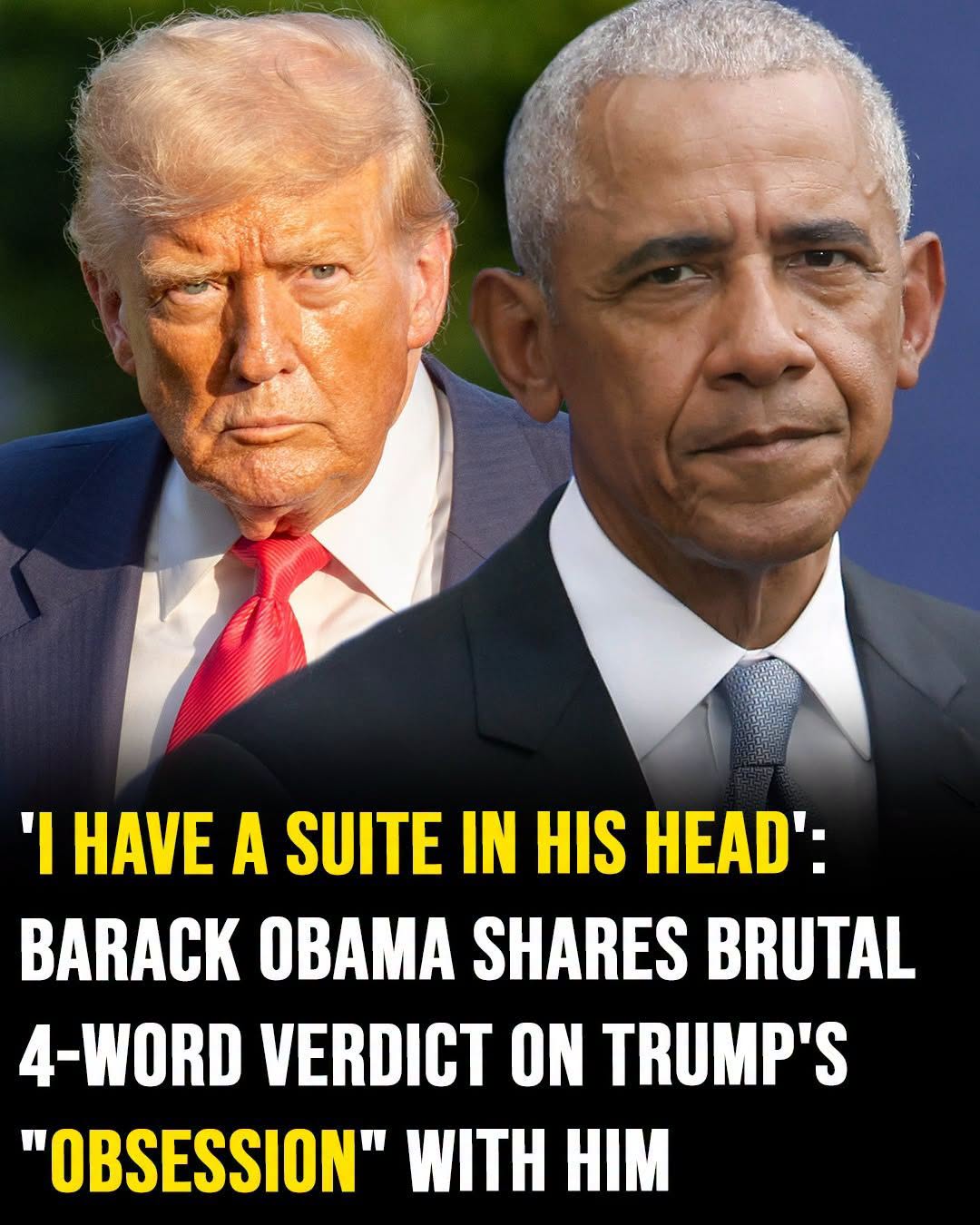
“I have a suite in his head,” Obama joked, drawing laughter from the audience. The line immediately spread across social media, news programs, and political discussions, with supporters praising the former president’s wit and critics dismissing the comment as another example of political theater.
But beneath the joke was something more serious.
Obama appeared to suggest that Trump’s repeated references to him over the years reveal an ongoing fixation that says less about Obama himself and more about Trump’s own political concerns.
For years, Donald Trump has frequently referenced his predecessor during speeches, rallies, interviews, and social media posts. Issues ranging from healthcare and immigration to economic policy and foreign affairs have often been framed through comparisons to the Obama administration.
Supporters of Trump argue that these references are natural because Obama’s policies continue to influence modern political debates. Critics, however, believe the continued focus reflects something deeper.
Obama’s recent remarks seemed aimed directly at that interpretation.
He described the situation with humor, suggesting that he occupies significant space in Trump’s thinking.
The audience responded immediately.
Laughter filled the room.
Applause followed.
Yet Obama did not stop there.
He drew a comparison between his own presidency and the transition that followed George W. Bush’s administration. According to Obama, his attention while serving as president was directed toward governing rather than dwelling on his predecessor.
He explained that worrying about former presidents was not a priority because the responsibilities of the office demanded complete focus.
The implication was clear.
A president consumed by the person who came before may not be fully focused on the people they currently serve.
That observation quickly became one of the most discussed moments from his appearance.
Political analysts interpreted the remarks in different ways.
Some viewed them as a direct criticism of Trump’s leadership style.
Others saw them as a broader statement about presidential responsibility.
For Obama supporters, the comments represented a rare moment in which the former president openly addressed years of criticism without appearing angry or defensive.
Instead of responding point by point to attacks, he reframed the discussion entirely.
Rather than defending himself, he suggested that the persistence of those attacks reveals insecurity.
This strategy has long been part of Obama’s public style.
Throughout his political career, he has often relied on calm delivery and understated humor rather than confrontation.
The “suite” comment fit perfectly within that approach.
It was brief.
It was memorable.
And it shifted attention toward the motivations behind the criticism rather than the criticism itself.
Donald Trump has repeatedly criticized Obama on issues including healthcare reform, foreign policy, economic management, immigration, and government regulations. Even years after Obama left office, references to his presidency continue to appear in speeches and campaign events.
Supporters of Trump argue that this focus reflects ongoing policy disagreements rather than personal obsession.
They point out that former presidents often remain important political figures whose decisions continue to influence national debates.
From this perspective, discussing Obama remains politically relevant.
Others disagree.
They argue that the frequency of these references goes beyond ordinary political criticism.
For them, Obama’s remarks captured a dynamic that has existed for years.
Social media quickly amplified the exchange.
Supporters shared clips of Obama’s comments alongside previous Trump statements mentioning the former president.
Memes appeared within hours.
Political commentators debated whether the remarks were fair, necessary, or overly personal.
Some praised Obama’s restraint.
Others argued that former presidents should avoid engaging in political rivalries altogether.
The reaction highlighted how deeply the relationship between the two men continues to shape American political conversations.
Although they served consecutive presidencies, Obama and Trump represent dramatically different approaches to leadership, communication, and governance.
Obama built much of his political identity around themes of unity, institutional trust, and measured rhetoric.
Trump emerged as a political outsider who frequently challenged institutions, embraced confrontation, and relied heavily on direct communication with supporters.
These differences have made their political rivalry particularly symbolic.
For many Americans, the contrast between the two men represents broader cultural and political divisions within the country.
Obama’s recent remarks seemed to acknowledge that reality while also attempting to rise above it.
He did not engage in a detailed rebuttal of specific criticisms.
He did not revisit old political battles.
Instead, he focused on priorities.
According to Obama, leadership requires attention to present responsibilities rather than constant focus on past opponents.
That message resonated with many listeners.
Some observers noted that Obama’s comments reflected confidence rather than anger.
Others described them as a reminder that humor can sometimes deliver criticism more effectively than confrontation.
The idea of occupying “a suite” in someone’s mind became a metaphor that extended far beyond politics.
It suggested influence.
It suggested comparison.
And it suggested that certain rivalries continue long after official positions change.
For Obama, the comment may have been little more than a joke.
For his supporters, it represented a moment of validation.
For his critics, it was unnecessary political commentary.
For Trump supporters, it reinforced their belief that political opponents remain focused on the former president.
Regardless of interpretation, the remarks succeeded in generating conversation.
Years after leaving office, Barack Obama remains one of the most recognizable political figures in the world.
Donald Trump continues to dominate headlines and public debate.
Their political paths remain deeply connected despite serving at different times and under vastly different circumstances.
The exchange also serves as a reminder that presidential legacies rarely end when administrations conclude.
Former presidents continue to influence political discussions, shape public opinion, and symbolize larger national debates.
Obama’s comments reflected that reality.
His words suggested that some political relationships never truly disappear.
They simply evolve.
And perhaps that is why his remark resonated so strongly.
It was not simply about one man criticizing another.
It was about memory.
It was about influence.
It was about the lingering presence of former leaders in the minds of their successors.
Whether people agreed with Obama or disagreed with him, his message was impossible to ignore.
A quiet joke became a national conversation.
A brief remark became a political statement.
And in just a few carefully chosen words, Barack Obama transformed years of criticism into a question that many people continue asking:
Why does the past still occupy so much space in the present?