A quiet entry in an official government report has sparked one of the most emotional debates in modern medicine.
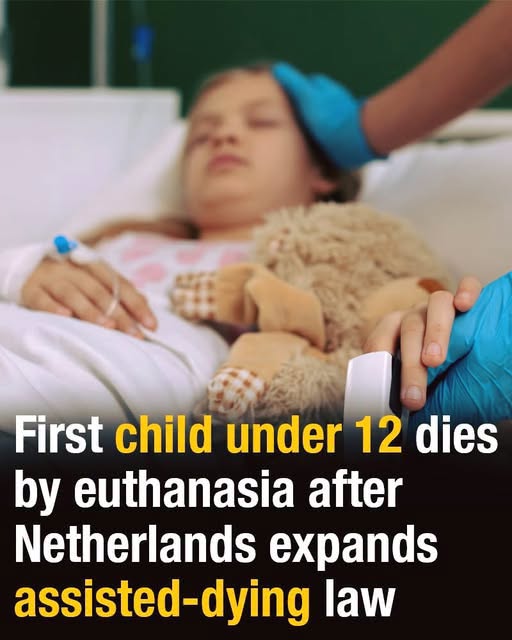
For the first time since the Netherlands expanded its assisted dying regulations for young children, officials confirmed that a child under the age of 12 died through the country’s euthanasia framework. The case, which occurred last year and was later included in an annual review presented to parliament, has drawn international attention and reopened difficult conversations about suffering, medical ethics, and the limits of modern healthcare.
Very little is publicly known about the child.
Authorities have deliberately withheld identifying details, including the child’s name, exact age, and medical condition. Dutch privacy laws surrounding pediatric cases are extremely strict, especially when end-of-life decisions are involved. Officials have emphasized that protecting the family’s privacy remains a priority.
Yet despite the absence of personal details, the case has become a powerful symbol in a much larger discussion.
According to government reports, the child suffered from a severe and incurable medical condition that caused unbearable suffering. Officials stated that no reasonable medical treatments remained and that recovery was impossible.
For many people outside the Netherlands, the news came as a shock.
The idea that a child under the age of 12 could legally receive medical assistance in dying raises questions that touch the deepest fears and values people hold about childhood, suffering, medicine, and parental responsibility.
The Netherlands has long been one of the world’s most closely watched countries when it comes to assisted dying laws.
For years, euthanasia regulations primarily applied to adults and, under certain conditions, older minors. However, in 2024 the country introduced new guidelines that extended eligibility to children between the ages of one and twelve under extremely limited circumstances.
The rules were designed specifically for situations involving terminal illness and unbearable suffering that could not be relieved through available treatments.
Government officials stressed that these situations are exceptionally rare.
According to the regulations, euthanasia can only be considered if several strict conditions are met.
The child must be suffering unbearably.
The illness must be irreversible.
No treatment options can remain.
Palliative care must have been explored.
Parents or legal guardians must be fully involved.
Medical specialists must agree.
Every case must undergo independent review.
Supporters of the law argue that these safeguards make the process one of the most heavily regulated medical decisions imaginable.
For families facing unimaginable suffering, they say, the law offers compassion in situations where medicine can no longer provide relief.
Health officials have repeatedly emphasized that the purpose of the policy is not to shorten life unnecessarily but to address the most severe and hopeless medical circumstances.
The recent case has now placed those safeguards under international scrutiny.
Dutch Health Minister Sophie Hermans acknowledged the case while presenting the annual review to lawmakers. Although she offered no personal details, the confirmation itself was enough to ignite debate both inside and outside the Netherlands.
Medical professionals have pointed out that such cases remain extraordinarily uncommon.
The decision-making process is extensive and involves numerous specialists. Physicians must carefully document the child’s condition, prognosis, treatment history, and level of suffering. Independent experts are consulted, and parents participate in every stage of the discussion.
When possible, the wishes and understanding of the child are also considered.
Following the procedure, the case is reviewed by a specialized committee that includes medical experts, legal professionals, and ethicists.
Their responsibility is to determine whether the physician complied fully with the law.
Only after this review does the Public Prosecution Service evaluate whether legal requirements were met.
Dutch officials argue that this multiple-layer system exists specifically to prevent abuse and ensure accountability.
Still, critics remain deeply concerned.
Some ethicists argue that extending assisted dying to younger children creates difficult questions about consent, vulnerability, and decision-making. Others worry about the emotional burden placed on parents and physicians who must confront choices that few people can imagine facing.
Religious organizations and advocacy groups have also voiced concern, arguing that society must continue searching for alternatives to assisted death, particularly for children.
For many people, the emotional weight of the issue makes it impossible to view it simply as a legal matter.
The case forces people to confront painful questions.
How should society respond when a child suffers without hope of recovery?
Who decides when suffering becomes unbearable?
Can compassion and protection coexist in such situations?
Is prolonging life always the best outcome?
There are no easy answers.
Supporters of the Dutch framework emphasize that the law applies only in extraordinary situations where medicine has reached its limits. They argue that allowing unbearable suffering to continue when no treatment exists may itself be an ethical failure.
Opponents believe that the risks and moral concerns remain too great.
The discussion has spread far beyond the Netherlands.
Countries around the world continue to debate assisted dying laws, with many governments examining how to balance patient autonomy, medical ethics, and legal safeguards. Pediatric cases remain especially controversial because they involve vulnerable patients and emotionally difficult decisions.
The Dutch case now serves as a focal point in that global conversation.
Despite the attention, authorities have remained cautious in their public statements.
They continue to emphasize that confidentiality rules limit what can be disclosed. The intention, officials say, is to protect the child’s family while ensuring that oversight mechanisms function properly.
As a result, much of the public discussion has focused not on the individual child but on the broader principles involved.
Behind the legal reviews, medical protocols, and political debates lies a tragedy that cannot be measured by laws or statistics.
A child suffered from an illness severe enough to place doctors, parents, and specialists in one of the most difficult positions imaginable.
The details may never become public.
The family may never speak.
The child’s identity may remain permanently protected.
Yet the case has already changed the conversation.
It has forced societies to look directly at questions that medicine alone cannot answer.
Questions about suffering.
Questions about dignity.
Questions about compassion.
And questions about how far modern healthcare should go when there is no possibility of recovery.
The Netherlands now finds itself once again at the center of an international ethical debate, not because of political controversy or legal headlines, but because of one child whose story remains largely unknown.
Even without knowing the name, age, or circumstances, the case has reminded the world that the hardest medical decisions are often the ones that take place quietly, far from public view, where families, doctors, and children face realities that few people ever hope to imagine.