
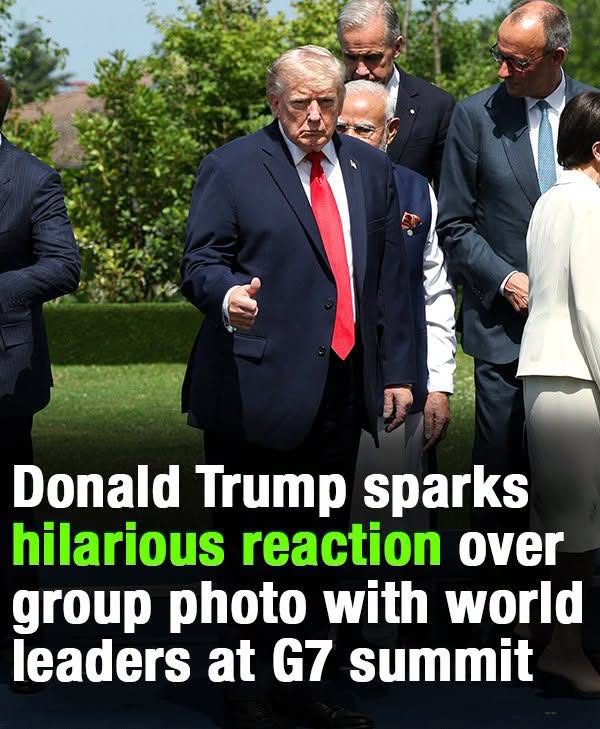
World leaders gathered for one of the most closely watched international meetings of the year expecting discussions about global security, economic stability, and geopolitical tensions to dominate headlines.
Instead, a brief moment during a routine group photograph became one of the most talked-about scenes of the summit.
Within hours, social media users around the world were replaying the footage, analyzing every movement, and debating what had actually happened. Commentators, political supporters, critics, and casual observers all weighed in, turning a matter of seconds into a viral international conversation.
The incident occurred during the G7 summit in Évian-les-Bains, where leaders from some of the world’s most influential economies gathered to discuss pressing international issues.
The summit agenda was packed with serious topics.
Ongoing conflicts.
Economic uncertainty.
International trade.
Energy security.
Diplomatic relations.
The official purpose of the gathering was to demonstrate cooperation among major world powers at a time when global challenges continue to grow increasingly complex.
Like every major summit, organizers carefully planned every detail.
Meetings were scheduled down to the minute.
Press appearances were coordinated.
Joint statements were negotiated through lengthy discussions.
And, as always, the traditional group photograph was arranged as a visual symbol of unity and cooperation.
These photographs have become a familiar part of international diplomacy.
For decades, images of world leaders standing shoulder to shoulder have represented collective efforts to address global problems.
The photographs often become lasting historical records, capturing moments that later symbolize entire political eras.
This year’s image was expected to be no different.
Leaders assembled.
Photographers prepared.
Cameras began rolling.
Then something unexpected happened.
As the group posed for the official photograph, Donald Trump appeared to step away from the formation and briefly move in a different direction.
The moment lasted only seconds.
But in today’s digital world, seconds are often all it takes.
Cameras captured the movement from multiple angles.
Video clips quickly appeared online.
Users slowed the footage down.
Others zoomed in.
Some replayed it repeatedly while offering their own interpretations.
Before long, the moment had become one of the summit’s most discussed events.
For critics of Trump, the clip immediately became symbolic.
Many argued that it reflected broader concerns they have expressed for years about his approach to international diplomacy.
Commentators suggested the footage showed a lack of focus or engagement during a gathering intended to project unity among allies.
Some social media users shared jokes and memes, portraying the moment as evidence of confusion or distraction.
The internet, as it often does, moved quickly.
Creative edits appeared almost immediately.
Videos were remixed.
Captions were added.
Reaction posts accumulated millions of views.
The brief scene became a source of endless commentary.
Supporters, however, saw the situation very differently.
They argued that the reaction was wildly exaggerated and driven more by political bias than by objective analysis.
Many pointed out that world leaders frequently move during public events and that isolated moments can easily be misrepresented when removed from their full context.
To them, the incident was another example of how even the smallest actions involving Trump can generate disproportionate media attention.
Some supporters accused critics of focusing on a trivial moment while ignoring the actual substance of the summit.
They argued that discussions involving international security, economic policy, and diplomatic cooperation deserved far more attention than a few seconds captured during a photo opportunity.
The disagreement highlighted a larger reality about modern political communication.
In previous decades, summit coverage often centered on official statements, policy announcements, and diplomatic outcomes.
Today, visual moments frequently compete with or even overshadow the issues themselves.
A single photograph can dominate news cycles.
A brief facial expression can generate headlines.
An awkward interaction can become more memorable than hours of formal negotiations.
The G7 incident served as a powerful example of this phenomenon.
While leaders spent significant time discussing critical global challenges, much of the online conversation shifted toward a fleeting moment during a ceremonial photo session.
For media analysts, the reaction was not particularly surprising.
The modern information environment rewards content that is immediate, visual, and emotionally engaging.
Complex policy discussions require time and attention.
A short video clip can spread worldwide in minutes.
As a result, public perception is increasingly shaped by moments rather than lengthy explanations.
Political figures across the spectrum face this reality.
Every gesture, glance, pause, and reaction can be recorded, shared, and interpreted by millions of people almost instantly.
Whether the interpretation is accurate often becomes secondary to the speed at which the content spreads.
The summit itself included substantial discussions on major international concerns.
Leaders addressed geopolitical tensions, economic cooperation, and ongoing global conflicts.
Negotiations resulted in statements intended to demonstrate alignment among participating nations.
Yet many casual observers learned more about the viral photo moment than about the policy outcomes.
This imbalance reflects a broader transformation in how political events are consumed.
Modern audiences increasingly encounter politics through short videos, clips, screenshots, and social media posts rather than through traditional reporting.
As attention spans shrink and information moves faster than ever before, visual impressions frequently become more influential than detailed explanations.
For some observers, the G7 photo incident was humorous.
For others, it was politically meaningful.
For many, it was simply another example of how quickly public narratives can form around incomplete information.
Regardless of perspective, the reaction demonstrated the extraordinary power of visual media in the digital age.
One moment.
One movement.
One clip lasting only seconds.
That was all it took to dominate conversations around an event involving some of the most powerful leaders in the world.
In many ways, the controversy revealed less about the photograph itself and more about the environment in which modern politics now operates.
Today, leaders are not judged solely on speeches, policies, or accomplishments.
They are also judged on moments.
Every public appearance becomes a potential viral event.
Every camera angle carries the possibility of creating a new narrative.
Every gesture can become a headline.
The line between political communication and entertainment continues to blur.
Supporters and critics often view the exact same footage and arrive at completely different conclusions.
One side sees evidence.
The other sees distortion.
One side sees symbolism.
The other sees overreaction.
And somewhere between those competing interpretations lies the reality that a global summit involving critical international issues became partially defined by a few unexpected seconds during a photo opportunity.
Long after official statements are forgotten, many people may remember that brief viral clip.
Not because it changed policy.
Not because it altered international relations.
But because it perfectly captured the strange reality of modern politics, where a single step in the wrong direction can travel farther than an entire summit agenda.
In today’s world, history is often compressed into moments.
And sometimes those moments become bigger than the events themselves.