
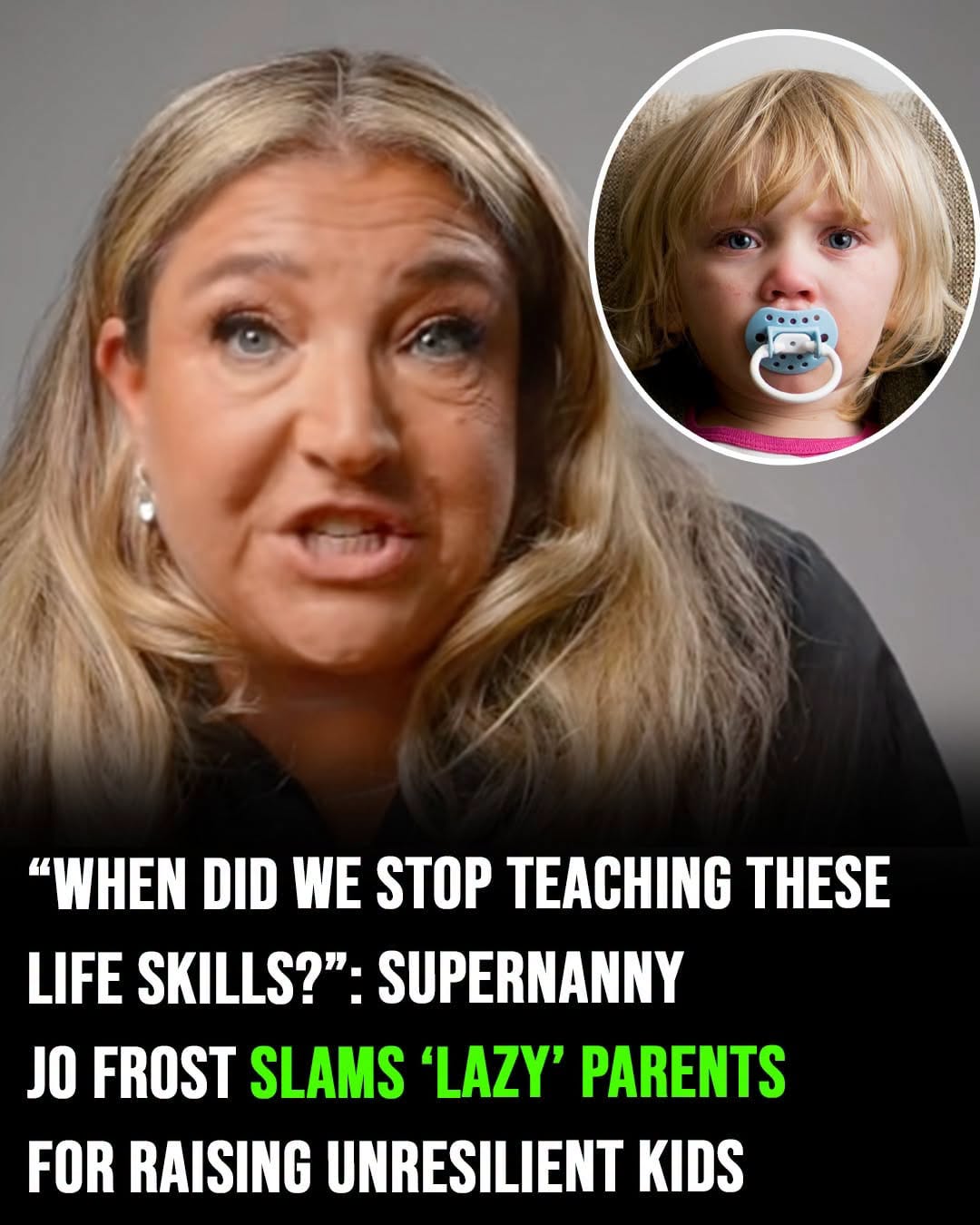
Jo Frost has never been known for softening her message, and her latest comments continue that pattern of direct, uncompromising advice aimed at modern parents.
Best known from her time on Supernanny, she built her reputation by stepping into chaotic households and showing families how structure, consistency, and boundaries could transform daily life with children. Now, years later, her concerns have shifted from discipline alone to something deeper: resilience.
At the center of her argument is a belief that many parents today are not failing because they don’t care, but because they care in a way that unintentionally removes opportunity for children to learn independence.
In her view, the modern home has become a place where convenience often overrides instruction.
Parents, she suggests, are exhausted, rushed, and constantly under pressure to make life smoother for their children. In that effort, they may be doing too much for them, too often, too early.
From helping a child dress in the morning to stepping in at the first sign of frustration, Frost argues that small, well-intentioned interventions can slowly accumulate into a larger problem: children who are not given enough space to struggle, try, fail, and try again.
Her message is not framed as blame, but as warning.
She does not accuse parents of neglect. Instead, she challenges the idea that constant assistance is always beneficial. According to her perspective, when adults routinely step in to remove discomfort, they may also be removing the very experiences that build resilience.
Everyday tasks that might seem minor putting on shoes, packing a school bag, cleaning up after meals, learning to wait, or managing small frustrations are, in her view, essential building blocks of independence.
When those moments are consistently taken over by adults, children may miss the gradual development of confidence that comes from doing things on their own.
Frost often points out that capability is not instant. It is learned through repetition, patience, and sometimes failure. A child learning to tie their shoes may struggle dozens of times before success. A child learning to ride a bike will fall, hesitate, and try again. These moments of difficulty, she argues, are not setbacks to be avoided but necessary steps in development.
In modern parenting culture, however, she believes there is a growing instinct to smooth every edge.
Busy schedules, digital distractions, and the pressures of daily life have created environments where it can feel faster and easier for an adult to step in and complete a task rather than guide a child through it. Over time, this pattern can become habitual.
What begins as help can slowly become dependence.
And what feels like kindness in the moment can, over years, reduce a child’s sense of capability.
Frost’s concern is particularly focused on resilience the ability of a child to cope with frustration, adapt to challenges, and recover from setbacks. These are not traits that develop in isolation. They are built through experience, especially experiences that require effort and persistence.
Without those opportunities, she suggests, children may struggle later in life when faced with situations that cannot be solved immediately or delegated to someone else.
Her approach emphasizes presence over perfection.
She is not asking parents to be flawless or to create rigid households where children are left unsupported. Instead, she advocates for intentional parenting: slowing down enough to teach rather than immediately rescue, and allowing children to participate in everyday responsibilities appropriate for their age.
Simple routines become teaching tools.
A child learning to pour their own drink, button their coat, or clean up a spill is not just completing a task they are building confidence in their ability to manage the world around them.
Frost also highlights the emotional component of independence. Children who are consistently guided rather than overprotected often develop a stronger sense of self-efficacy. They begin to trust their own abilities and feel more comfortable facing unfamiliar situations.
On the other hand, when adults constantly intervene, children may internalize the message that they are not capable without help.
This dynamic, she warns, can follow them into adolescence and adulthood.
School environments, friendships, and eventually workplaces all require a degree of independence and problem-solving. If those skills are underdeveloped, young people may find everyday challenges more overwhelming than necessary.
At the heart of Frost’s message is a simple but uncomfortable question for parents: are we helping too much?
She acknowledges that modern parenting is demanding. Many families are balancing work, finances, emotional stress, and limited time. In that context, efficiency often feels like survival. Doing things quickly and keeping children calm can feel like the only workable option in a busy day.
But she argues that long-term development sometimes requires slowing down in the short term.
A few extra minutes spent teaching a child how to do something themselves may prevent years of dependency later on.
Her perspective has sparked strong reactions because it touches a sensitive area of parenting culture. For some, it feels like validation of concerns they already hold about overindulgence and lack of boundaries. For others, it can sound overly critical of parents who are simply doing their best under pressure.
Still, Frost’s central message remains consistent: resilience is not accidental.
It is taught.
It is practiced.
It is built through everyday moments that may seem insignificant at the time but accumulate into lifelong skills.
She returns repeatedly to the idea that childhood is not just about comfort, but preparation. Children are not only meant to be cared for—they are meant to grow into capable, independent individuals who can handle the demands of life without constant assistance.
That growth, she suggests, cannot happen if adults remove every obstacle before a child has the chance to engage with it.
In her view, the goal of parenting is not to eliminate struggle, but to guide children through it.
Not to remove frustration entirely, but to help them learn how to navigate it.
And not to create an effortless childhood, but a strong one.
Ultimately, Frost’s warning is less about criticism and more about recalibration. It is a reminder that in the desire to make life easier for children, parents should be careful not to take away the very experiences that help them become capable adults.
Because in the long run, independence is not given.
It is learned.