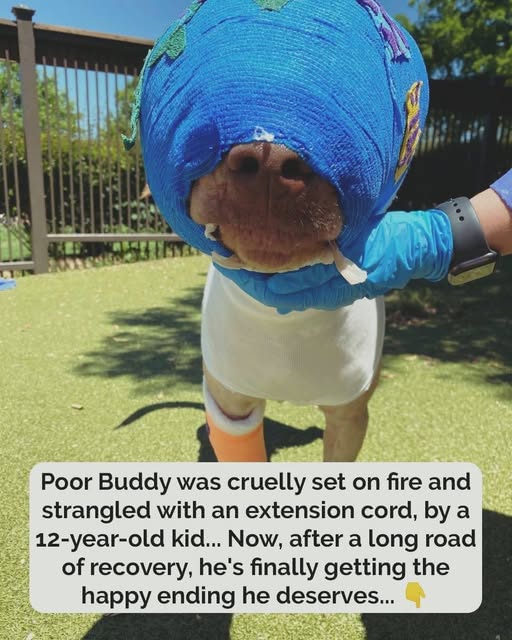
Some stories of survival leave a lasting mark not only because of the suffering involved, but because they reveal the extraordinary resilience of the spirit. Buddy’s journey is one such story.
Once the victim of severe cruelty that shocked animal lovers across the country, this gentle dog faced unimaginable pain and a recovery process that would test even the most dedicated caregivers.
Yet years later, Buddy’s story has become something far greater than a tragedy.
It has become a symbol of healing, perseverance, and the remarkable bond between humans and animals.
When Buddy was first rescued in Mississippi, his condition was heartbreaking. Reports from animal welfare organizations described extensive burn injuries covering much of his face and upper body. His injuries were so severe that rescuers immediately recognized he would require specialized medical care if he had any chance of survival.
Those who encountered him were struck not only by the extent of his wounds, but by his temperament.
Despite everything he had endured, Buddy was described as friendly and gentle.
Animal rescue workers often encounter frightened or defensive animals after traumatic events, but Buddy reportedly remained remarkably calm. That quiet resilience would become one of the defining features of his recovery.
The Tunica Humane Society took responsibility for Buddy’s care and quickly arranged for him to be transferred to the Mississippi State University College of Veterinary Medicine. There, teams of veterinary specialists prepared to begin what would become a long and complex journey toward healing.
Severe burn injuries present enormous challenges in both humans and animals.
Burned skin loses its ability to protect the body from infection, regulate temperature, and retain moisture. Healing is often slow, painful, and unpredictable. Veterinary professionals knew from the beginning that Buddy faced a difficult road ahead.
His treatment required constant monitoring.
Pain management became a major priority, as did infection prevention and wound care. Veterinarians carefully cleaned injured tissue, changed bandages regularly, and monitored his progress day by day.
Recovery from severe burns is rarely measured in dramatic leaps.
Instead, it unfolds through countless small victories.
A reduction in swelling.
The formation of healthy tissue.
An increase in appetite.
A moment of comfort after weeks of pain.
For Buddy, each small improvement represented another step toward survival.
The veterinary staff worked tirelessly to support his healing. Advanced treatments, including skin graft procedures and specialized wound care, became part of his recovery plan. These interventions aimed not only to save his life but also to maximize his long-term quality of life.
Throughout this process, caregivers recognized something important: healing involves more than medicine.
Animals experience stress and trauma just as humans do. Fear, confusion, and anxiety can all affect recovery. For that reason, Buddy’s emotional well-being became an essential part of his care.
Veterinarians and rescue workers spent time with him, spoke gently, and created an environment that felt safe and predictable. Compassion became as important as clinical treatment.
As weeks passed, signs of improvement slowly began to emerge.
Buddy became more alert.
He responded more actively to human interaction.
He started exploring his surroundings with growing curiosity.
The updates shared by the Tunica Humane Society drew widespread support from people around the world. Thousands followed his progress online, celebrating each milestone and offering encouragement to those caring for him.
For many people, Buddy represented more than one dog.
He symbolized hope.
His journey demonstrated that even in the aftermath of cruelty, healing remains possible.
Veterinary teams often explain that burn recovery occurs in multiple stages. The first stage focuses on stabilization and survival. The next involves infection control and tissue repair. Later stages emphasize rehabilitation, comfort, and long-term management.
Buddy experienced each of these phases.
As damaged areas gradually healed, bandages could be reduced in certain regions. Veterinarians monitored skin regeneration carefully and adjusted treatments as his needs changed.
One particularly encouraging development came as Buddy became increasingly active.
Caregivers noticed him showing interest in toys and interacting more confidently with people. His playful side slowly began to reappear.
These moments carried enormous emotional significance.
Animals do not understand medical procedures or treatment plans. They live in the present moment. When Buddy showed curiosity, playfulness, and trust, caregivers saw evidence that healing was taking place not only physically, but emotionally as well.
Recovery from trauma often involves rebuilding a sense of safety.
For Buddy, that process unfolded gradually through consistent care and positive experiences. Day after day, people showed him kindness.
And little by little, he learned to trust again.
His case also highlighted the extraordinary capabilities of modern veterinary medicine. Advances in wound management, skin grafting, pain control, and rehabilitation have dramatically improved outcomes for animals suffering severe injuries.
Yet medicine alone was not enough.
Buddy’s survival depended upon collaboration between rescue organizations, veterinary specialists, donors, and supporters who followed his story from around the world.
Every person involved contributed to his recovery.
The veterinarians who treated him.
The rescue workers who advocated for him.
The caregivers who comforted him.
And the countless individuals whose support helped make long-term treatment possible.
Even after major improvements, Buddy’s journey did not simply end.
Animals recovering from severe burns often require lifelong care. Scar tissue can remain sensitive. Skin may require protection from sunlight and environmental exposure. Ongoing medical evaluations help ensure continued health and comfort.
Buddy’s recovery therefore became not a destination, but a continuing process.
Yet what makes his story so inspiring is not the absence of challenges.
It is his ability to overcome them.
Today, Buddy’s transformation serves as a powerful reminder of resilience. The dog who once arrived in critical condition gradually regained strength, confidence, and comfort. His progress reflects the extraordinary capacity of animals to heal when given compassion and care.
His story has also helped raise awareness about animal welfare and the importance of protecting vulnerable animals from neglect and abuse.
Cases like Buddy’s can be difficult to read about because they reveal the reality of suffering that animals sometimes endure. But they also reveal something equally important: the remarkable difference that empathy can make.
A single act of cruelty changed Buddy’s life.
But so did countless acts of kindness.
Veterinary medicine saved his body.
Compassion helped heal his spirit.
Today, Buddy stands as a living example of what is possible when dedication, science, and empathy come together. His journey reminds us that recovery is rarely quick or easy, but even after unimaginable hardship, healing remains possible.
His scars tell a painful story.
But his survival tells a far more powerful one.
In the end, Buddy’s legacy is not defined by the cruelty he suffered.
It is defined by the love that helped him live.