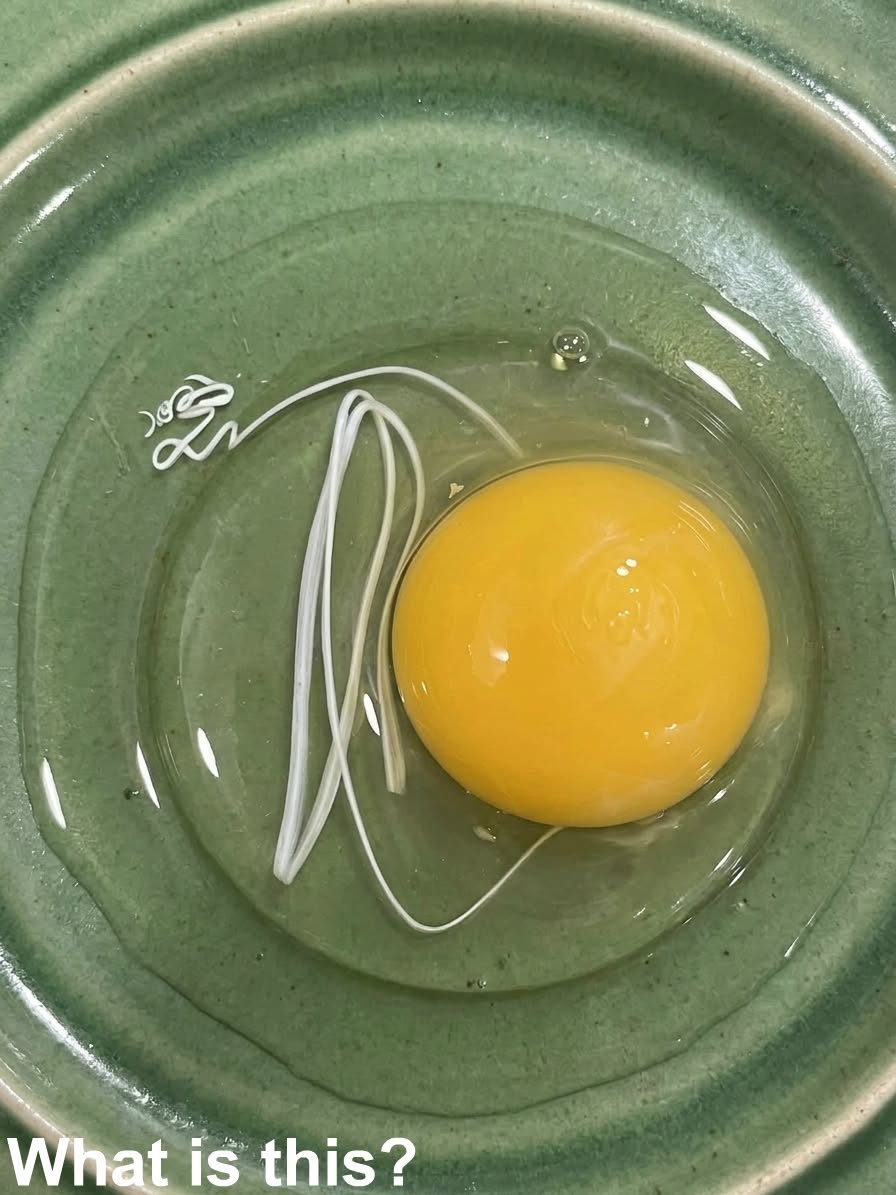
It was an ordinary morning, the kind that begins quietly and without urgency. The house was still, sunlight filtered gently through the kitchen window, and I decided to make one of the simplest breakfasts imaginable: fried eggs.
There was nothing unusual about the routine. I opened the refrigerator, took out a carton of eggs, and placed a frying pan on the stove. It was one of those small moments of everyday life that most of us barely think about.
Then I cracked the first egg.
At first, everything looked normal. The yolk settled neatly into the pan, surrounded by the clear egg white. But as I looked closer, something immediately caught my attention.
Stretching through the white was a strange, pale strand.
It looked almost like a tiny cord or ribbon, twisted and slightly opaque. My heart skipped for a moment.
I froze.
Anyone who has spent enough time on the internet knows how quickly the mind jumps to worst-case scenarios. Suddenly, every unsettling story I had ever heard about food contamination rushed into my thoughts.
Was it a worm?
A parasite?
A sign that the egg had spoiled?
The more I stared at it, the more uneasy I became.
The quiet comfort of breakfast disappeared almost instantly, replaced by curiosity mixed with concern. I stood in the kitchen holding the shell, unsure whether to throw the egg away or continue investigating.
The strange thing about fear is that it often grows in silence.
The more I looked at that mysterious white strand, the more my imagination filled in terrifying possibilities. What had started as an ordinary breakfast now felt like an unexpected mystery sitting in my frying pan.
I immediately checked the expiration date on the carton.
Everything seemed normal.
The eggs were still within date.
Nothing smelled unusual.
Still, doubt lingered.
I carefully cracked a second egg into a separate bowl.
Normal.
Then a third.
Also normal.
Soon I found myself examining the entire carton one egg at a time, searching for any sign of the same strange feature.
But none of the others looked quite like the first one.
Oddly enough, that made me even more uncomfortable.
If every egg had contained the same thing, perhaps it would have seemed ordinary. But finding it in only one egg made it feel unique—almost as though this strange breakfast surprise had singled me out.
Our minds often work that way.
When something unexpected appears alone, it can seem far more alarming than it really is.
Unable to stop thinking about it, I did what millions of people do when faced with an unfamiliar object: I took a photo and turned to the internet.
Within minutes, I was scrolling through food forums, scientific articles, cooking websites, and countless discussions from people who had experienced the same moment of confusion.
To my surprise, I quickly discovered that I was far from alone.
Many people had cracked open eggs only to discover similar white strands and immediately feared the worst.
And then I found the answer.
That strange structure had a name.
It is called the chalaza.
Far from being something dangerous, the chalaza is actually a completely natural part of the egg’s anatomy. Its job is remarkably important: it acts as a kind of anchor, helping keep the yolk centered inside the shell.
In simple terms, the chalaza works like tiny support cords that stabilize the yolk and protect it as the egg moves.
Suddenly, everything changed.
The object that had filled me with concern only moments earlier was not a sign of contamination or decay at all.
In fact, it meant almost the opposite.
Food experts explain that the chalaza is often more visible in fresher eggs. As eggs age, these structures gradually become less noticeable.
That realization completely transformed my reaction.
The very thing that had disgusted me at first was actually evidence that the egg was fresh.
What I had mistaken for a problem was, in reality, a sign of quality.
It is fascinating how often this happens in life.
Humans are naturally cautious about unfamiliar things, especially when it comes to food. Evolution has taught us to avoid potential dangers, which helps explain why unexpected sights can trigger immediate discomfort.
But sometimes our first reaction is not the full story.
Sometimes what appears strange is perfectly normal.
The chalaza is one of those hidden details most people never notice until they suddenly do.
Once you learn about it, however, you begin to realize just how remarkable something as ordinary as an egg truly is.
Eggs are surprisingly sophisticated natural structures.
Their shells protect delicate contents inside. The membrane provides additional defense. The yolk contains nutrients for development, while the albumen the egg white offers cushioning and protection.
And hidden quietly within it all sits the chalaza, doing its job unnoticed.
Until someone making breakfast suddenly discovers it and panics.
Food scientists often point out that nature includes countless small details we rarely think about. Many features that seem unusual at first glance exist for important biological reasons.
The chalaza is one perfect example.
It quietly performs its role without drawing attention, helping maintain the structure of the egg from the moment it is laid.
Ironically, many people remove it during cooking simply because they find its appearance unfamiliar.
Yet it is completely edible and harmless.
As I continued reading, my anxiety gradually turned into fascination.
The kitchen that had briefly become the setting of a miniature horror story transformed back into what it had always been: a place for breakfast.
I laughed a little at how quickly my imagination had run wild.
One strange-looking strand had sent me searching through websites and forums, convinced I had uncovered something alarming.
Instead, I had stumbled upon a tiny lesson in biology.
There is something strangely comforting about moments like these.
They remind us how much there still is to learn about the ordinary things surrounding us every day.
Even the simplest foods carry hidden details and remarkable designs that often go unnoticed until curiosity forces us to take a closer look.
So the next time you crack an egg and notice a small white cord attached to the yolk, don’t panic.
You’re not looking at a parasite.
You’re not seeing spoilage.
You’re seeing the chalaza a tiny natural anchor that has been quietly doing its job all along.
And if anything, its presence may be telling you something surprisingly reassuring:
Your breakfast is probably fresher than you think.