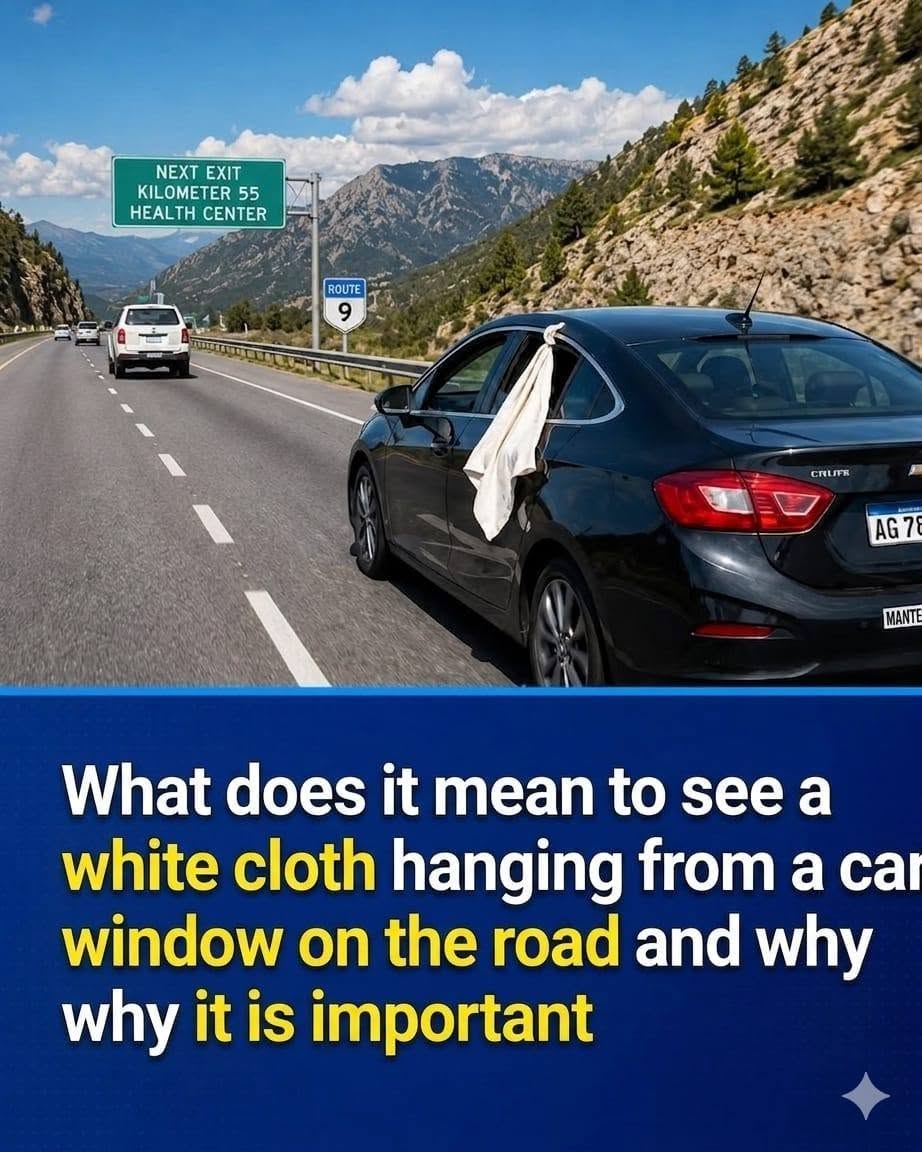
You may have seen it while driving down the highway: a white cloth hanging from a car window, tied to a side mirror, or tucked beneath a windshield wiper.
To some drivers, it appears insignificant a random piece of fabric fluttering in the wind. But for others, that simple white cloth carries an important message.
Long before smartphones, roadside assistance apps, and GPS tracking, drivers often relied on improvised signals to communicate distress or unusual circumstances. Among the most recognizable of these informal symbols was the white cloth.
Though not an official traffic sign in most places, the white cloth has developed a widely understood meaning over time. It serves as a silent signal that something may be wrong and that the driver could need assistance or understanding from others on the road.
The exact meaning can vary depending on the situation, region, or country. In some cases, it may indicate a mechanical breakdown. In others, it could signal a medical emergency, a stalled vehicle, or simply a request for patience from nearby drivers.
At its heart, however, the message remains the same: someone behind that vehicle may be facing an unexpected problem.
The tradition of using cloth as a signal dates back decades, long before modern communication technology transformed travel. Drivers who became stranded often had limited ways to alert others without leaving their vehicles. A white handkerchief, towel, or piece of fabric became an easy and visible way to communicate distress.
In many communities, motorists learned to recognize this signal as an indication that help might be needed. It became part of an unspoken language of the road—a simple act of communication between strangers.
Over time, different interpretations emerged.
Some drivers display a white cloth after experiencing engine trouble or a flat tire. Others use it when waiting for roadside assistance, signaling to law enforcement or passing motorists that help has already been called.
In certain situations, the cloth may indicate a medical concern inside the vehicle. A driver transporting someone who feels unwell may display a white cloth in the hope that others will be more patient or cautious nearby.
In convoy travel or group events, white cloths have occasionally been used as markers to help drivers identify members of the same group. This use is less common but still exists in some regions.
Because practices vary, there is no universal meaning that applies in every circumstance.
This is important to understand.
A white cloth does not carry legal authority. It is not an official emergency designation, and it does not grant any special privileges on the road.
Displaying a white cloth does not transform a private vehicle into an emergency vehicle. It does not permit speeding, ignoring traffic signals, driving recklessly, or bypassing road rules.
Traffic laws remain in effect regardless of the presence of a cloth or flag.
Emergency vehicles such as ambulances, police cars, and fire services operate under specific legal frameworks that allow certain actions during emergencies. A white cloth does not provide those protections or permissions.
For this reason, drivers should avoid assuming that every vehicle displaying a white cloth is involved in a life-threatening emergency. At the same time, they should also avoid dismissing the signal entirely.
The safest approach lies somewhere in between.
When you notice a white cloth on a vehicle, experts generally recommend increasing awareness and exercising caution. Slow down if necessary, maintain a safe following distance, and pay attention to surrounding conditions.
Observe whether the vehicle appears disabled, parked in an unsafe location, or behaving unusually.
If the situation seems serious—such as a driver signaling distress, visible smoke, or a possible medical emergency—it may be appropriate to contact emergency services or local authorities.
However, rushing into an unfamiliar situation without assessing potential risks can sometimes create additional danger.
Roadside emergencies are unpredictable. Traffic, weather conditions, and limited visibility can place both drivers and would-be helpers at risk. In some cases, the most effective assistance comes not from direct intervention but from alerting trained professionals.
Helping others remains an important part of road safety, but safety should always come first.
The white cloth also reflects something deeply human about travel and transportation.
Roads connect cities, communities, and families, but they also expose people to uncertainty. Flat tires happen. Engines fail. Fuel runs out. Medical issues arise unexpectedly.
In those moments, drivers often depend on the kindness, patience, and awareness of strangers.
A simple piece of fabric becomes more than cloth.
It becomes a request for understanding.
It represents vulnerability in a system governed largely by rules, signs, and regulations. It reminds us that behind every windshield sits a person with a story, responsibilities, and sometimes an emergency unfolding in real time.
In an age dominated by digital technology, many traditional road signals continue to survive because they address something technology cannot fully replace: human connection.
Not every driver carries roadside assistance membership. Not every area has immediate cell service. Not every emergency unfolds in a predictable way.
Sometimes people use whatever resources they have available.
A towel from the trunk.
A handkerchief from a pocket.
A piece of white fabric tied carefully to a mirror.
These small acts may seem outdated in the modern world, yet they continue to communicate something universally understood—the need for caution, patience, or help.
The next time you see a white cloth attached to a vehicle, remember that it is more than an object moving in the wind.
It may signal inconvenience.
It may signal uncertainty.
It may signal genuine distress.
While its meaning is not always identical, the message behind it remains rooted in a simple idea: someone may need understanding.
In the end, how we respond matters more than the cloth itself.
Drive carefully.
Stay alert.
Offer help when it is safe to do so.
And when professional assistance is needed, do not hesitate to contact emergency services.
Because on the road, as in life, small gestures of awareness and kindness can make an enormous difference for someone having their worst day.