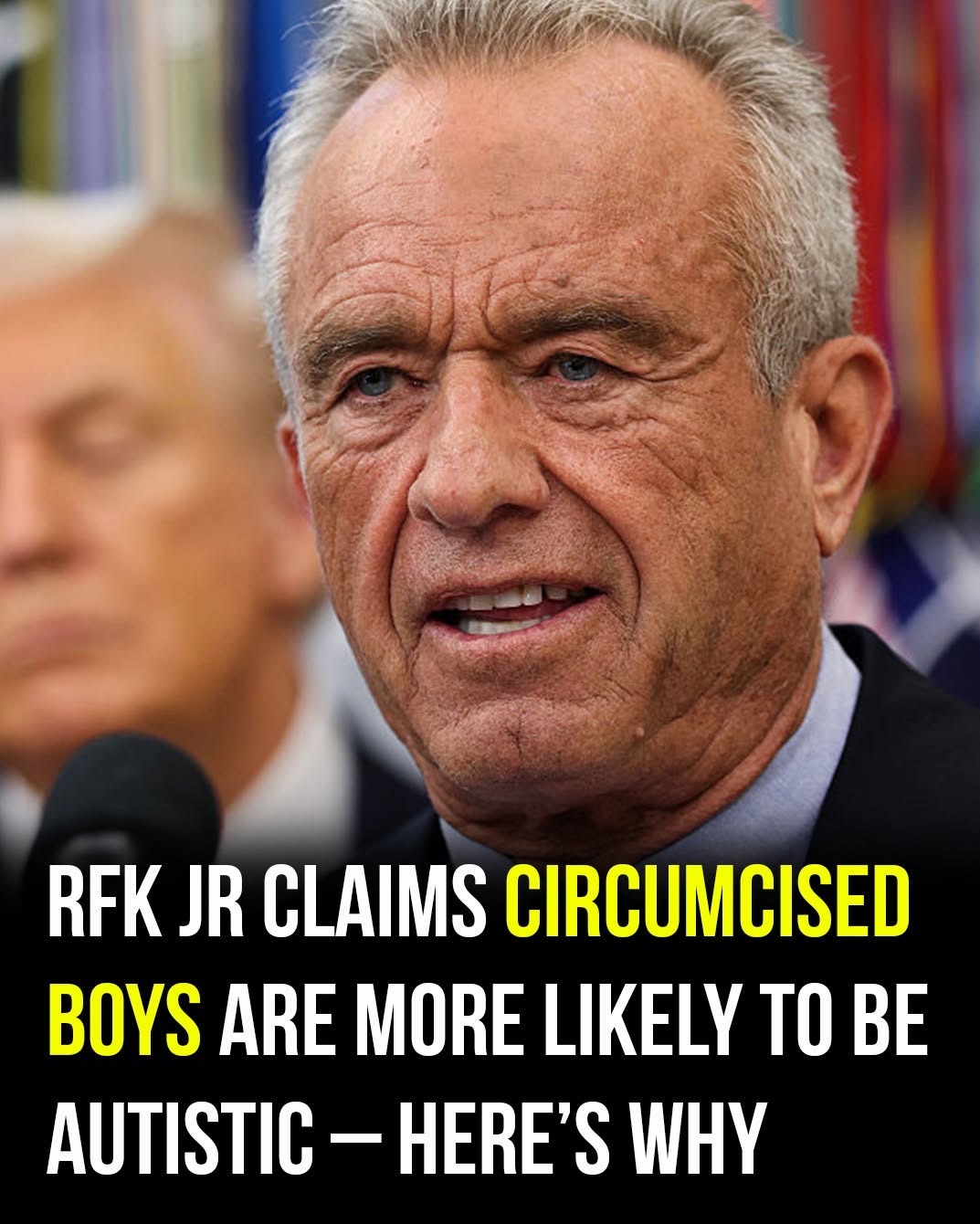
Public health debates have always carried enormous weight, but when they come from one of the nation’s most powerful health officials, their impact can extend far beyond headlines and political arguments.
Recent comments made by Robert F. Kennedy Jr. have reignited a long-running and deeply emotional conversation about autism, medical evidence, and the responsibilities of public leaders.
The remarks quickly spread across social media, television networks, and political circles, generating strong reactions from scientists, medical organizations, autism advocates, and families alike. At the center of the controversy were claims involving potential links between certain medical practices and autism claims that critics say lack sufficient scientific support.
For many observers, the debate extends beyond any single statement. Instead, it raises larger questions about how health information should be communicated, who the public trusts, and what responsibilities come with positions of influence.
Autism spectrum disorder affects millions of people worldwide and remains one of the most widely studied developmental conditions in medicine. Researchers have spent decades investigating genetic, environmental, and neurological factors that may contribute to autism, yet many questions remain under active scientific investigation.
Despite years of research, major medical organizations have repeatedly stated that no single cause of autism has been identified. Scientists generally agree that autism likely results from a complex interaction of genetic and environmental influences rather than any one factor alone.
This complexity has not prevented controversy.
Few medical topics have generated as much public discussion, confusion, and misinformation over the years as autism. Families seeking answers often find themselves navigating a flood of competing claims, studies, opinions, and online debates.
For parents, the search for information can become deeply personal.
When a child receives an autism diagnosis, many families naturally ask difficult questions. They want to understand why. They search for explanations. They seek certainty in an area where science often provides probabilities rather than absolute answers.
It is within this emotional landscape that public statements about autism can carry extraordinary influence.
Critics argue that when high-profile officials speculate about possible causes without strong evidence, even carefully worded remarks may unintentionally amplify fear and confusion. Supporters, however, often contend that asking difficult questions and encouraging further research should remain part of scientific inquiry.
The tension between open debate and scientific consensus lies at the heart of many modern health controversies.
Medical researchers emphasize that scientific understanding evolves through rigorous testing, peer review, and repeated verification. A single hypothesis does not become accepted fact simply because it is publicly discussed. Instead, evidence must withstand years of examination by independent experts.
This process can be frustratingly slow, but it exists for a reason.
History offers examples of ideas once considered plausible that later failed under scientific scrutiny. Likewise, some theories initially dismissed eventually gained acceptance after stronger evidence emerged. The challenge lies in distinguishing between questions that deserve investigation and claims that may outpace available data.
Public trust plays a crucial role in this process.
Health agencies, physicians, and researchers rely on public confidence to communicate guidance about vaccines, medications, pregnancy, and disease prevention. When trust weakens, confusion can spread quickly, particularly in the age of social media.
Information now travels faster than ever before.
A single statement can reach millions of people within hours, often stripped of context and amplified through headlines, videos, and online commentary. As a result, complex scientific topics are sometimes reduced to simple narratives that may not fully capture the evidence.
This dynamic has become especially visible in debates surrounding autism.
Advocates within the autism community have repeatedly emphasized that autism is not a disease to be feared or erased, but a form of neurodiversity that shapes how individuals experience and interact with the world. Many autistic individuals describe unique strengths, perspectives, and ways of thinking that contribute meaningfully to society.
At the same time, families living with autism may experience very different realities depending on the support needs of their loved ones.
These diverse experiences make public conversations about autism particularly sensitive.
Language matters.
How leaders discuss autism can influence not only public understanding but also how autistic individuals see themselves and how society views them. Advocacy groups frequently encourage conversations that balance scientific research with dignity, respect, and inclusion.
Scientists also stress the importance of distinguishing correlation from causation.
Two events occurring together do not necessarily mean one caused the other. Establishing causation requires extensive research designed to eliminate alternative explanations and biases. This principle lies at the foundation of modern epidemiology and medical science.
Without rigorous evidence, assumptions can sometimes lead to misunderstanding.
Public health officials face a difficult responsibility: communicating uncertainty honestly while avoiding unnecessary alarm. Striking this balance is rarely easy, particularly when scientific questions remain unresolved or emotionally charged.
The challenge becomes even greater when politics enters the conversation.
Health debates increasingly overlap with ideology, identity, and trust in institutions. As a result, scientific discussions sometimes become political battles, making consensus harder to achieve.
Observers across the political spectrum continue to debate where the line should be drawn between free inquiry and public responsibility.
Most experts agree on one point: evidence matters.
Scientific claims carry the greatest value when supported by transparent research, reproducible results, and peer-reviewed findings. In areas affecting public health, these standards become especially important because decisions based on inaccurate information can have far-reaching consequences.
For families seeking guidance, clarity can be difficult to find amid competing narratives.
Parents want reliable information.
Researchers want rigorous evidence.
Advocates want dignity and inclusion.
Public officials must navigate all three.
The current debate serves as a reminder of how deeply health issues intersect with emotion, identity, and trust. Discussions about autism are never merely academic; they touch millions of lives, families, and communities.
As science continues to explore the many factors that shape human development, one principle remains essential: extraordinary claims require extraordinary evidence.
In an era where information spreads instantly and public confidence is often fragile, words from influential leaders carry enormous weight. Questions deserve investigation, but conclusions require proof.
The conversation surrounding autism will undoubtedly continue for years to come. Yet amid political disagreements and public debate, many believe one goal should remain constant: pursuing knowledge with humility, respecting those whose lives are directly affected, and ensuring that evidence not fear guides the path forward.