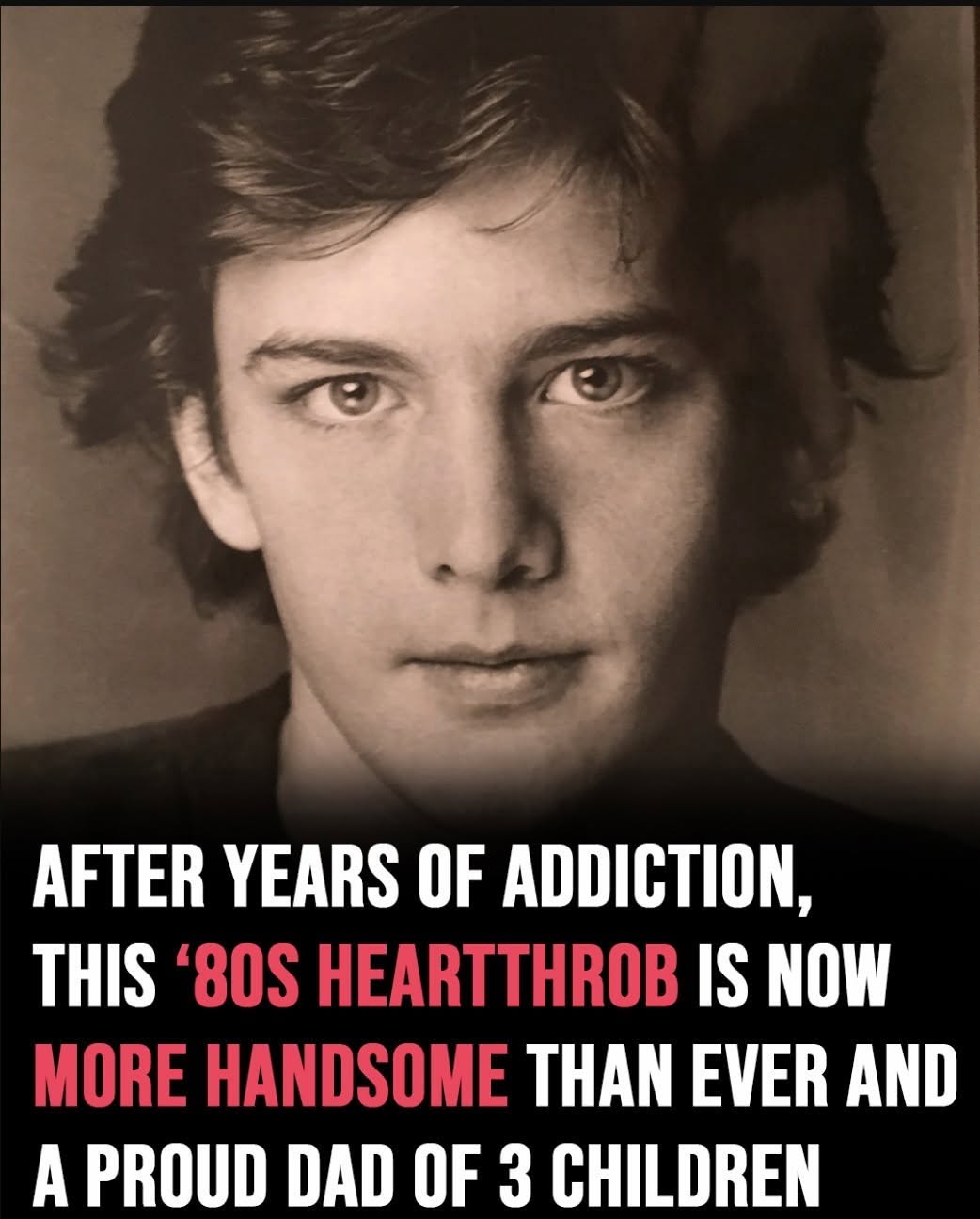
From the outside, it looked like the perfect Hollywood story. A young actor with movie-star looks rises from obscurity to become one of the biggest heartthrobs of his generation.
Fans screamed his name, magazines put his face on their covers, and studios lined up to cast him in hit films. To millions of people, he appeared to be living a dream few could ever imagine.
But behind the bright lights, sold-out theaters, and red carpets was a very different reality.
Long before he became one of the defining faces of 1980s cinema, Andrew McCarthy was simply a quiet kid from New Jersey trying to figure out where he belonged. Like many young people, he often felt like an outsider. While others seemed to move confidently through life, he carried a sense of uncertainty that would follow him into adulthood.
Those who knew him early on have described him as thoughtful, introspective, and often more comfortable observing the world than standing at its center. Ironically, fate would soon place him directly in the spotlight.
McCarthy’s acting career began to take shape at a time when Hollywood was searching for fresh faces to capture the imagination of a new generation. It did not take long for audiences to notice him. His natural charisma and understated style made him stand out in an industry filled with larger-than-life personalities.
Then came the films that changed everything.
Movies like St. Elmo’s Fire, Pretty in Pink, and Less Than Zero turned him into a household name almost overnight. Alongside a group of young actors who would later become known as the “Brat Pack,” McCarthy became one of the defining stars of an era.
To fans, he represented youth, romance, and possibility.
But fame often has a hidden price.
While audiences saw glamour, success, and endless opportunity, McCarthy experienced something far more complicated. The attention that thrilled millions of fans often left him deeply uncomfortable. Interviews, publicity events, and constant scrutiny became overwhelming. The more famous he became, the more disconnected he sometimes felt from himself.
Suddenly, life was no longer simple.
Every move was watched.
Every appearance was analyzed.
Every success brought even greater expectations.
For someone naturally private and introspective, the pressure became increasingly difficult to navigate.
Like many in Hollywood before him, McCarthy turned to alcohol.
At first, drinking seemed harmless enough. It offered temporary relief from anxiety and self-doubt. It quieted the noise that came with celebrity and softened the edges of fear. In an industry where parties were common and excess was often normalized, alcohol blended easily into daily life.
But what begins as an escape can slowly become a trap.
Over time, the occasional drink became something more serious. Alcohol no longer simply accompanied his life—it began to shape it. The very thing that once seemed to provide comfort gradually took control.
Addiction rarely announces itself all at once.
Instead, it arrives quietly.
A habit becomes a routine.
A routine becomes a dependence.
And before long, a person may find themselves living a life they no longer recognize.
By his late twenties, McCarthy found himself confronting a painful truth. The career that had once seemed full of promise was being overshadowed by personal struggles. Behind the public image of success was a man who felt frightened, exhausted, and increasingly disconnected from who he wanted to be.
He later spoke openly about reaching a point where fear had taken over.
There was no dramatic movie scene.
No triumphant soundtrack.
Just the difficult realization that something had to change.
At only twenty-nine years old, Andrew McCarthy made a decision that would alter the course of his life: he entered rehabilitation.
For many people, asking for help is one of the hardest steps imaginable. It requires vulnerability, honesty, and the willingness to confront painful realities. Recovery is rarely glamorous. It does not happen overnight, and it rarely follows a straight path.
For McCarthy, rehabilitation was not the end of a story.
It was the beginning of a new one.
Recovery forced him to examine not only his relationship with alcohol but also his relationship with fame, identity, and success. Away from Hollywood’s spotlight, he began rebuilding his life piece by piece.
The transformation was not immediate.
Real change seldom is.
Instead of chasing the constant noise of celebrity, McCarthy started embracing quieter pursuits. He discovered value in reflection rather than recognition. The things that once seemed essential fame, attention, public approval—began to lose their power over him.
In time, he found new ways to tell stories.
While many fans remembered him primarily as an actor, McCarthy expanded his creative horizons. He worked behind the camera as a director, bringing fresh perspectives to television and film. He also became a respected writer, sharing deeply personal reflections on life, travel, and recovery.
Travel, in particular, became a meaningful part of his journey.
Exploring different countries and cultures offered him something fame never could: perspective. As a travel writer, he discovered joy not in being recognized, but in observing the world with curiosity and humility.
There is a certain freedom in becoming a student of life rather than its center of attention.
McCarthy embraced that freedom.
As the years passed, he built a life defined less by celebrity and more by purpose. He became a father, a husband, an author, and a mentor. Those closest to him often describe a man who values family, authenticity, and peace over public acclaim.
The image of the young heartthrob remains frozen in movie posters and nostalgic memories, but the man himself has continued to evolve.
Perhaps that is his greatest achievement.
Hollywood often celebrates dramatic comebacks and reinventions, but some of the most meaningful victories happen quietly, far from cameras and headlines. Recovery does not always look like triumph on a stage. Sometimes it looks like waking up each day and choosing a different path.
Andrew McCarthy’s story resonates because it is ultimately not about fame.
It is about survival.
It is about confronting fear, making difficult choices, and rebuilding a life after losing your way. His journey serves as a reminder that success does not protect anyone from struggle, and that even those who seem to have everything may be fighting battles no one else can see.
Today, McCarthy stands not only as an actor who helped define an era but as proof that people are more than the worst moments of their lives. His legacy extends beyond movies and magazine covers.
It lives in his recovery.
In his family.
In the stories he continues to tell.
And perhaps most importantly, in the quiet truth that no matter how far someone falls, there is always the possibility of beginning again.