
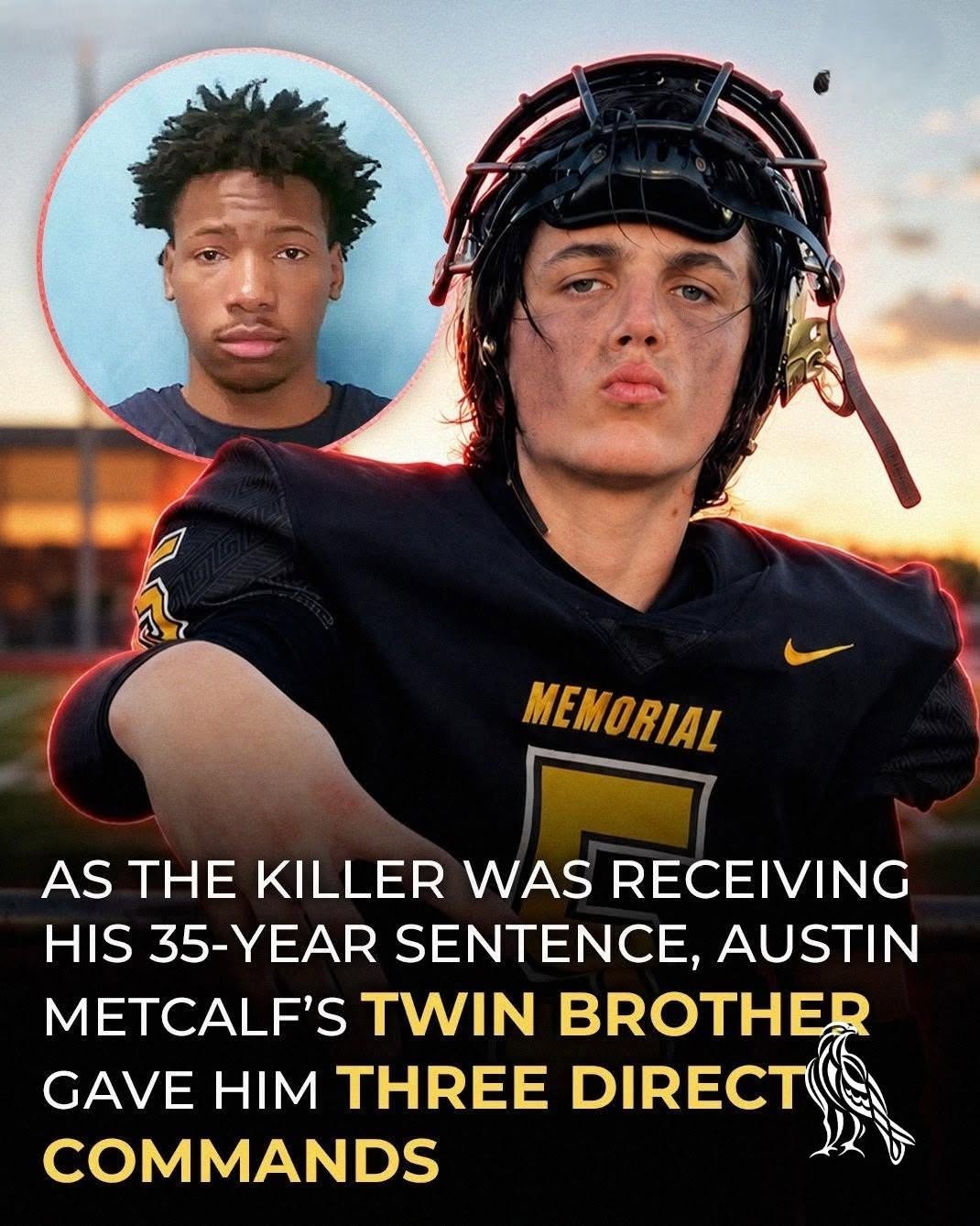
The courtroom fell silent long before the sentence was read. Families, reporters, lawyers, and jurors all understood that the trial had moved beyond legal arguments. What remained was grief, anger, and the impossible task of measuring the value of a teenage life against decades in prison.
Nineteen-year-old Karmelo Anthony stood before the judge after being found guilty of murdering 17-year-old Austin Metcalf at a Texas high school track meet. Prosecutors said a confrontation over seating escalated into violence, ending when Anthony stabbed Austin in the chest. The jury rejected Anthony’s claim of self-defense and returned a murder conviction.
But the most emotional moments came after the verdict, when Austin’s family addressed the court directly.
His twin brother, Hunter Metcalf, walked to the podium carrying a pain that seemed far heavier than his age. Looking toward Anthony, he demanded eye contact before speaking.
“You took away my best friend,” he said. “You took away the person who was supposed to be with me for every major moment of my life.”
Hunter described waking up each morning to a bedroom that no longer opened, birthdays that would never feel normal again, and a mother whose grief had become part of the family’s daily life. His voice shook as he imagined future weddings, children, and holidays with one chair permanently empty.
At one point, he turned fully toward Anthony and said he wanted “everything taken” from him. The statement was not polished or restrained; it sounded like exactly what it was the raw anger of a brother trying to survive something that made no sense.
Austin’s mother spoke next. She described talking to her son at his grave because she no longer knew what to do with the conversations still trapped inside her. She spoke about walking past his room, seeing his belongings untouched, and feeling time split into two eras: before the track meet and after it.
“Austin was a peacemaker,” she said. “He hugged people. He calmed people down. He was not looking for a fight.”
Other relatives echoed the same image a teenager known for kindness, leadership, and loyalty. Family members described him carrying younger cousins on his back, making friends easily, and treating people gently. The portrait they painted was painfully ordinary in the best way: a good kid whose future had seemed wide open.
Then Anthony’s mother approached the podium.
Her composure broke almost immediately. Through tears, she begged the court to show mercy, repeating that her son was deeply sorry and insisting that he was still “her baby.” She spoke not like a strategist trying to reduce a sentence, but like a mother staring at the collapse of the future she imagined for her child.
“Please don’t throw his whole life away,” she said.
The contrast in the room was devastating. One family was mourning a son who would never come home again. The other was preparing to lose a son to prison for most of his adult life.
When Judge Angela Tucker announced the sentence 35 years in prison Anthony visibly crumpled. He wept openly, his shoulders shaking as deputies moved closer. Behind him, relatives cried and held one another. Across the aisle, Austin’s family sat rigid and exhausted, as if even the sentence could not touch the emptiness left behind.
Outside the courthouse, reactions were immediate and divided.
Some people believed the punishment was appropriate for a deliberate act of deadly violence. Others argued that a teenager acting in panic should not spend decades behind bars. The case had already drawn national attention because of arguments over self-defense, youth violence, and the way social media transformed a local tragedy into a cultural battlefield.
But inside the courtroom, the politics faded. What remained were two families shattered in different ways.
Prosecutors had argued that Anthony made a conscious choice to escalate a minor dispute into fatal violence. They pointed to witness testimony, the discarded knife, and Anthony’s actions immediately afterward. The defense maintained that he feared for his safety and reacted impulsively during a confrontation.
The jury ultimately sided with the prosecution.
Still, even the conviction did not create closure. Austin’s father later told reporters that his family had been “robbed” not only of a son, but of the future he was supposed to have. Hunter said no sentence could restore what was taken.
Anthony’s family, meanwhile, faced a different kind of devastation: the realization that a teenager’s single decision had now defined an entire life.
Legal experts noted that because Anthony was convicted as an adult, the sentence reflected the seriousness of the offense under Texas law. Depending on parole eligibility, he could still spend the majority of his life incarcerated before becoming eligible for release.
The case has reignited broader debates about youth violence and conflict escalation among teenagers. A disagreement that might once have ended in shouting instead ended with a funeral, a prison sentence, and families permanently bound together by trauma.
Friends and teachers remembered Austin as academically driven and active in athletics. A scholarship fund created in his name has already raised significant support from the community. Vigils held after his death drew classmates, coaches, and neighbors who struggled to understand how a school event turned into a homicide scene.
Meanwhile, Anthony’s supporters have continued to describe him as a teenager who made a catastrophic mistake rather than a lifelong criminal. Some community members have called for programs focused on conflict resolution, mentorship, and emotional intervention for young people before violence occurs.
None of those discussions, however, changed the scene in the courtroom.
At the end of the hearing, deputies led Anthony away in handcuffs. His mother reached toward him briefly before he disappeared through a side door. Austin’s family gathered together quietly, holding one another as the room emptied.
The judge thanked the jurors for their service. Lawyers packed their files. Reporters rushed outside to deliver updates.
And two families walked out carrying sentences that looked very different on paper, but were both shaped by irreversible loss.
One mother would begin planning prison visits.
The other would return to a cemetery.
The case was over. The grief was not.