
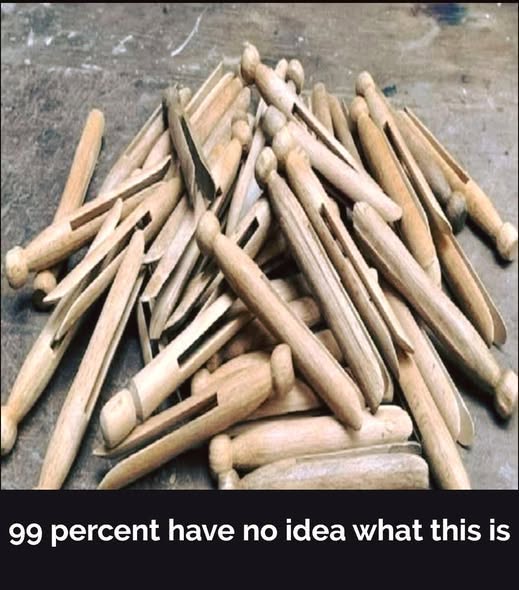
Every so often, images of old, weathered objects appear online and spark widespread confusion. A piece of rusted metal, a carved wooden tool, or an unfamiliar household item turns into a global guessing game as users attempt to identify what it once was.
Recently, one such mystery object circulated widely an old wooden device found outdoors that left many people puzzled about its purpose. While some speculated it was agricultural equipment or part of an old construction tool, the truth reveals a much more ordinary yet historically rich story: the wooden clothespin.
At first glance, the clothespin seems almost too simple to matter. It is small, unremarkable, and easy to overlook in modern life. Yet this humble object once played a central role in daily household routines across the world. Before electric dryers and indoor laundry systems became common, something as basic as drying clothes required planning, space, and dependable tools. The clothespin was one of those quiet innovations that made everyday life more manageable for generations.
Long before industrial manufacturing, people had to improvise ways to secure wet clothing outdoors. Laundry was typically washed by hand and then hung on long lines stretched between trees, fences, rooftops, or wooden posts. This method depended entirely on weather conditions. Wind could easily displace garments, and heavier fabrics often slipped off improvised supports. To solve this, early households relied on makeshift solutions such as small stones, twigs, carved wood pieces, or even bone fragments to hold fabric in place.
These early methods worked, but they were inconsistent. Some materials were too heavy, others too smooth, and many were not designed for repeated use. As communities grew and laundry demands increased, the need for a more reliable fastening tool became obvious. This need set the stage for one of the simplest yet most enduring household inventions: the clothespin.
By the 19th century, as industrialization began reshaping daily life, inventors turned their attention to improving basic domestic tools. Among these improvements was the development of a more structured clothespin design made from wood. Early versions consisted of two pieces held together in a way that allowed them to grip fabric more securely than earlier single-piece designs. The idea was simple but effective: apply steady pressure to hold clothing in place even under changing weather conditions.
A major breakthrough came when the spring mechanism was introduced. This innovation allowed the clothespin to open and close using tension, creating a firm grip that could adjust naturally to different fabric thicknesses. Instead of relying on weight or friction alone, the spring provided consistent pressure that kept garments from slipping. This small improvement dramatically changed how people handled outdoor laundry.
As manufacturing techniques advanced, clothespins became more standardized. Factories began producing them in large quantities using durable woods such as maple and birch. The design remained simple, typically consisting of two wooden arms joined by a metal spring. Despite its simplicity, this structure proved highly effective and easy to mass-produce. It also made clothespins affordable, allowing them to become a common household item across Europe, North America, and eventually much of the world.
During the early 20th century, the wooden clothespin became a familiar sight in everyday life. Clotheslines stretched across backyards, apartment courtyards, and rural fields. Families would gather laundry, hang garments carefully, and secure each item with clothespins before leaving them to dry in the sun and wind. In many communities, this routine was part of daily rhythm something shared across neighborhoods and generations.
The clothespin also found uses beyond laundry. Its simple design made it useful in classrooms, craft projects, and small household repairs. Children used them in art activities, while adults repurposed them for practical tasks around the home. Its versatility contributed to its long-lasting presence in domestic life, even as newer technologies began to emerge.
With the rise of plastic manufacturing in the mid-20th century, many traditional household items began to change. Plastic clothespins were lighter, cheaper to produce, and resistant to weather damage. These advantages led to their widespread adoption, gradually replacing wooden versions in many regions. However, the transition was not absolute. Wooden clothespins continued to be used in homes that valued durability, tradition, or environmental considerations.
Unlike plastic alternatives, wooden clothespins offered a natural, biodegradable option. They did not rely on synthetic materials and could often withstand years of use when properly maintained. In some households, they remained the preferred choice, especially in rural areas or among those who continued using outdoor clotheslines.
In modern times, wooden clothespins have taken on new roles beyond their original purpose. While they still function as laundry tools, they are also widely used in arts and crafts, home decoration, and do-it-yourself projects. Their simple shape and natural texture make them popular in creative work, from holiday ornaments to educational activities. This adaptability has helped them remain relevant even in an era dominated by machines and automation.
Beyond their practical uses, wooden clothespins also carry a sense of nostalgia. They are often associated with older ways of living—times when household chores required more manual effort and closer connection to natural conditions. For some, they represent simplicity, patience, and a slower pace of life. Seeing them today can evoke memories of family routines, outdoor chores, and traditional household practices.
The evolution of the clothespin also reflects broader changes in technology and society. What began as a handmade necessity gradually became a standardized industrial product. Yet despite advancements in design and materials, the core concept has remained largely unchanged for over a century. This continuity highlights the effectiveness of its original idea and the lasting value of simple engineering solutions.
In recent years, growing interest in sustainability has brought renewed attention to wooden household tools. As concerns about plastic waste and environmental impact increase, some people have returned to traditional materials like wood. Wooden clothespins, being biodegradable and reusable, are often seen as a more eco-friendly alternative to plastic versions. This shift has helped maintain their presence in modern households, even if in a more limited role.
Ultimately, the wooden clothespin is far more than a forgotten object found outdoors or an outdated laundry accessory. It represents a long history of practical innovation, everyday problem-solving, and human adaptation to changing living conditions. From improvised early versions to mass-produced modern designs, it has remained a consistent part of domestic life across generations.
What makes it remarkable is not its complexity, but its simplicity. The clothespin demonstrates how even the smallest inventions can have a lasting impact when they solve a real and universal problem. Though often overlooked today, it continues to bridge the gap between past and present, reminding us that some of the most important tools in history are also the most ordinary.