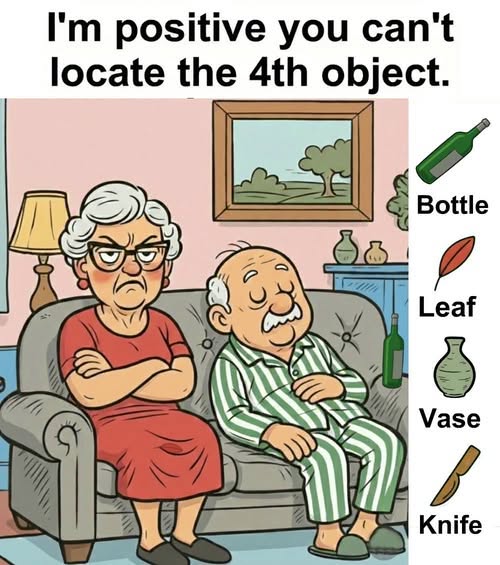
At first glance, it feels like a simple visual puzzle: somewhere in the scene are a bottle, a leaf, a vase, and a knife. People scan quickly, eyes jumping from corner to corner, convinced they’ll spot them in seconds.
But the longer you look, the more the exercise stops being about objects and starts becoming about attention itself. What you notice, what you ignore, and what your mind filters out says more than you expect.
Because hidden-object challenges like this don’t just test observation. They test interpretation. The brain doesn’t see the world as a raw image; it edits, simplifies, and fills gaps instantly. That’s why obvious details can vanish in plain sight while subtle shapes suddenly feel meaningful. A curved shadow becomes a vase. A long reflection becomes a knife. A blurred edge becomes a leaf. And somewhere in that mental sorting process, a bottle might be right in front of you without ever registering.
It’s a strange reminder that perception is never fully neutral. What we “see” is always influenced by expectation, memory, and focus. And once you accept that, even a simple list of objects starts to feel like a lesson in how the mind quietly constructs reality.
But behind this visual puzzle sits something even more layered: a reflection on presence, memory, and the things that are easy to overlook until they’re pointed out. In the same way hidden objects disappear into a busy image, certain figures in life can become so familiar that their importance fades into the background. We assume we’ll always notice them, always understand them, always have time for them.
Grandparents are often like that in a family.
They are there in the background of everything, steady and constant, rarely demanding attention but shaping the entire structure around them. Like a frame holding up a picture, their presence is not always the focus, but without it, everything would feel less stable.
A grandmother and grandfather are not just older relatives. They are living archives of a family’s story. They carry memories that no one else recorded, details that were never written down, and emotional histories that exist only in conversation. Long before photographs were stored on phones and events were posted online, they were the ones who remembered.
They remember who loved whom first, which years were difficult, which ones were quietly happy, and which moments changed everything. In many families, they are the last direct link to eras that younger generations will never experience firsthand. That makes them more than relatives. It makes them witnesses to time.
And yet, like hidden objects in a crowded image, their influence is often unnoticed in daily life. Life moves quickly, especially for younger generations. School, work, responsibilities, and digital noise take attention in every direction. In that movement, the quiet presence of grandparents can become something assumed rather than appreciated.
But their role is far from passive.
Grandmothers and grandfathers often provide the kind of emotional grounding that is difficult to replace. It is not loud or dramatic support. It is steady reassurance. A sense that no matter how chaotic life becomes, there is still a place, a voice, or a person who remains unchanged in their care.
Their love tends to be different from parental love. It is often less pressured, less shaped by responsibility and expectation. It carries more patience, as if time has softened everything unnecessary and left only what matters. For many grandchildren, this creates a rare emotional space where they feel accepted without performance or pressure.
That sense of acceptance becomes a kind of refuge. A place where mistakes are smaller, where silence is comfortable, and where simply being present is enough. In a world that constantly demands improvement and comparison, that kind of emotional safety is quietly powerful.
Their homes often reflect that same feeling. A grandmother’s or grandfather’s house can feel like a separate world, slightly slowed down from everything outside. Familiar smells linger longer. Objects seem to have histories attached to them. Even ordinary routines feel intentional, repeated over years until they become part of the atmosphere itself.
In those spaces, conversations stretch further. Stories surface naturally. Meals take on meaning beyond nutrition. Time feels less urgent, as if it is allowed to pause for a while.
And in many families, grandparents are also the bridge between generations. They connect past to present in a way no one else can. Parents may focus on raising children in the present moment, but grandparents widen the frame, reminding everyone where the story began.
They pass down traditions, habits, sayings, and small rituals that might otherwise disappear. A recipe written nowhere. A phrase repeated in certain situations. A way of doing things that carries memory even when no one is actively thinking about it. These small details become part of family identity without anyone noticing when they first started.
There is also something deeply stabilizing about their presence during difficult times. When tension enters a family, grandparents often respond with a kind of calm that comes from having already lived through many changes. They understand that intensity fades, that conflict softens, that time eventually reshapes everything.
That perspective does not erase problems, but it reframes them. It reminds others that not every moment needs immediate resolution, and not every difficulty defines the future.
Still, in modern life, the value of older generations is sometimes underestimated. Societies often celebrate speed, novelty, and youth, while overlooking the quiet strength that comes from experience. But experience is not passive. It is accumulated understanding, built through years of observation, loss, joy, and adaptation.
Like the hidden bottle, leaf, vase, and knife in a crowded image, their importance is always there, even when not immediately seen. It simply requires attention to notice.
And once noticed, it becomes difficult to ignore again.
Because what looks ordinary at first often holds the most meaning. A small object in a complex picture. A quiet presence in a busy family. A life filled with stories that shaped others long before they realized it.
In the end, both the puzzle and the reflection point to the same truth: nothing important is truly hidden. It only waits for the moment someone finally looks closely enough to see it.