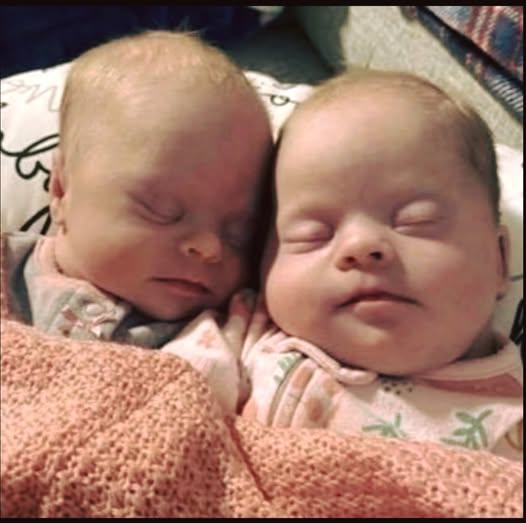
When Savannah Combs first learned she was pregnant, she expected the usual emotions that come with becoming a parent: excitement, nervousness, endless questions about the future.
Like many young mothers, she imagined baby clothes, nursery decorations, sleepless nights, and the overwhelming love that people often describe when preparing to welcome a child into the world.
What she did not expect was to hear doctors describe her pregnancy as extraordinarily rare.
Savannah, from Middleburg, Florida, soon discovered she was carrying identical twins, something that already occurs in only a small percentage of pregnancies worldwide. Identical twins alone are considered medically uncommon because they happen when a single fertilized egg splits into two embryos. The situation becomes even more complex when the twins share certain conditions or complications during development.
But her pregnancy would become even more unusual.
During prenatal testing and medical evaluations, Savannah and her husband, Justin Ackerman, received news that changed everything. Doctors informed them that both babies had Down syndrome, a genetic condition caused by the presence of an extra chromosome 21. While many children with Down syndrome live healthy and meaningful lives, the diagnosis often brings emotional, medical, and social challenges for families.
What made Savannah’s pregnancy especially rare was that both identical twins had the condition simultaneously.
According to medical experts, the occurrence is exceptionally uncommon. The pregnancy immediately became classified as high-risk, requiring close monitoring throughout every stage. Doctors carefully tracked the babies’ growth, development, and overall health because twin pregnancies alone carry increased risks, even before additional medical complications are involved.
For Savannah, the news triggered a flood of emotions.
There was fear, uncertainty, and concern about what the future might hold for her daughters. Yet alongside those feelings was something stronger: determination. She and Justin decided early that they would focus on loving and supporting their children rather than viewing the diagnosis as something tragic or hopeless.
That decision would later place them directly in the center of online debate.
As Savannah documented parts of her pregnancy journey on social media, her story began reaching thousands of people. At first, many viewers offered support and encouragement, praising her openness and honesty. But as her audience grew, so did criticism from strangers who questioned her decision to continue the pregnancy after learning about the twins’ condition.
Some comments were deeply hurtful.
Certain users implied the babies would suffer unnecessarily. Others questioned why she would knowingly bring children with disabilities into the world. The criticism reflected a darker side of online culture, where personal medical decisions often become public battlegrounds for opinions from people completely removed from the emotional reality of the situation.
Savannah refused to back down.
Instead of responding with anger, she answered with clarity and love. She repeatedly explained that her daughters deserved the same respect, dignity, and opportunity as any other children. To her, they were not defined by a diagnosis. They were simply her babies.
Behind the scenes, the pregnancy remained difficult.
Doctors warned Savannah about the possibility of complications related to prematurity and the challenges associated with monochorionic-diamniotic twins, often called “mo-di twins.” This means the babies shared a placenta while remaining inside separate amniotic sacs, a condition that requires constant medical observation because of the increased risk of developmental complications.
Every appointment carried uncertainty.
Every ultrasound brought hope mixed with anxiety.
Then, on May 12, 2021, the twins arrived earlier than expected.
Kennadi Rue and McKenzi Ackerman were born at approximately 29 weeks of pregnancy, making them significantly premature. Because their bodies were still developing, they immediately required intensive medical support after birth. The newborns were taken to a neonatal intensive care unit, where doctors and nurses worked carefully to stabilize them and monitor their progress.
For many parents, the NICU experience becomes an emotional roller coaster unlike anything they imagined. Machines beep constantly. Tiny bodies rest inside incubators surrounded by tubes and monitors. Every ounce gained feels like a victory, while every setback creates fear.
Savannah and Justin spent weeks watching their daughters fight through those fragile first days of life.
The twins remained hospitalized for an extended period as they slowly grew stronger. Premature babies often need help regulating body temperature, breathing, and feeding, and children born with additional medical conditions may require even more specialized care.
Despite the challenges, Savannah continued sharing updates online.
What surprised many people was not sadness or defeat, but joy.
Her videos and photos showed two expressive little girls surrounded by love, wrapped in blankets, smiling, playing, and growing in their own unique ways. Savannah openly acknowledged that children with Down syndrome may reach milestones differently than other children, but she emphasized that different does not mean lesser.
That message resonated with thousands of families.
Parents of children with disabilities began sharing their own stories in response. Many thanked Savannah for helping challenge stereotypes surrounding Down syndrome and special needs parenting. Others admitted her posts changed the way they thought about disability altogether.
Still, criticism never fully disappeared.
Social media can be brutal toward families who live outside traditional expectations. Some commenters continued insisting the children would face unnecessary hardship, while others reduced the twins entirely to their diagnosis rather than seeing them as individuals.
Savannah answered those comments with remarkable composure.
Again and again, she reminded people that her daughters laugh, learn, express emotions, and experience the world just like any other children. They have personalities, preferences, moods, and dreams forming in their own way. They are daughters first, diagnoses second.
Her willingness to speak publicly about the realities of parenting children with special needs also helped expose the emotional complexity many families experience after prenatal diagnoses. Conversations surrounding disability often become politicized or oversimplified online, but Savannah’s story forced people to confront the human side of those decisions.
There were difficult days.
There were hospital visits, exhaustion, and moments of fear about the future.
But there was also love powerful enough to drown out much of the noise surrounding them.
Over time, Savannah’s online presence evolved beyond simply documenting a rare pregnancy. She became an advocate for acceptance, inclusion, and understanding. Her content showed ordinary family moments: bedtime routines, laughter, milestones, sibling bonding, and the messy beauty of raising young children.
That normalcy became part of what made her story so impactful.
Many viewers realized they had rarely seen families like hers represented publicly without pity or sensationalism. Instead of portraying her daughters as tragic figures, Savannah presented them as joyful human beings deserving of love, patience, and opportunity.
Medical professionals often note that children with Down syndrome can lead fulfilling lives when provided with support, education, healthcare, and inclusion within their communities. While developmental timelines may vary, many individuals with the condition build friendships, attend school, pursue careers, and form strong emotional relationships throughout their lives.
Savannah’s story became a living reminder of that truth.
Today, Kennadi and McKenzi continue growing surrounded by parents determined to give them every chance to thrive. Their journey remains challenging at times, but it is also filled with moments of happiness that no diagnosis can erase.
Perhaps the most powerful part of Savannah’s story is not the rarity of the pregnancy itself, but the message that emerged afterward.
In a world quick to judge difference, she chose visibility instead of shame.
In a culture that often measures value through perfection, she defended the worth of children others dismissed too quickly.
And in the face of criticism that could have broken many people, she answered with something stronger than outrage: unconditional love.
That is the part people remember long after the headlines fade.