For years, Stephen Colbert built his version of late-night television on sharp satire, controlled chaos, and the unmistakable sense that no institution was too powerful to escape a punchline.
Politicians, billionaires, cable news networks, Hollywood elites, and even his own employers all eventually found themselves in his crosshairs. But during what many viewers now describe as one of the most unforgettable moments of his career, Colbert appeared to aim his sharpest joke directly at the network standing behind him.
The audience laughed immediately. Some gasped. Others clapped before the joke had even fully landed. Yet beneath the laughter, something heavier settled across the studio. It felt less like a scripted monologue line and more like a public act of defiance wrapped inside comedy.
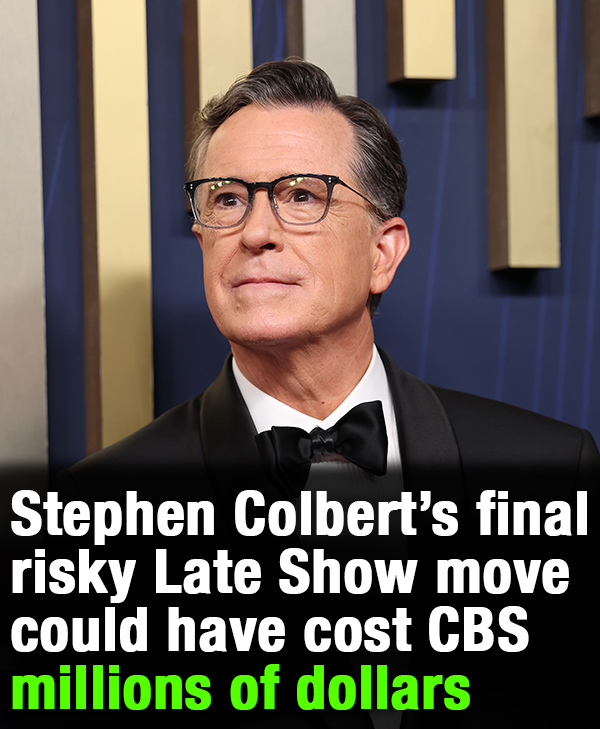
“Oh no,” Colbert joked with carefully timed sarcasm, “I hope this doesn’t cost CBS any money.”
The line lasted only seconds. But online, it exploded almost instantly.
Social media users dissected every facial expression, every pause, every inflection in his voice. To many viewers, the joke was not really a joke at all. It was a final shot aimed at executives, corporate decision-makers, and a media machine Colbert had spent years both working for and quietly challenging.
The tension surrounding the moment had reportedly been building for months. Rumors swirled about disputes behind the scenes, financial anxieties inside major television networks, and growing discomfort over political commentary in an increasingly polarized media environment. Publicly, corporate representatives emphasized business realities, changing audience habits, advertising pressures, and the broader financial instability facing late-night television. Official explanations framed difficult decisions as economic rather than ideological.
But audiences are rarely satisfied with official statements, especially when timing and context tell a more complicated story.
Many viewers connected Colbert’s comments to broader controversies involving network leadership, political pressure, and high-profile settlements that had already generated public criticism. To those watching closely, his joke felt like a coded message hidden in plain sight. It carried the tone of someone who knew exactly how much he could say publicly while still making his meaning unmistakably clear.
That tension between entertainment and truth has always defined Colbert’s career.
Long before hosting one of television’s biggest late-night shows, Colbert built his reputation by mastering a very particular kind of performance: saying dangerous things while technically hiding behind humor. His comedy often worked because audiences understood the deeper meaning underneath the joke. He trusted viewers to connect the dots themselves.
This moment felt no different.
Inside the theater, the crowd reacted with the kind of laughter that comes from recognition rather than surprise. It was not simply that the joke was funny. It was that people believed they understood exactly what he was really saying.
For many fans, the remark symbolized frustration with the increasingly uneasy relationship between corporate media and political influence. Critics of major networks have long argued that executives often prioritize financial stability and political access over journalistic independence or creative freedom. In that context, Colbert’s line sounded less like comedy and more like quiet rebellion.
What made the moment especially powerful was how brief it was.
There was no angry monologue. No dramatic confrontation. No emotional speech condemning executives or naming enemies directly. Instead, Colbert used the tool he has always understood best: timing. A single sarcastic sentence managed to communicate more than a lengthy public statement ever could.
That subtlety only amplified its impact.
Viewers immediately began replaying the clip online, searching for hidden meaning in every detail. Some praised Colbert for refusing to leave quietly. Others accused him of turning personal grievances into public spectacle. Supporters saw courage. Critics saw bitterness. But almost everyone agreed on one thing: the joke did not feel accidental.
Part of what resonated so deeply was the sense that audiences were witnessing something unusually authentic in an industry often built on carefully managed appearances. Television hosts are expected to entertain, not openly challenge the systems paying them. Yet Colbert seemed willing, at least for one fleeting moment, to blur that boundary completely.
The response revealed how emotionally invested audiences become in late-night television personalities over time. For years, viewers invite these hosts into their homes night after night. They become part comedian, part commentator, part emotional companion during political chaos, cultural upheaval, and personal uncertainty. When conflict emerges between a host and the institution surrounding them, audiences often interpret it almost like a personal betrayal.
Colbert’s fans especially viewed him as someone who consistently used comedy to push back against power rather than protect it. That reputation made the joke land with extraordinary force. People believed him because they believed they knew who he was.
At the same time, the incident highlighted the fragile state of modern television itself. Late-night programming once dominated cultural conversation in a way that feels almost impossible today. Younger audiences increasingly consume clips online rather than full broadcasts. Advertising models have shifted. Networks face financial pressure from streaming competition and shrinking traditional viewership.
Inside that environment, every controversy carries financial consequences.
Executives worry about advertisers. Advertisers worry about political backlash. Public figures worry about viral outrage. Networks try to balance profitability with creative freedom while navigating audiences that are more divided and more reactive than ever before.
Colbert’s joke landed directly inside those tensions.
To many viewers, he appeared to be mocking not only corporate fear but also the larger culture of caution that increasingly shapes mainstream media. The implication behind the humor seemed clear: institutions willing to tolerate controversy for profit can suddenly become very uncomfortable when criticism turns inward.
The irony, of course, is that controversy itself often drives attention.
The clip spread across social media within hours. Commentators analyzed it on television panels, podcasts, blogs, and YouTube channels. Supporters celebrated it as one of the boldest exits in recent television memory. Critics dismissed it as self-important grandstanding. But either way, people were talking about Colbert again in a way that felt larger than ratings or corporate memos.
Perhaps that was the point.
For years, Colbert mastered the art of making audiences laugh while simultaneously making them uncomfortable. He understood that comedy becomes powerful when it exposes something people already suspect but rarely hear spoken aloud.
That final jab seemed to accomplish exactly that.
Beneath the humor sat a deeper question haunting much of modern media: who really controls the conversation? Is it the hosts audiences trust? The corporations funding the shows? The advertisers shaping acceptable boundaries? Or the viewers themselves, whose loyalty ultimately determines what survives?
Colbert never answered those questions directly. He did not need to. The audience reaction answered them for him.
As the applause rolled through the studio, many viewers sensed they were witnessing more than the ending of another television episode. It felt like the closing scene of a much larger argument about media, power, money, and truth.
CBS still owns the cameras, the stage, the archives, and the broadcast rights. The network will continue moving forward long after one host leaves. Television institutions always do.
But in the eyes of many fans, Colbert walked away with something harder to manufacture and impossible to fully control: credibility.
In the end, that may explain why the moment resonated so deeply. Long after ratings reports, executive statements, and financial explanations fade away, audiences will likely remember one image above all else: a comedian standing under studio lights, smiling through the tension, delivering one final line that sounded an awful lot like freedom.