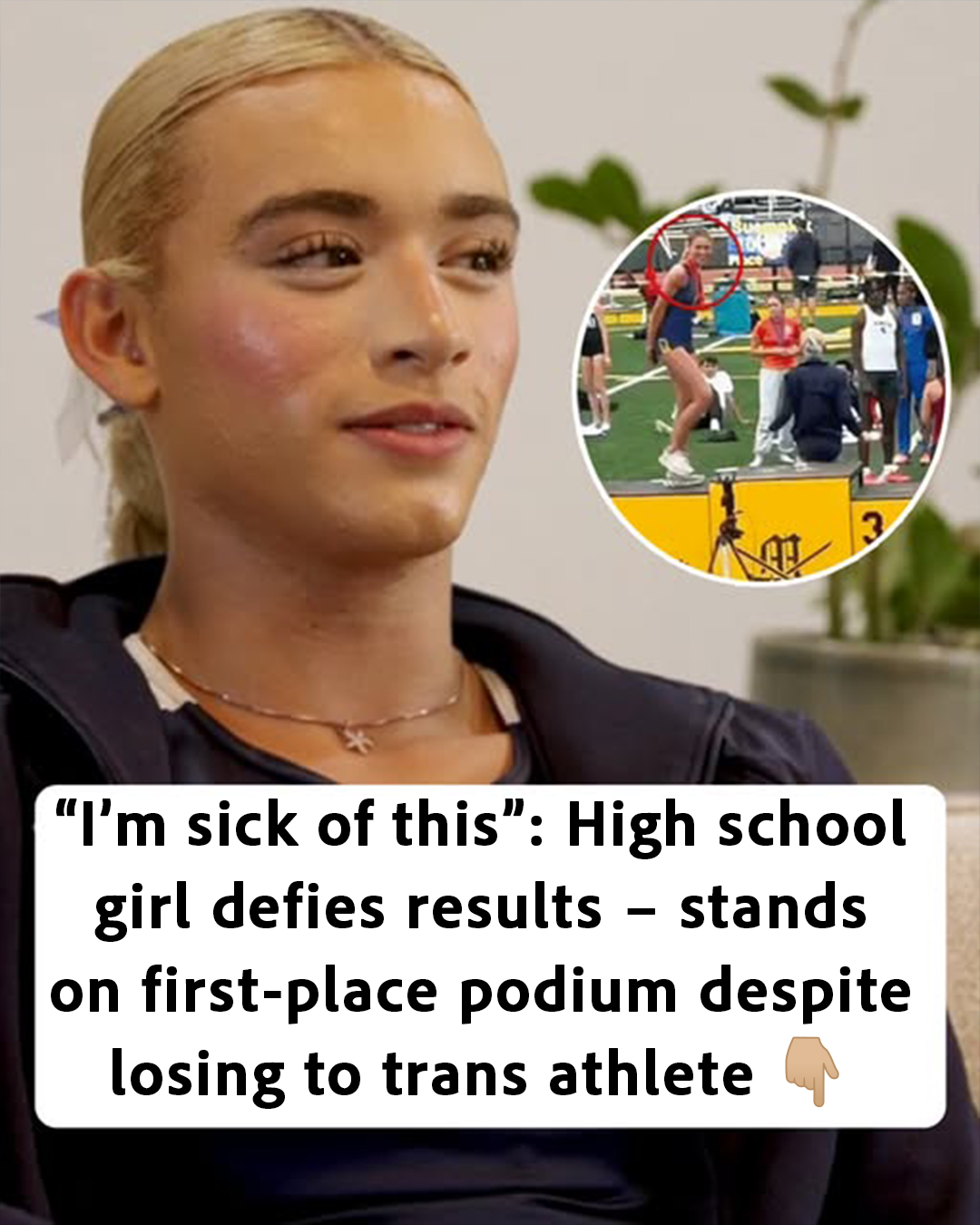
What should have been a simple celebration of athletic achievement quickly turned into one of the most emotionally charged moments in high school sports.
A teenage athlete standing on a podium became the center of a national argument that reaches far beyond medals, records, or championships. Within hours, photos and videos spread across social media, transforming a local competition into a symbol of a much larger cultural battle over fairness, identity, and the future of women’s sports.
To some people watching, the girl’s decision to symbolically claim the top podium position after losing to a transgender athlete was an act of courage. They saw it as a young woman speaking up for what she believed was fairness in female competition, especially in sports where physical differences can significantly affect performance. Supporters argued that many girls feel increasingly uncomfortable voicing concerns because they fear criticism, backlash, or accusations of intolerance. For them, the moment represented frustration that has been quietly building for years.
To others, however, the gesture felt deeply hurtful. Critics argued that transgender athletes are often treated as political symbols rather than human beings, forced into impossible situations where simply participating becomes controversial. Many pointed out that transgender teenagers already face high levels of isolation, bullying, anxiety, and public scrutiny, and that moments like this can intensify feelings of exclusion. From that perspective, the incident was not about defending fairness, but about publicly singling out a young athlete who also came to compete, belong, and be accepted.
What made the moment so powerful was not just the image itself, but everything it represented beneath the surface. The podium became more than a place where winners stand. It became a collision point between competing fears, values, and definitions of justice.
Behind every athlete involved was a story the cameras could not fully capture.
There were years of early morning practices, exhausted drives home after meets, injuries pushed through in silence, and countless moments of self-doubt. There were parents who sacrificed weekends, coaches who invested endless hours, and teenagers who built their identities around competition and discipline. None of that disappeared simply because the public suddenly focused on one controversial aspect of the event.
The reality is that both sides of this debate are often driven by deeply emotional concerns. Many female athletes genuinely worry that opportunities created over decades of advocacy could slowly erode if biological differences are not considered in competition rules. Scholarships, rankings, records, and championship spots can shape futures, especially for young athletes hoping to compete at higher levels. For these girls, the debate feels intensely personal because it directly touches their hard work and aspirations.
At the same time, transgender athletes are often navigating identities that already place them under enormous public pressure. Many are simply trying to participate in the activities they love while being constantly discussed in political speeches, online arguments, and media headlines. For them, sports can represent belonging, confidence, friendship, and normalcy in a world that often treats them as controversial before even knowing them personally.
That is what makes this issue so difficult. It is not a battle between villains and heroes. It is a conflict between competing experiences of vulnerability.
The public conversation surrounding transgender participation in sports has grown increasingly intense in recent years. Legislators, school boards, athletic organizations, medical professionals, and advocacy groups continue to disagree sharply about where the balance between inclusion and fairness should exist. Some states and organizations have introduced restrictions based on biological sex at birth, while others prioritize gender identity inclusion policies. Courts have become involved. Schools have become battlegrounds. Teenagers have become unwilling symbols of ideological wars far bigger than themselves.
Yet social media often reduces these deeply complicated questions into simplistic slogans, viral clips, and outrage-driven narratives. A single photograph gets turned into proof of either bravery or cruelty depending on who shares it. The actual human complexity disappears beneath political tribalism.
What many people forget is that these are still children and teenagers learning how to navigate identity, competition, conflict, and public attention at an age when most people are still figuring out who they are. Adults project enormous political meaning onto moments that the young athletes themselves may not fully understand. Meanwhile, the emotional consequences can follow them for years.
The incident also exposed how divided many parents and coaches feel. Some parents believe strongly that girls’ sports require sex-based protections to preserve equal opportunity and safety. Others believe inclusion and empathy should remain central values in school athletics, especially for marginalized students. Many find themselves trapped somewhere in the middle, struggling to reconcile compassion with concerns about competitive balance.
Coaches face similar tension. They are expected to support every athlete while also navigating constantly changing policies, public pressure, and emotional team dynamics. One decision can place them at the center of controversy overnight. Many describe feeling torn between legal obligations, institutional rules, and personal beliefs.
Even athletes themselves often experience conflicting emotions. A competitor may genuinely like and respect a transgender teammate or opponent while still feeling uneasy about the competitive implications. Likewise, transgender athletes may understand why some girls feel frustrated while also feeling devastated by public rejection. Human emotions rarely fit neatly into ideological categories.
This is why the debate continues to resist easy answers.
Science, policy, ethics, and lived experience all intersect in ways that make simple solutions nearly impossible. Questions about hormone levels, biological development, fairness standards, and inclusion policies remain heavily debated not only politically, but medically and philosophically as well. Different sports involve different physical demands, making universal rules difficult to create.
But beneath all the arguments lies a deeper question about what society wants sports to represent. Is competition primarily about preserving strict physical fairness? Is it about participation and belonging? Is it possible to fully protect both values at once? These questions do not disappear after one championship meet or one viral controversy.
The image from that podium resonated so strongly because it reflected a broader cultural uncertainty. People are trying to define fairness in a rapidly changing social landscape where older assumptions are constantly being challenged. Some fear progress is moving too fast. Others fear compassion is being abandoned. Both anxieties now collide publicly in schools, locker rooms, and athletic competitions.
And yet, despite all the outrage, one truth remains easy to overlook: every athlete standing on that podium was still a young person hoping to be respected.
The girl protesting wanted her effort and opportunities recognized. The transgender athlete wanted dignity and acceptance while competing in the sport they loved. Neither created the national debate surrounding them, yet both became faces of it anyway.
That is perhaps the saddest part of all. Adults continue arguing endlessly about laws, fairness, identity, and politics while teenagers carry the emotional weight of those arguments in real time.
The cameras captured a symbolic moment, but they did not capture the sleepless nights, the pressure, the confusion, or the humanity behind it. They did not show how exhausting it can be to become a public symbol before you are old enough to fully understand the fight surrounding you.
This debate will not end with one protest, one competition, or one policy change. It is likely to continue shaping schools, sports, and public discourse for years to come. But somewhere beneath the headlines and outrage lies a challenge society still has not fully solved: how to protect fairness without losing compassion, and how to defend dignity without dismissing legitimate concerns.
Because behind every podium, beyond every argument and every viral clip, there are still real people standing there.