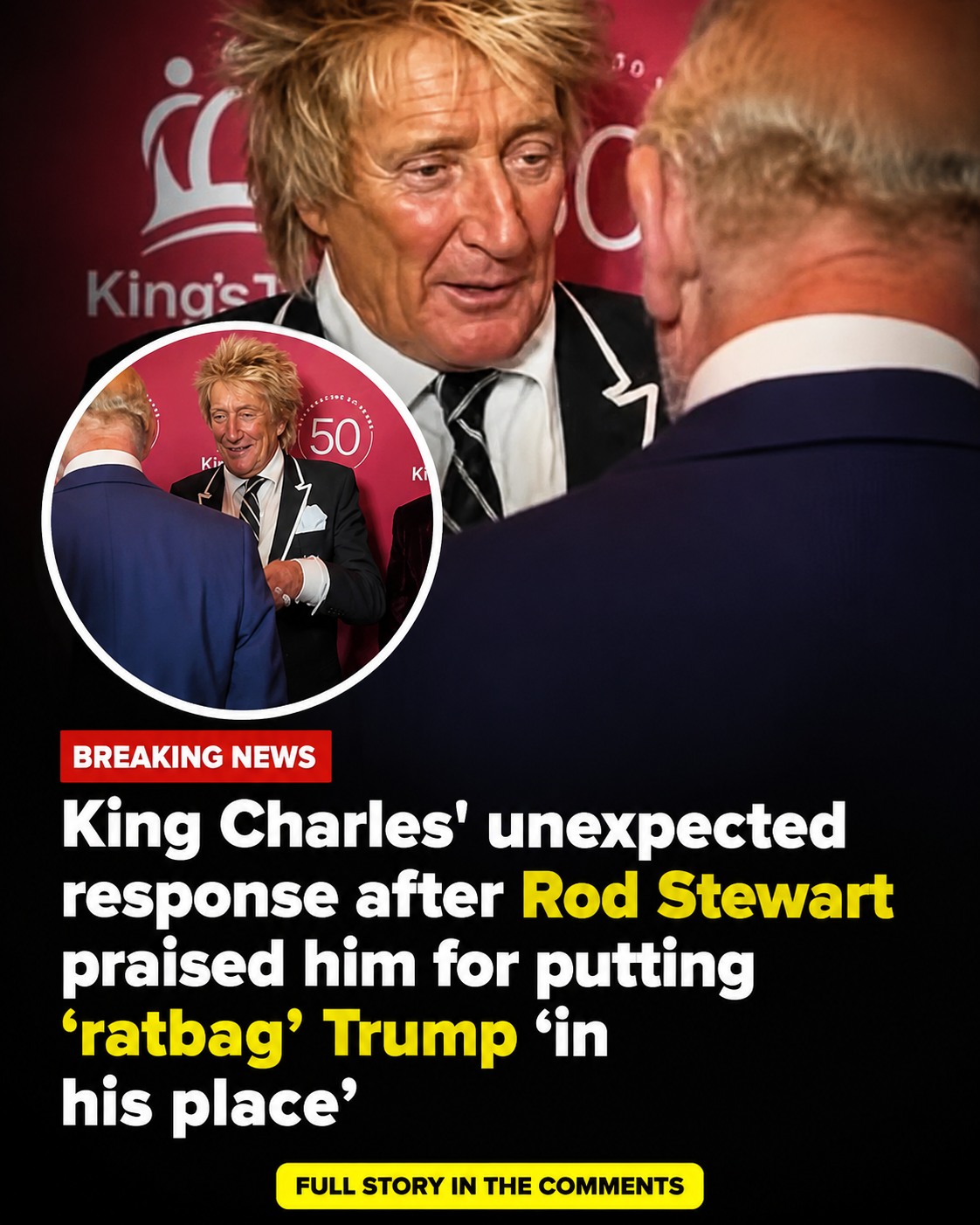
A brief conversation between Rod Stewart and Charles III has suddenly drawn international attention, not because of a formal political statement or diplomatic announcement, but because of a few carefully chosen words spoken in passing.
Yet in today’s political climate, even quiet remarks can explode into global headlines.
What began as a seemingly lighthearted interaction quickly became a talking point across social media, television panels, and entertainment news outlets after Stewart praised the King for what he described as a “wonderful performance in the Americas.” To many listeners, the comment carried far more meaning beneath the surface than simple admiration.
The phrase was widely interpreted as a subtle reference to Charles’ handling of Donald Trump during recent diplomatic events and state appearances connected to the United States.
That interpretation immediately sparked fascination because it brought together three powerful worlds rarely separated anymore: celebrity culture, monarchy, and modern political warfare.
For some observers, the exchange felt almost surreal.
One of Britain’s most iconic rock stars appeared to be quietly applauding the King for navigating interactions with one of the world’s most polarizing political figures. Reports describing Charles’ reaction varied. Some claimed the King laughed politely and moved on. Others suggested the comment may have passed over him entirely without acknowledgment. Either way, the moment quickly became symbolic of something much larger than one whispered exchange.
It reflected how impossible it has become for public figures to avoid the gravitational pull of Trump-era politics.
Even royal diplomacy now exists under constant political interpretation.
For years, members of the British royal family have carefully maintained the tradition of political neutrality, avoiding direct commentary on elected leaders or partisan conflicts. The monarchy survives partly because it presents itself as stable, restrained, and above everyday political warfare.
That restraint, however, becomes increasingly difficult during moments charged with global controversy.
Trump’s visits to the United Kingdom created exactly that kind of tension. Every interaction, handshake, speech, and ceremonial gesture was analyzed endlessly by supporters and critics alike. Observers searched constantly for hidden signals, subtle facial expressions, or symbolic acts that might reveal private opinions behind diplomatic politeness.
In that environment, even small gestures gained outsized meaning.
Some commentators pointed to symbolic details during Trump-related events involving King Charles, including carefully chosen gifts, measured speeches, and restrained public appearances that many interpreted as examples of classic British diplomatic subtlety. Rather than direct confrontation, the monarchy traditionally communicates through tone, symbolism, and carefully calibrated formality.
To critics of Trump, those moments appeared quietly deliberate.
To supporters, such interpretations often seemed exaggerated or politically motivated.
But that ambiguity is exactly what makes royal diplomacy so powerful.
Nothing is stated openly, yet everyone searches for meaning anyway.
Rod Stewart’s comment reignited that entire conversation.
For Stewart himself, criticism of Trump is hardly new territory. Over the years, the legendary musician has spoken openly about political frustration and disappointment regarding Trump’s rhetoric and behavior. Much of his criticism appears tied not simply to policy disagreements, but to deeply personal convictions surrounding patriotism, veterans, and respect for military sacrifice.
Stewart has repeatedly expressed admiration for service members and spoken emotionally about honoring those who fought in wars. Comments Trump allegedly made in past controversies involving military veterans reportedly angered Stewart profoundly, shaping much of his public criticism afterward.
That emotional background gives his exchange with King Charles additional weight.
His praise did not sound merely political.
It sounded personal.
For Stewart, the King’s measured diplomatic conduct may have represented something larger: composure, restraint, and dignity in the face of political turbulence he believes has damaged public discourse globally.
Meanwhile, for King Charles, every interaction involving politics presents an extraordinarily delicate balancing act.
Unlike elected officials, monarchs operate under intense expectations of neutrality. Every public appearance is choreographed carefully to avoid appearing partisan or inflammatory. Even facial expressions can generate headlines capable of dominating international media cycles.
That pressure has only intensified in the social media era.
Moments that once would have disappeared quietly now circulate globally within seconds, replayed endlessly by audiences eager to decode hidden meaning from every glance and gesture. A brief exchange at a public event can suddenly become a global cultural debate overnight.
The Stewart incident demonstrates exactly how fragile that balance has become.
Neither man delivered a formal political speech.
No direct attack occurred.
Yet millions of people instantly interpreted the interaction through the lens of modern political division.
That reaction reveals how deeply Trump’s political presence continues influencing global culture long beyond campaign rallies or election cycles. Discussions about him now extend far beyond traditional politics. They enter entertainment, diplomacy, celebrity culture, and even royal ceremonies.
In many ways, Trump has become more than a political figure.
He functions as a symbol onto which people project larger fears, frustrations, loyalties, and cultural anxieties. Public figures often find themselves forced into indirect positions regarding him whether they intend to or not.
That dynamic helps explain why the Stewart-Charles exchange generated such intense interest despite its simplicity.
People were not merely reacting to a comment.
They were reacting to what the comment represented.
For critics of Trump, Stewart’s praise appeared to celebrate subtle resistance and quiet dignity in powerful institutions confronting political volatility. For Trump supporters, the moment may have seemed like another example of celebrities and elite cultural figures mocking a leader they continue to support strongly.
Once again, a brief public interaction became another battleground within a much larger cultural conflict.
And perhaps most strikingly, the exchange highlighted how impossible it has become to separate politics from public life entirely.
Music legends become political commentators.
Royal appearances become interpreted as ideological statements.
Diplomatic symbolism becomes viral internet analysis.
Even silence itself becomes meaningful.
King Charles now governs during a uniquely difficult era for monarchy and public leadership generally. Institutions once protected by distance and formality are now subjected to relentless real-time scrutiny. Every gesture is analyzed not only by journalists, but by millions of ordinary people online searching for hidden messages and emotional clues.
That environment leaves very little room for neutrality to remain invisible.
Even when public figures say almost nothing, audiences often fill the silence with their own assumptions and interpretations.
Perhaps that is why the moment between Rod Stewart and King Charles resonated so strongly.
It felt human.
Not scripted diplomacy or official ceremony, but a fleeting glimpse of personality breaking through layers of protocol and public expectation. A rock star making a knowing comment. A monarch responding with composure. And hanging over the exchange, once again, was the unavoidable shadow of Donald Trump.
Because whether discussed openly or whispered quietly in elite rooms, the Trump question still lingers almost everywhere powerful people gather.
And sometimes, the smallest remarks reveal the biggest tensions underneath.