What began as a national crackdown on gang violence in El Salvador has evolved into something far larger and far more unsettling a global conversation about justice, power, and the limits of democracy under pressure.
At the center of this debate stands CECOT, the Terrorism Confinement Center, a massive, high-security prison that has quickly gained a reputation as one of the most severe detention facilities in the world. Now, that same institution has become entangled in a new and controversial proposal tied to Donald Trump, raising questions that reach far beyond national borders.
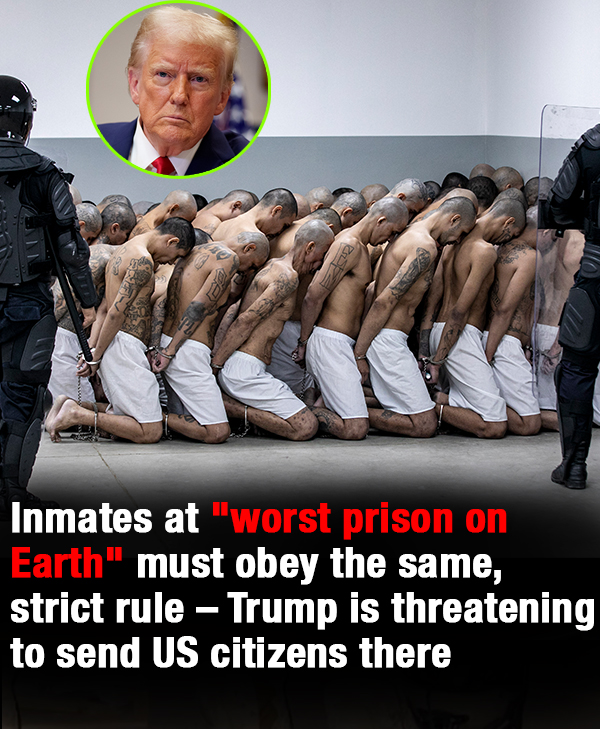
CECOT was designed with a single purpose: absolute control. Built as part of El Salvador’s aggressive campaign against organized crime, the facility reflects a philosophy that prioritizes containment above all else. It is not simply a prison in the traditional sense. It is an environment engineered to eliminate individuality, suppress identity, and enforce total compliance. Every aspect of life inside its walls follows strict, uniform rules. Heads are shaved. Clothing is standardized. Personal names are replaced with numbers. Surveillance is constant, leaving no moment unobserved.
Supporters of this model argue that such measures are necessary in the face of extreme violence. El Salvador, once plagued by some of the highest homicide rates in the world, has seen a dramatic drop in crime following its sweeping anti-gang policies. For many, CECOT symbolizes a turning point a decisive response to years of instability and fear. The results, they say, speak for themselves: safer streets, restored order, and a government willing to act decisively.
But critics see something very different.
To them, CECOT represents a dangerous shift away from the principles that underpin democratic justice. The concern is not only about the conditions inside the prison, but about the process or lack of it that leads people there. Reports have highlighted cases where individuals are detained without formal charges, trials, or clear evidence presented in court. In such a system, the line between punishment and disappearance begins to blur.
It is within this context that recent political developments have intensified the debate. The suggestion that individuals from the United States could be sent to facilities like CECOT under certain circumstances has introduced a new layer of complexity. The idea is tied to the use of an obscure wartime legal framework, raising questions about how far governments can extend their authority in the name of security.
For supporters of this approach, the argument is rooted in deterrence and efficiency. They believe that harsher consequences for criminal activity especially for those deemed dangerous could strengthen public safety. The logic is straightforward: if the threat of severe punishment exists, fewer people will be willing to take the risk.
However, opponents argue that such policies risk undermining fundamental rights. The concept of due process—the idea that every individual is entitled to a fair trial and legal representation is a cornerstone of democratic systems. Removing or bypassing that process, they warn, sets a precedent that could be difficult to reverse.
Inside CECOT, the reality of this debate takes on a human dimension. The facility operates on a strict regime designed to maintain order through uniformity. Inmates live in large, controlled spaces with minimal personal autonomy. Interaction is limited, routines are rigid, and the environment is intentionally austere. The goal is not rehabilitation in the traditional sense, but containment and deterrence.
This approach raises broader philosophical questions about the purpose of incarceration. Is the role of a prison to punish, to reform, or simply to isolate? Different societies have answered this question in different ways, but CECOT represents one of the most extreme interpretations currently in practice.
The international response has been mixed. Some governments and observers have expressed cautious interest in the results achieved by El Salvador’s policies, particularly in terms of crime reduction. Others have voiced strong concerns about human rights and the long-term implications of such measures. Legal experts continue to debate whether similar approaches could or should be applied elsewhere.
For ordinary people watching from afar, the issue can feel both distant and immediate at the same time. On one hand, it involves complex legal frameworks and international policy decisions. On the other, it touches on fundamental questions about fairness, accountability, and the balance between security and freedom.
The possibility of exporting individuals to a facility like CECOT introduces a new dimension to these concerns. It challenges assumptions about jurisdiction, responsibility, and the reach of national laws. If one country can send individuals to another for detention under extraordinary circumstances, what safeguards exist to prevent misuse?
At its core, the debate is not just about one prison or one policy. It is about the direction in which modern societies are heading when faced with fear and uncertainty. History has shown that moments of crisis often lead to expanded powers for governments. The question is whether those powers remain temporary or become permanent features of the system.
CECOT stands as a powerful symbol within this conversation. For some, it represents strength and decisive action. For others, it serves as a warning about the potential costs of prioritizing control over due process. Both perspectives are shaped by deeply held beliefs about what justice should look like.
As discussions continue, the focus remains on what kind of future these choices will create. Policies designed to address immediate threats can have lasting consequences, shaping not only how societies respond to crime, but how they define rights and responsibilities.
In the end, the story of CECOT is not confined to its walls. It extends into broader debates about governance, accountability, and the values that guide decision-making in times of pressure. Whether viewed as a necessary measure or a troubling development, it forces a difficult but unavoidable question: how far should any system go in the pursuit of safety, and what must never be left behind in the process