
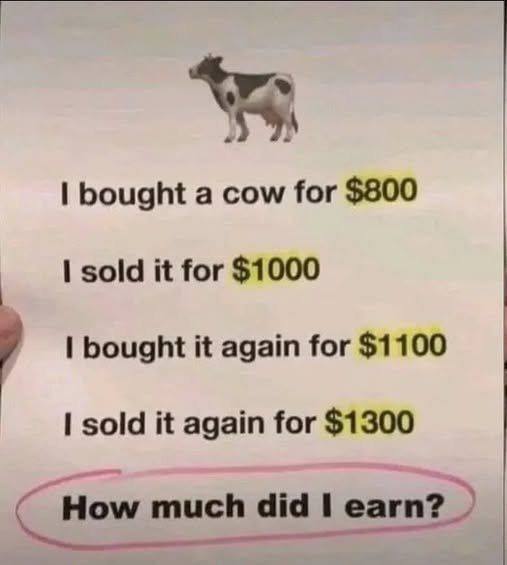
At first glance, it looks like the easiest problem in the world. There’s no complicated formula, no hidden trick involving percentages, no obscure mathematical rule you forgot from school.
Just a cow, four clean numbers, and a straightforward sequence of events. You buy, you sell, you buy again, you sell again. That’s it. And yet, somehow, this simple setup has managed to confuse thousands of people, sparking debates, wrong answers, and a surprising amount of frustration.
The numbers are almost too neat: 800, 1,000, 1,100, 1,300. Nothing intimidating about them. No decimals, no fractions, no large sums that might overwhelm your thinking. It feels like something you could solve in seconds. That’s exactly why so many people fall into the trap. The simplicity invites overconfidence, and overconfidence leads to shortcuts. Before long, what should be a calm, step-by-step calculation turns into a rushed mental shortcut that produces the wrong result.
The scenario unfolds like a small story. You start by buying a cow for 800. Later, you sell it for 1,000. Then, without much pause, you buy the cow again, this time for 1,100. Finally, you sell it once more for 1,300. The question seems harmless: how much profit did you make?
That’s where the confusion begins. Many people instinctively try to compress everything into one quick calculation. They glance at the numbers and attempt to combine them all at once, as if there’s a single shortcut that will instantly reveal the answer. Others assume there’s some kind of cancellation happening, that the second transaction somehow offsets the first. This leads to answers like zero profit or maybe a modest gain of 200. People feel confident in these guesses because the problem looks simple enough to solve without slowing down.
But that instinct is exactly what the puzzle exploits. It’s not testing advanced math skills. It’s testing patience and clarity of thought. The real challenge isn’t the numbers it’s resisting the urge to rush.
When you slow everything down, the fog begins to lift. Instead of trying to juggle all four numbers at once, you break the story into two separate parts. Each transaction becomes its own mini scenario, clear and self-contained.
In the first part, you buy the cow for 800 and sell it for 1,000. That’s a straightforward gain of 200. No tricks, no complications. You spent 800, you received 1,000, and you walked away with 200 more than you started with. That alone is simple enough.
Then comes the second part. You buy the cow again, this time for 1,100, and later sell it for 1,300. Once again, the math is clean. You spent 1,100 and received 1,300, giving you another profit of 200.
Now, instead of forcing everything into one messy equation, you simply add the results of these two separate transactions. The first gain of 200 plus the second gain of 200 gives you a total profit of 400. That’s it. No hidden twist, no complicated logic. Just two clear steps leading to a clear answer.
If you prefer to look at the entire sequence from a wider perspective, the result remains the same. Add up everything you spent: 800 plus 1,100 equals 1,900. Then add up everything you earned: 1,000 plus 1,300 equals 2,300. The difference between what you earned and what you spent is 400. Two different approaches, same conclusion.
So why do so many people get it wrong?
The answer lies in how the human brain processes information under pressure, even mild pressure. When faced with a problem that looks easy, we tend to skip steps. We assume we can “see” the answer without carefully working through it. This shortcut often works in everyday situations, but puzzles like this are designed to punish that habit.
Another common mistake is trying to treat the entire sequence as a single transaction. People attempt to merge the two buying and selling events into one combined operation, which creates confusion. The numbers start to blur together, and the clarity of each individual step gets lost. Once that happens, it becomes easy to arrive at an incorrect conclusion while still feeling confident about it.
There’s also a subtle psychological element at play. The repetition of buying and selling the same cow makes the situation feel circular, as if things are canceling each other out. That illusion leads some to believe that the gains and losses somehow balance, even when they clearly do not.
What makes this puzzle so effective is not its difficulty, but its ability to expose how easily our thinking can become tangled when we move too quickly. It’s a reminder that even the simplest problems deserve a moment of attention. Rushing doesn’t just increase the chance of error it almost guarantees it in situations like this.
Once you see the solution clearly, it feels almost laughable that there was ever any confusion. The numbers are straightforward, the steps are logical, and the result is undeniable. But that clarity only comes after you slow down and treat each part of the problem with care.
In a way, the puzzle is less about math and more about mindset. It highlights the value of breaking problems into smaller pieces, of resisting the urge to oversimplify too quickly, and of trusting a methodical approach over a rushed guess. These are lessons that extend far beyond a simple cow puzzle.
The next time you encounter something that looks deceptively easy, it might be worth pausing for a moment. Take a breath, walk through each step, and resist the temptation to jump ahead. Because as this puzzle proves, the real trick isn’t hidden in the numbers it’s hidden in how we choose to think about them.
And once you learn to slow down, the confusion disappears just as quickly as it appeared, leaving behind a solution that was simple all along.