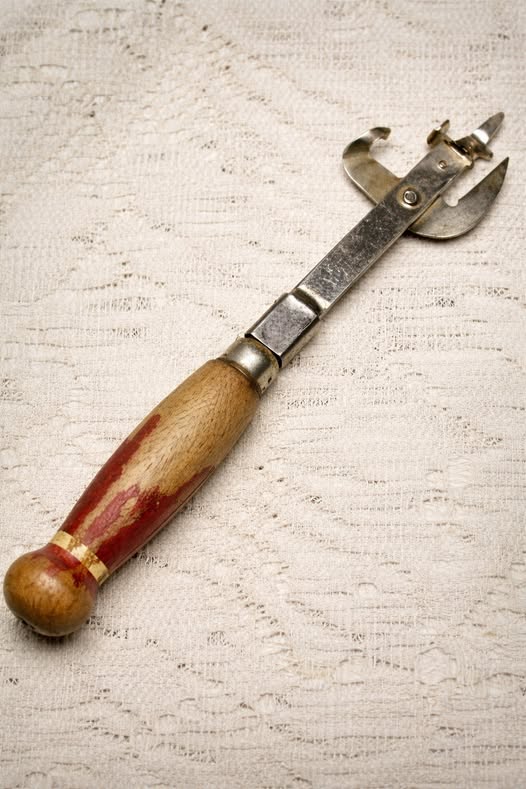
At first, it didn’t look threatening. It sat quietly in the back of a drawer, small and unassuming, its worn metal dulled by time.
You could easily mistake it for just another outdated kitchen gadget, something kept out of habit rather than purpose. But the moment someone recognized it, the reaction was instant and visceral. Memories surfaced not as gentle nostalgia, but as something sharper something tied to slips, cuts, and the unmistakable sting of skin meeting steel.
This was no ordinary utensil. It was an old puncture-style can opener, a tool from a time when opening a simple tin wasn’t effortless, but an act that required force, precision, and a bit of courage. Before the smooth, rotating wheels of modern designs, before safety edges and ergonomic handles, this was how people accessed their food. You didn’t glide along the lid. You stabbed it.
The process was as direct as it was unforgiving. You positioned the pointed tip against the lid, applied pressure, and drove it through with a controlled thrust. Then you pried, lifted, repositioned, and repeated the motion again and again, circling the rim until the lid finally gave way. It was mechanical, repetitive, and deeply physical. There was no buffer between your hand and the task. No safety net if your grip slipped or your angle faltered.
And often, it did.
For many who remember using it, the experience is inseparable from the risk. Fingers too close to the edge, hands slick from washing or cooking, a moment of distraction and suddenly the tool would bite back. The lid itself, jagged and uneven after being forced open, became its own hazard. Cuts were common. Small, quick injuries that stung sharply, sometimes bled more than expected, and were quickly rinsed off before returning to the task at hand. It wasn’t dramatic. It was normal.
That’s what makes the rediscovery of this tool so striking. It doesn’t just remind people of how things were done it reveals how much was accepted without question. The kitchen, often imagined as a place of comfort and routine, was also filled with quiet dangers. Not extreme or unusual ones, but small, constant risks embedded into everyday tasks.
Drawers held more than utensils; they held potential for harm. Knives without protective sheaths slid loosely against each other. Graters and peelers were as sharp as they were necessary. A mandoline slicer, often used without guards, could slice vegetables with perfect precision and fingers just as easily. Open flames flickered beneath pots, and hot surfaces were navigated with bare hands and instinct rather than caution labels or protective gear.
And yet, none of this was seen as unusual. It was simply part of life. Tools weren’t designed to protect you; they were designed to work. The responsibility for safety rested entirely with the person using them. You learned through experience, through repetition, and sometimes through pain. A slip taught you to be more careful next time. A cut reminded you where not to place your hand.
There was a kind of toughness in that, a resilience that came from engaging directly with the physical world. But there was also a cost one that’s easy to overlook now that many of those risks have been engineered out of our daily routines.
Modern kitchens are built differently. Today’s can openers are designed to glide smoothly along the lid, cutting from the side and leaving behind a dull edge that won’t slice your fingers. Handles are shaped for comfort and grip. Safety features are built in, not added as an afterthought. The expectation has shifted. Tools are no longer something you adapt to; they adapt to you.
So when someone stumbles across that old puncture-style opener, it feels like more than just a forgotten object. It feels like a message from another time. A reminder of how much effort once went into even the simplest tasks, and how much risk was quietly accepted as part of the process.
What’s fascinating is how quickly recognition spreads. One person identifies it, shares the memory, and suddenly others chime in. Stories emerge of grandparents who used it daily without complaint, of parents who kept it long after newer models were available, of childhood moments spent watching or trying to help, only to learn the hard way how unforgiving it could be.
There’s a strange mix of pride and disbelief in those recollections. Pride in having used it, in having navigated those small dangers and come out the other side. And disbelief that something so sharp, so precarious, was once considered standard.
But that’s the nature of progress. What was once normal becomes surprising. What was once necessary becomes optional, then obsolete. And objects like this become artifacts not just of technology, but of mindset.
The old can opener tells a story not just about how people opened cans, but about how they approached daily life. With patience. With attention. With an understanding that not everything was designed to be easy or safe. It reflects a time when tools demanded respect, and when the line between usefulness and danger was often thin.
Holding it now, it’s hard not to feel a shift in perspective. It’s no longer just a piece of metal. It’s a symbol of effort, of adaptation, of a world where even the simplest actions required a bit more from you. It invites a kind of quiet appreciation for the people who used it, for the hands that learned its edges, and for the changes that have made such tools largely unnecessary today.
And maybe that’s why it leaves such a strong impression. Not because it was dangerous, but because it reveals how much danger once blended seamlessly into the ordinary. How many small risks were accepted without a second thought. How different daily life can be, even when the task opening a can remains exactly the same.
In the end, that forgotten tool does more than draw blood in memory. It draws a line between then and now, reminding us that convenience didn’t just arrive it was built, often in response to the very risks we once lived with every day.