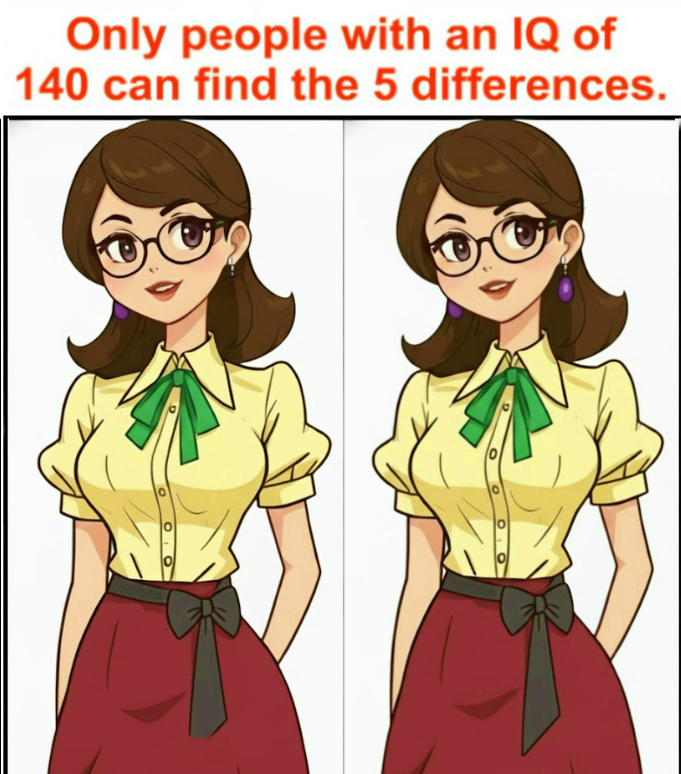
In a world where attention is constantly pulled in a hundred different directions, the simple act of focusing on a puzzle has become something rare and surprisingly powerful.
What may seem like a lighthearted challenge at first glance often turns into a deeper test of patience, perception, and mental endurance. A spot-the-difference puzzle, especially one that dares you to find five subtle changes, is not just a casual pastime. It is a quiet battlefield where your brain is pushed to notice what it normally overlooks.
These puzzles tap into something fundamental about how we see the world. Our brains are wired to recognize patterns quickly, to fill in gaps, and to assume consistency. That’s efficient for everyday life, but it also means we can miss details hiding right in front of us. When two nearly identical images are placed side by side, your mind initially treats them as the same. Breaking that assumption requires effort, discipline, and a willingness to slow down qualities that define strong cognitive performance.
People often joke that only those with exceptionally high intelligence can solve these puzzles quickly, but the truth is more nuanced. It’s not just about raw IQ. It’s about attention to detail, persistence, and how willing you are to challenge your own assumptions. Some people scan quickly and miss everything. Others take their time, carefully comparing each section, and begin to notice inconsistencies that seemed invisible moments earlier.
The beauty of these puzzles lies in how they engage multiple parts of the brain at once. Visual processing is at the forefront, of course, as your eyes move back and forth between images, searching for mismatches. But beneath that, your memory is working to retain small details, your reasoning is analyzing patterns, and your focus is being tested with every passing second. It’s a full mental workout disguised as entertainment.
One of the most powerful aspects of solving puzzles like this is how they sharpen problem-solving skills. Each difference you uncover is the result of a small victory an instance where your brain successfully challenged its own assumptions. Over time, this strengthens your ability to approach real-world problems with the same level of care and observation. Instead of rushing to conclusions, you begin to look closer, think deeper, and question what you see.
Focus is another skill that gets a serious boost. In an age of constant notifications and endless scrolling, maintaining attention on a single task can feel almost unnatural. A spot-the-difference puzzle demands that you stay present. If your mind wanders, you lose track of what you’ve already examined. But if you stay engaged, your concentration deepens, and the hidden details begin to reveal themselves one by one.
Memory also plays a subtle but important role. As you scan the images, your brain is constantly storing small pieces of information shapes, colors, positions so you can compare them effectively. This strengthens your short-term memory and improves your ability to retain visual information, a skill that carries over into everyday tasks.
But beyond the cognitive benefits, there’s something deeply calming about immersing yourself in a puzzle. The outside world fades, replaced by a quiet determination to solve what’s in front of you. This kind of focused attention has a meditative quality, reducing stress and allowing your mind to reset. It’s a rare moment where productivity and relaxation exist side by side.
There’s also a powerful emotional reward tied to solving these challenges. Each difference you find triggers a small burst of satisfaction, reinforcing your effort and encouraging you to keep going. When you finally spot all five differences, the sense of accomplishment is real. It’s not just about finishing a puzzle—it’s about proving to yourself that patience and persistence pay off.
Interestingly, puzzles like this also highlight how differently people perceive the same information. One person might immediately notice a missing object, while another focuses on color variations or background details. This diversity in perception reflects the uniqueness of each mind. There is no single “correct” way to approach the puzzle only the method that works for you.
Solving puzzles can even become a social experience. Whether you’re working with friends, family, or colleagues, comparing observations and strategies adds another layer of engagement. It turns a solitary activity into a shared challenge, where different perspectives come together to solve a common problem. Sometimes, the difference you’ve been staring at for minutes becomes obvious the moment someone else points it out.
As we age, maintaining mental sharpness becomes increasingly important, and puzzles offer a simple yet effective way to keep the brain active. Regularly engaging in activities that challenge perception, memory, and logic helps preserve cognitive function and keeps the mind agile. It’s like exercise for your brain small efforts that add up over time.
Patience is perhaps the most underrated skill these puzzles teach. In a culture that values speed and instant results, taking the time to carefully observe and analyze can feel counterintuitive. But that’s exactly what makes it valuable. Learning to slow down, to resist the urge to rush, and to trust the process is a lesson that extends far beyond the puzzle itself.
At their core, spot-the-difference challenges are about awareness. They remind us that the world is full of details waiting to be noticed, if only we take the time to look. What seems identical at first glance often holds subtle variations beneath the surface. The ability to recognize those differences is not just a measure of intelligence it’s a reflection of curiosity, attention, and a willingness to engage deeply with what’s in front of you.
So when you sit down to find those five hidden differences, you’re doing more than solving a puzzle. You’re training your brain, sharpening your perception, and rediscovering the power of focused attention. And in that process, you might just realize that the real challenge isn’t spotting what’s different it’s learning how to truly see.