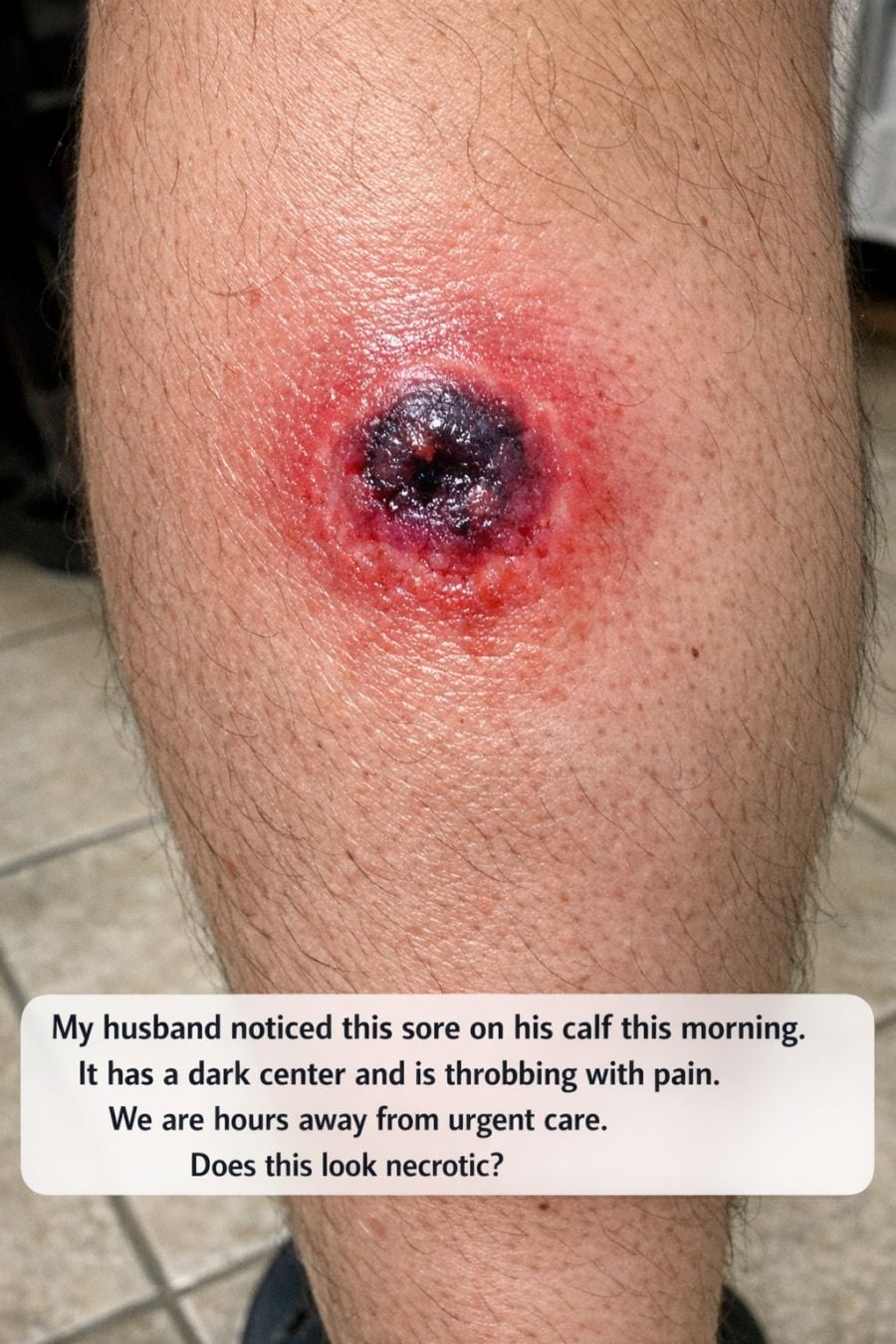
It started as something small, almost easy to dismiss in the soft light of early morning. A sore on his calf, nothing dramatic at first glance, just a spot that hadn’t been there the night before.
But within minutes, that quiet discovery began to feel heavier. The center was dark unmistakably darker than the surrounding skin and the pain wasn’t mild or dull. It throbbed, pulsing in a way that felt alive, insistent, impossible to ignore. What should have been an ordinary start to the day shifted into something tense, uncertain, and quietly frightening.
When something like this appears without warning, the mind races ahead of the facts. Is it just an irritated bite, something harmless that will fade with time? Or is it the beginning of something far more serious, something that changes hour by hour in ways you can’t control? The word “necrotic” has a way of taking over those thoughts, conjuring images of tissue damage, spreading discoloration, and wounds that deepen before your eyes. It’s the kind of possibility that turns observation into urgency, especially when help isn’t close.
Being hours away from urgent care adds another layer to that fear. Distance changes how you interpret every detail. The color matters more. The size matters more. The pain matters more. Every sensation becomes a clue, every visual change a potential signal that time is working against you. It’s not just about what the sore is now it’s about what it might become before you can get it properly examined.
Lesions that develop a dark center can have many causes, and not all of them are as severe as they first appear. Still, certain patterns raise concern. When the center of a sore begins to darken, it can indicate reduced blood flow or damage to the tissue beneath the surface. That’s why the appearance of a deep purple, brown, or blackened area often triggers alarm. Combined with throbbing pain, it suggests that the body is reacting strongly, whether to a bite, an infection, or another underlying issue.
One of the most commonly feared explanations in these moments is a bite from a spider like the brown recluse spider. Stories about these bites have circulated for years, often describing how they begin quietly before progressing into something far more destructive. In some cases, they can lead to necrosis, where the tissue breaks down and forms a crater-like wound. But it’s important to remember that not every dark-centered sore is caused by a spider, and not every spider bite becomes severe. The challenge is that, in the early stages, they can look similar to other conditions, making it difficult to know exactly what you’re dealing with in the moment.
That uncertainty is what makes careful observation so important. When you can’t immediately access medical care, your role shifts from passive concern to active monitoring. Watching the sore closely becomes essential. Has it grown larger over the past hour? Is the dark center expanding, or staying the same? Is the surrounding skin becoming redder, warmer, or more swollen? These details matter, not just for peace of mind, but for providing clear information once you do reach a healthcare professional.
Taking photos can be one of the most useful things you do in this situation. It creates a visual timeline, capturing changes that might otherwise be hard to recall accurately. What feels like a dramatic shift in your memory may look more gradual in reality or vice versa. Having that record can help doctors understand how quickly the sore has evolved, which can influence how they assess and treat it.
While waiting, there are simple, safe steps that can help manage the situation without risking further harm. Keeping the area clean and avoiding unnecessary pressure is a good starting point. Elevating the leg slightly can reduce swelling, and applying a cool compress may help ease the throbbing sensation. Over-the-counter pain relief can make him more comfortable, but it’s important not to mask symptoms so completely that changes go unnoticed.
What matters just as much is knowing what not to do. The urge to “fix” the problem immediately can lead to actions that make things worse. Cutting into the sore, applying heat, or using harsh chemicals or unverified remedies can increase damage or introduce infection. Even well-intentioned attempts can complicate what might otherwise remain manageable. In moments like this, restraint is just as important as action.
At the same time, certain warning signs should override any plan to wait. If the sore begins to expand rapidly, if the center becomes distinctly black or starts to sink inward, or if the pain intensifies sharply, those are signals that the situation may be escalating. Systemic symptoms are even more urgent. Fever, chills, nausea, dizziness, or difficulty breathing suggest that the body is reacting beyond the local wound, and that immediate medical attention is necessary regardless of distance.
What makes situations like this so difficult is the balance between caution and panic. Not every alarming symptom leads to a worst-case outcome, but ignoring early warning signs can allow a manageable condition to become something far more serious. The goal isn’t to assume the worst, but to stay alert, informed, and ready to act if needed.
In those hours of waiting, what you’re really doing is buying time with awareness. You’re watching, documenting, and protecting against unnecessary risk. It may feel passive, but it isn’t. It’s a deliberate, careful response to uncertainty, one that keeps options open until professional care is within reach.
By the time you arrive at urgent care or an emergency department, the information you’ve gathered the timing, the progression, the symptoms becomes part of the treatment itself. It helps doctors move faster, decide more confidently, and provide care that’s tailored to what has actually happened, not just what is visible in a single moment.
What began as a small, unsettling mark on the skin becomes something larger in those hours: a test of awareness, patience, and judgment under pressure. And while the outcome may still be uncertain, the steps you take in that window staying calm, observing carefully, and knowing when to act—can make all the difference in how the story ends.