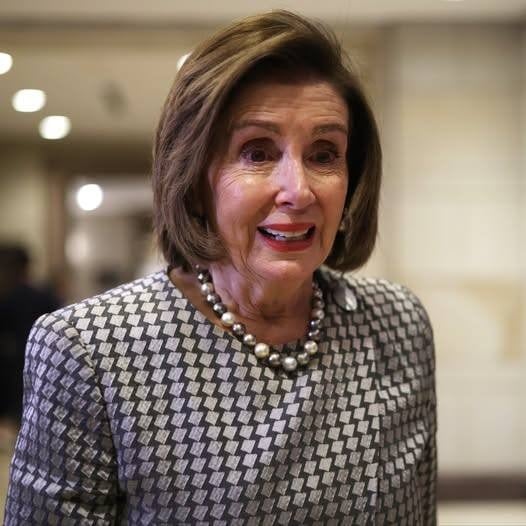
Far from the marble corridors and political theater of United States Capitol, Nancy Pelosi found herself in a setting defined not by legislation, but by memory.
In Luxembourg, where history is etched into quiet landscapes and solemn ceremonies, she had traveled to honor the legacy of those who fought during the Battle of the Bulge. It was meant to be a moment of reflection, a pause to acknowledge sacrifice and endurance. Instead, it became something far more personal and immediate a reminder that even the most seasoned figures are not immune to the limits of the human body.
The fall itself was sudden, unceremonious, and entirely out of step with the carefully orchestrated dignity of the event. One moment, she stood among dignitaries, part of a gathering designed to remember history’s harshest winter battles. The next, that sense of control fractured. What had been a symbolic tribute shifted into a real-time test of resilience, not on a battlefield, but within her own body. For someone whose career has been defined by precision, discipline, and command, the abruptness of the moment carried a quiet, undeniable weight.
Yet those close to her describe a response that felt unmistakably familiar. There was no visible panic, no surrender to the shock of the moment. Instead, even as medical staff moved in and concern spread through the delegation, Pelosi reportedly remained focused, asking questions, staying engaged, continuing to think beyond herself. It is a reaction that mirrors decades of public life, where crisis is met not with retreat, but with calculation and resolve. Even in a hospital setting, far from committee rooms and press briefings, that instinct did not disappear.
The irony of the setting was not lost on those present. The commemoration of the Battle of the Bulge is, at its core, about endurance under impossible conditions soldiers pushed beyond their limits, forced to continue despite exhaustion, injury, and uncertainty. In an unexpected way, Pelosi’s fall reframed that message, bringing it out of history and into the present. The ceremony continued, but now carried an added layer of meaning, one shaped by the very human vulnerability unfolding alongside it.
News of her hospitalization traveled quickly, crossing political lines and national borders with unusual unity. Messages of support arrived from figures who, under normal circumstances, would be defined by opposition rather than agreement. Republicans and Democrats, often locked in fierce debate, found themselves speaking with one voice. European leaders and representatives from NATO added their own acknowledgments, recognizing not just her role in American politics, but her broader influence on the international stage.
It is a rare moment when the noise of politics quiets, even briefly, and what remains is something more fundamental. Pelosi’s career has spanned decades of change, conflict, and transformation. She has been at the center of some of the most consequential decisions in modern American history, navigating crises that tested institutions and reshaped public life. For supporters, she represents perseverance and strategic brilliance. For critics, she embodies a different set of political tensions. Yet in this moment, those distinctions softened, replaced by a shared recognition of endurance.
Hospitalization, especially in a foreign country, carries its own kind of isolation. The familiar rhythms of home are replaced by unfamiliar surroundings, different systems, and the quiet awareness of distance. And yet, even there, the structure of her life seemed to follow her. Reports suggest that her attention remained fixed not just on recovery, but on ongoing responsibilities staff updates, schedules, the steady flow of information that defines high-level public service. It is a pattern that has defined her career: the inability, or perhaps the refusal, to fully step away.
Still, the moment introduces something that no amount of experience can entirely control: the need to pause. Not as a strategic decision, not as a calculated move, but as a necessity imposed by the body itself. For someone whose identity has long been intertwined with action, momentum, and presence, that pause carries its own quiet significance. It is not an ending, but it is a disruption an interruption in a narrative that has rarely slowed.
The ceremonies she traveled to attend continued, as such events always do. Wreaths were laid, speeches delivered, history remembered. The themes of sacrifice, duty, and resilience echoed through each moment, unchanged in their meaning yet subtly altered in their context. For those aware of what had happened, the symbolism felt sharper, more immediate. The distance between past and present seemed to narrow, connected by the shared reality of human limitation.
Pelosi’s story has never been one of stillness. It has been defined by movement through political ranks, through moments of crisis, through victories and setbacks that shaped not only her own path but the broader direction of American governance. This incident does not erase that trajectory, nor does it define its conclusion. Instead, it introduces a moment of reflection, a brief but powerful reminder that even the most enduring figures are subject to forces beyond their control.
As doctors continue to monitor her condition and guide her recovery, attention remains fixed not only on her health, but on what comes next. The expectation, from those who know her and those who have watched her career unfold, is not of retreat, but of return. That expectation itself speaks volumes, reflecting a lifetime of consistency, determination, and an almost relentless commitment to showing up.
In the end, this moment does not rewrite her legacy. It adds to it. It reveals another dimension of a life lived in constant motion, highlighting not just strength, but vulnerability. Not just leadership, but humanity. And perhaps most importantly, it underscores a truth that transcends politics entirely: that resilience is not the absence of falling, but the decision to rise again, even when the ground feels uncertain.
For now, the world waits not for an ending, but for the next chapter in a story that has never been defined by a single moment, no matter how unexpected.