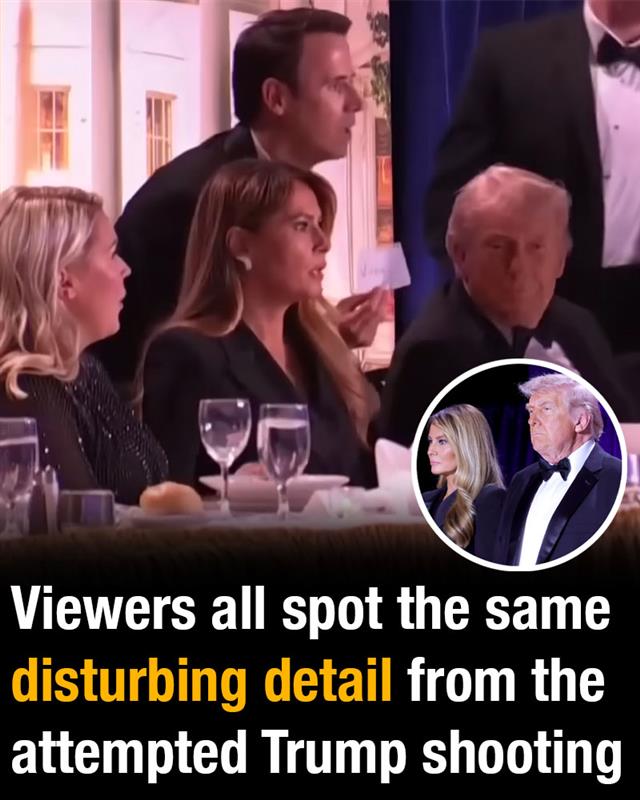
For many watching the chaos unfold at the White House Correspondents’ Dinner, the initial shock came from the violence itself.
A formal evening built on humor, tradition, and carefully choreographed appearances dissolved in seconds into confusion and fear. Reports of gunfire shattered the rhythm of speeches and laughter, sending guests scrambling for cover as security forces moved with urgency that left no room for doubt. In a setting defined by prestige and proximity to power, the illusion of safety collapsed almost instantly.
At the center of the response was Donald Trump, who was swiftly escorted away by agents trained for precisely this kind of moment. Around him, officials, journalists, and invited guests experienced the same jarring shift from ceremony to survival. What had been a night designed to celebrate the relationship between the press and the presidency became something far more sobering a reminder that even the most controlled environments can be pierced by sudden violence.
Investigators would later describe the suspect as heavily armed, allegedly prepared for a targeted attack that could have escalated into something far worse. Early findings pointed toward intent rather than impulse, with authorities examining writings and digital traces that suggested a deliberate focus on high-profile political figures. The rapid response by security personnel prevented a deeper tragedy, but the sense of vulnerability lingered long after the immediate threat was contained.
Yet as footage circulated and details emerged, one particular element began to dominate public reaction. It was not just the danger, but the setting itself. The incident took place at the Washington Hilton, a location already etched into American history for a moment that nearly changed the course of a presidency decades earlier. For many viewers, that connection was impossible to ignore.
In 1981, outside the same hotel, Ronald Reagan was shot during an assassination attempt that stunned the nation. A single bullet, deflected in a way no one could have predicted, struck the president and brought the fragility of even the most powerful office into sharp focus. The images from that day became part of the country’s collective memory agents moving quickly, a leader wounded, a system tested under pressure.
To witness another president being rushed away from danger at the same location more than four decades later felt, to many, like something beyond coincidence. Social media quickly filled with comparisons, side-by-side timelines, and expressions of disbelief. The parallels were not identical, but they were close enough to trigger a sense of déjà vu that was difficult to shake. For some, it was described as a chilling echo; for others, as a reminder that certain places carry the weight of what has happened within them.
The reaction revealed something deeper than simple historical awareness. It spoke to a broader anxiety about repetition, about whether lessons learned in moments of crisis truly endure or simply fade until they are tested again. The Washington Hilton, in this context, became more than just a venue. It became a symbol a fixed point where past and present seemed to collide in a way that felt almost scripted, even as it unfolded in real time.
For those inside the ballroom, the experience was immediate and visceral. Accounts from attendees described the sound of gunfire cutting through conversation, the instinctive movement toward shelter, and the confusion that followed as information struggled to keep pace with events. Some spoke of the surreal quality of it all, the difficulty of reconciling the formal setting with the sudden presence of danger. Others focused on the speed and precision of the security response, noting how quickly chaos was brought under control.
For those watching from afar, however, the perspective was different. Distance allowed for reflection, for pattern recognition, for the kind of narrative-building that often follows high-profile incidents. The connection to Reagan’s shooting became a focal point, not because it explained what had happened, but because it gave the moment a sense of continuity. It placed the event within a larger story about risk, leadership, and the recurring vulnerability of public figures.
That sense of continuity can be both grounding and unsettling. On one hand, it reinforces the idea that institutions endure, that systems designed to protect leaders have evolved and improved over time. The survival of both Reagan and Trump in moments of danger can be seen as evidence of that progress. On the other hand, it raises questions about why such moments continue to occur at all, why the threat remains persistent despite decades of experience and adaptation.
The suspect’s alleged motivations, still under investigation, add another layer of complexity. While early reports suggest a targeted intent, the broader context in which such actions take place cannot be ignored. Political polarization, public rhetoric, and the amplification of extreme views through digital platforms all contribute to an environment where individuals may feel driven toward drastic actions. Understanding that environment is essential, even as authorities focus on the specifics of this case.
In the aftermath, official statements emphasized resilience and continuity. The dinner, it was said, would return in the future. The traditions disrupted by the incident would not be abandoned. There was a clear effort to project stability, to reassure both participants and the public that the event and what it represents—remains intact despite the interruption.
But reassurance does not erase memory. For many, the image that will endure is not the speeches that were never delivered or the jokes that went unheard. It is the sight of a president being hurried out of a room, the sudden realization that safety can vanish without warning, and the uncanny familiarity of a location where history has already tested the same boundaries.
What lingers most is not just fear, but recognition. Recognition that the past is never entirely past, that certain places and moments carry forward in ways that can resurface when least expected. The Washington Hilton stands as a reminder of that truth, a place where two different eras briefly touched through the shared language of crisis.
In the end, the incident leaves behind more than headlines or investigative reports. It leaves a question that extends beyond this single night: whether the repetition people sensed was coincidence, inevitability, or something more symbolic about the cycles that shape public life. Whatever the answer, one thing is clear—the sense of déjà vu felt by millions was not imagined. It was rooted in history, sharpened by circumstance, and impossible to ignore.