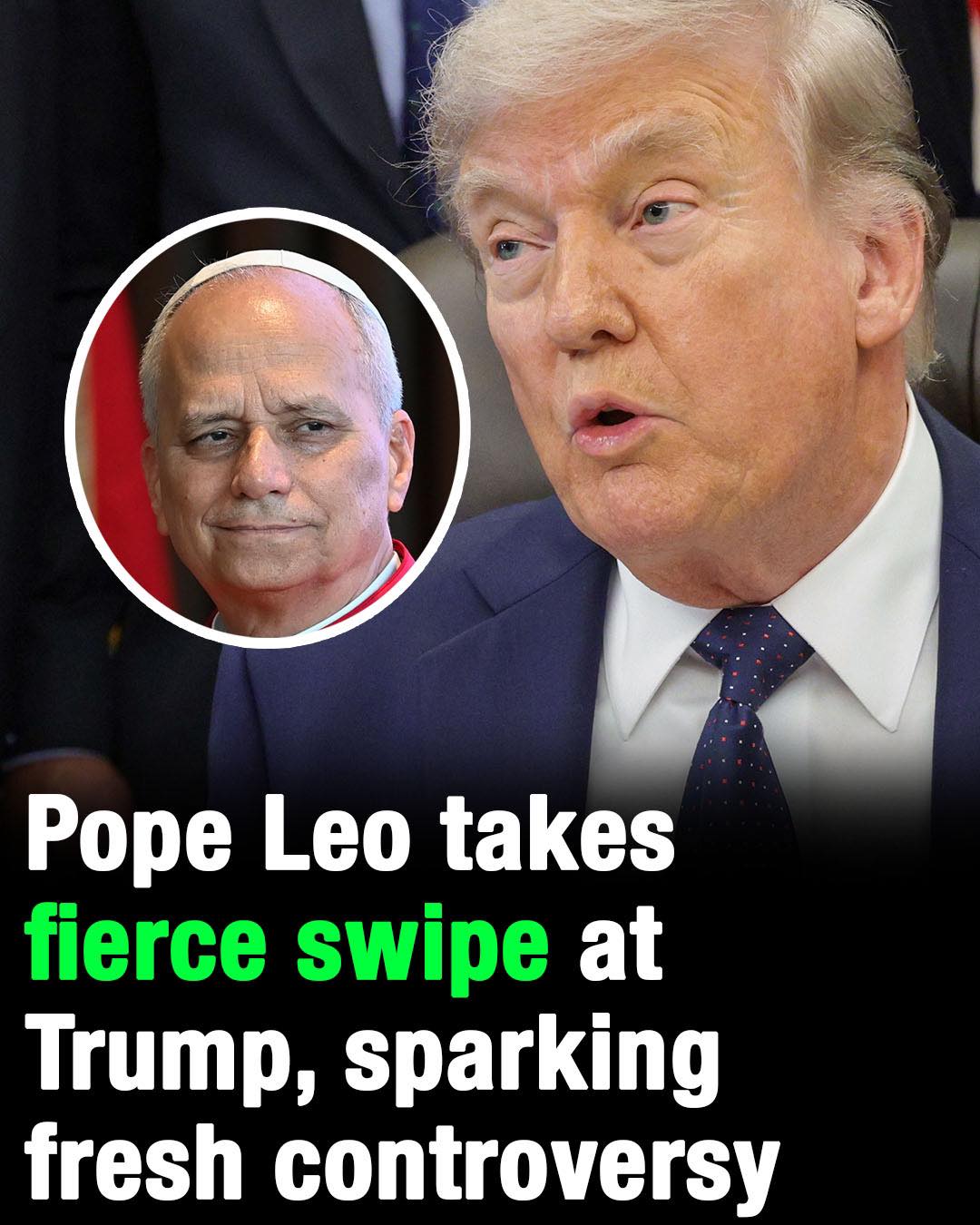
What began as a pointed remark has quickly expanded into something far larger: a confrontation that feels less like a political disagreement and more like a collision between two fundamentally different visions of the world.
On one side stands Donald Trump, speaking in the language of power, deterrence, and strategic necessity. On the other is Pope Leo XIV, appealing to conscience, human dignity, and the moral cost of decisions made far from the people who must live with their consequences.
The tension between them has been building quietly, but it sharpened dramatically following recent remarks about global security, particularly regarding Iran and the looming threat of nuclear escalation. Trump has framed the issue in stark, urgent terms, warning that failure to act decisively could invite catastrophe. His argument rests on a familiar premise: that strength, even when it appears harsh, is ultimately what preserves peace. In his view, hesitation is dangerous, and the willingness to project power is not aggression but responsibility.
But the Pope’s response did not engage on those terms. Speaking during a return flight from a pastoral visit, he shifted the focus entirely, away from geopolitical chessboards and toward the human cost embedded in every such calculation. His words carried a different kind of weight, not measured in military capability or strategic leverage, but in moral clarity. He rejected outright any framework that treats nuclear weapons as acceptable tools of stability, calling them instead a permanent threat hanging over humanity.
What makes this exchange so striking is not simply the disagreement itself, but the way each man defines reality. For Trump, the world is shaped by forces that must be managed through strength and vigilance. Threats are real, adversaries are calculating, and outcomes depend on who is willing to act first and most decisively. It is a worldview grounded in competition, where hesitation can be exploited and power is the only reliable guarantee.
For Pope Leo XIV, that same world looks profoundly different. He does not deny the existence of danger, but he refuses to accept that violence, even when justified as defensive, is inevitable or necessary. In his view, the language of “deterrence” often masks a deeper failure: the inability or unwillingness to imagine alternatives. His criticism extends beyond nuclear weapons themselves to the broader systems that sustain conflict economic sanctions that suffocate populations, military strikes that devastate communities, and political decisions that reduce human lives to strategic variables.
The Pope’s remarks also carry an implicit challenge to the way global leaders communicate with their own citizens. When policies are framed solely in terms of national interest or security, the suffering they produce can become abstract, distant, almost invisible. By contrast, his rhetoric insists on bringing that suffering back into focus. Behind every policy, he suggests, are real people families navigating fear, cities struggling to recover, children growing up in the shadow of decisions they had no part in making.
This is where the clash becomes especially intense. Trump’s supporters argue that such moral appeals, however compelling, fail to grapple with the realities of a dangerous world. They see his approach as grounded, pragmatic, and necessary in an era defined by unpredictable threats. From this perspective, strength is not a choice but an obligation, and leaders who hesitate risk far greater harm.
Critics, however, interpret the Pope’s intervention as a needed corrective. They argue that without moral boundaries, the logic of power can justify almost anything, gradually eroding the very values it claims to protect. In this reading, the Pope is not rejecting security but redefining it, insisting that true safety cannot be built on fear, coercion, or the normalization of destruction.
What gives this moment its broader significance is the way it resonates beyond the two figures at its center. It taps into a deeper global unease, a sense that the systems designed to maintain order are themselves contributing to instability. As tensions rise in various regions and the threat of escalation becomes more tangible, the question of how to balance power and principle feels increasingly urgent.
The Pope’s critique also reflects a long-standing tradition within the Catholic Church of challenging the moral legitimacy of certain forms of warfare, particularly those involving weapons of mass destruction. But in the current context, his words carry added weight, amplified by the immediacy of global tensions and the visibility of leaders like Trump who embody a contrasting philosophy.
At the same time, Trump’s response direct or implied reinforces his broader political identity. He has consistently positioned himself as a leader willing to say what others will not, to act where others hesitate, and to prioritize national strength above international approval. For his base, this confrontation with the Pope may even reinforce that image, casting him as someone unafraid to challenge even the most revered global figures.
Yet beneath the rhetoric and reactions lies a more uncomfortable truth: both perspectives speak to fears that are real. The fear of unchecked violence, of catastrophic conflict, of a world slipping toward chaos. And the fear, equally potent, of vulnerability, of being unprepared in the face of genuine threats. The divide is not simply about policy; it is about which fear should guide decision-making.
As this exchange continues to unfold, it is unlikely to produce immediate resolution. The gap between these two worldviews is not easily bridged, because it is rooted in fundamentally different assumptions about human nature, power, and responsibility. But the conversation itself matters, if only because it forces those watching to confront their own beliefs about what leadership should look like in a time of uncertainty.
In the end, this is not just a dispute between a political leader and a religious figure. It is a reflection of a world struggling to define its own direction, caught between the pull of force and the call of conscience. Whether one sees Trump’s stance as necessary realism or dangerous escalation, or the Pope’s words as moral clarity or impractical idealism, the tension between them reveals something deeper: a global conversation about what kind of future is being built, and at what cost.