In the hours after panic swept through the Washington Hilton during the White House Correspondents’ Dinner, attention did not settle solely on the terrifying breach of security or the swift actions that prevented a far worse outcome.
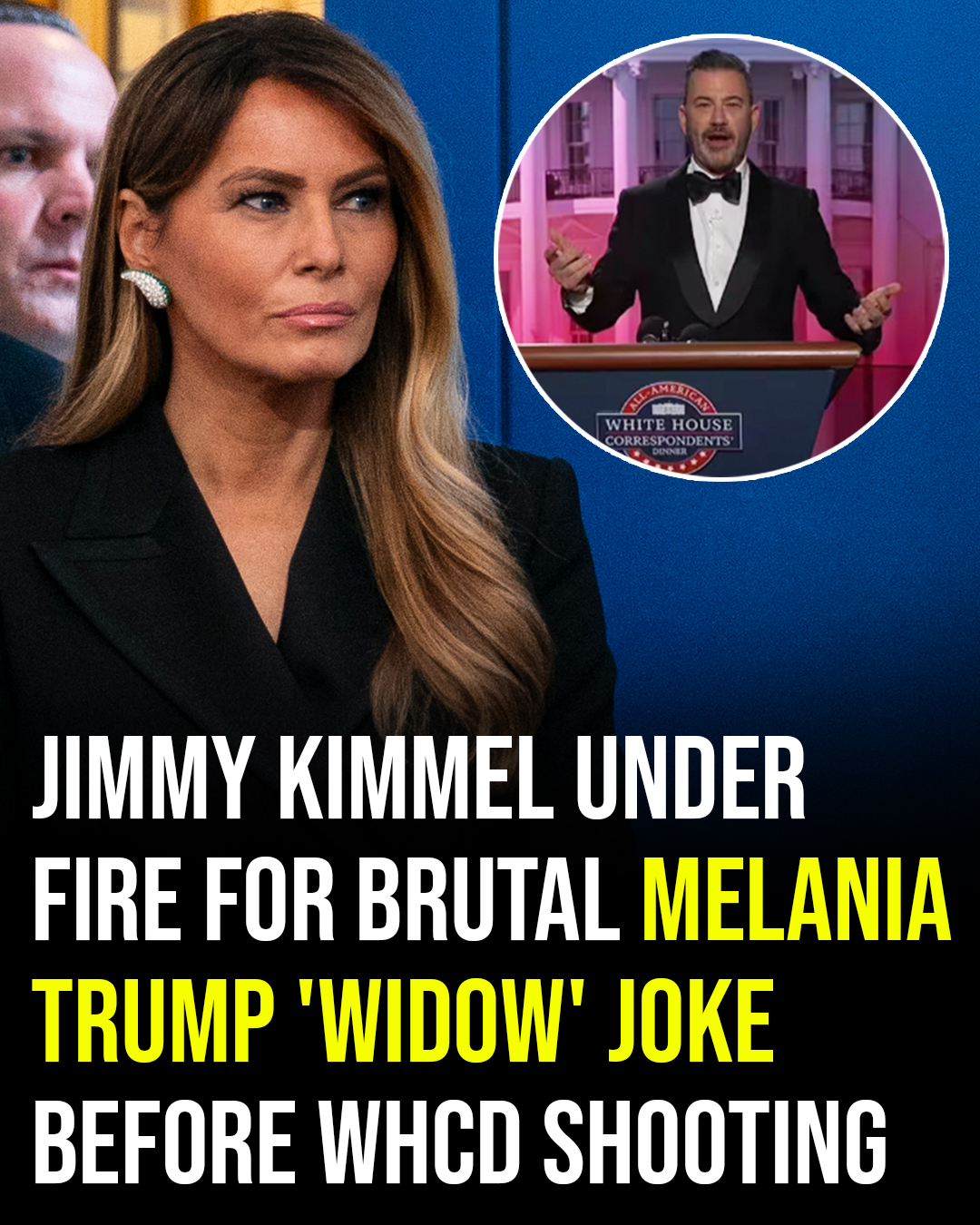
Instead, another element began to circulate with equal intensity, pulling public focus in an unexpected direction. A resurfaced joke by Jimmy Kimmel, delivered days earlier on his late-night show, suddenly carried a weight that few could have anticipated at the time it aired.
The remark, aimed at Melania Trump, had originally been framed as political satire, the kind of sharp-edged humor that has long defined late-night television. In its original context, it was one more jab in a crowded landscape of commentary, designed to provoke reaction, laughter, or discomfort depending on the audience. But after gunfire erupted near one of the most tightly controlled political events in the country, the tone of that joke shifted dramatically in the public imagination.
What had once been dismissed by some as biting humor was now being replayed under entirely different emotional conditions. The images from the dinner guests diving for cover, Secret Service agents rushing into action, and Donald Trump being escorted out of the ballroom created a stark and unsettling contrast. Against that backdrop, Kimmel’s words began to feel, for many critics, less like satire and more like something darker.
Commentators, particularly from conservative circles, responded swiftly and forcefully. They argued that the joke reflected a broader culture in which political figures are not just criticized but dehumanized, where lines between humor and hostility have blurred beyond recognition. For these critics, the timing of the resurfaced clip was not merely unfortunate it was revealing. They described it as an example of how certain forms of entertainment, in their view, have drifted into territory that normalizes extreme rhetoric for the sake of applause.
The backlash was intense. Social media platforms became battlegrounds of interpretation, with clips of the joke spreading rapidly alongside footage from the chaotic night at the Hilton. Words like “disturbing,” “crossing the line,” and even “dangerous” were used repeatedly, not only to describe the comment itself but to question the broader environment in which it was delivered. To many, the juxtaposition of humor and real-world violence created a discomfort that could not easily be dismissed.
Yet the reaction was far from unanimous. Others pushed back, defending Kimmel and the role of satire in a democratic society. They argued that late-night comedy has always thrived on exaggeration, provocation, and the willingness to challenge those in power. From this perspective, isolating a single joke and placing it under the microscope of a completely different event risked distorting its original meaning. Humor, they insisted, is often uncomfortable by design, and its purpose is not always to reassure or unify.
Supporters also pointed out that hindsight can transform perception in ways that are not always fair. A line that seemed exaggerated or absurd in one context can take on unintended implications when real-world events echo its tone. But that does not necessarily mean the intent behind it was malicious or predictive. Instead, they suggested, it reflects the unpredictable way in which reality can intersect with commentary.
Still, the emotional impact of the shooting overshadowed these nuances for many observers. The incident itself was a sobering reminder of how fragile even the most carefully managed environments can be. The White House Correspondents’ Dinner, traditionally a blend of humor and politics, had long been seen as a space where tensions could be momentarily eased through shared laughter. That illusion was shattered in seconds, replaced by fear, confusion, and the unmistakable awareness of vulnerability.
In that altered atmosphere, words carried differently. Jokes that once seemed exaggerated now felt uncomfortably close to reality. The resurfacing of Kimmel’s remark became part of a larger conversation about responsibility about where humor ends and something more serious begins. It raised questions that extend beyond one individual or one show, touching on the role of media, the limits of satire, and the ways in which public discourse shapes perception.
Donald Trump himself addressed the broader situation in the aftermath, emphasizing resilience and defiance. His response framed the incident not only as a security breach but as part of a larger pattern of hostility faced by public figures. While he did not focus solely on the joke, the environment in which it was being discussed added to the sense of tension surrounding the moment.
Meanwhile, the Correspondents’ Dinner, abruptly halted and overshadowed by the events of the night, is expected to return at a later date. Organizers have promised that it will come back stronger, an assertion meant to restore a sense of continuity and confidence. But the memory of what happened and the conversations that followed will likely linger long after the event itself is rescheduled.
At the heart of the debate is a question that has no simple answer. Comedy has always walked a fine line, especially when it intersects with politics. It thrives on pushing boundaries, yet those boundaries are constantly shifting, shaped by context, culture, and circumstance. What feels acceptable one moment can feel jarring the next, particularly when reality intrudes in unexpected ways.
The resurfacing of Kimmel’s joke is, in many ways, less about the joke itself and more about the environment into which it reemerged. It reflects a society grappling with how to process fear, anger, and uncertainty while still maintaining space for expression and critique. It highlights the tension between freedom of speech and the responsibility that comes with it, especially in an era where every word can be replayed, reframed, and reinterpreted within seconds.
As the dust settles, both in Washington and across the media landscape, the incident serves as a reminder of how interconnected these worlds have become. A line delivered on a late-night stage can echo far beyond its original audience, especially when real events give it new context. And in those moments, the question is no longer just whether something was meant as a joke, but how it is received, remembered, and understood in a world where the line between humor and reality can disappear without warning.