What unfolded inside the Washington Hilton that night was supposed to follow a familiar script polished speeches, sharp humor, and a carefully balanced dance between power and the press.
Instead, it became something else entirely, a moment that shattered expectation and replaced it with instinct. For most of the people in the room, the shift was immediate and overwhelming. But for one man, seated near the stage, the reaction or lack of it would become the image that defined the night.
The evening had begun like so many before it. The White House Correspondents’ Dinner carried its usual blend of ceremony and satire, a place where journalists, politicians, and public figures gathered under one roof to perform a kind of ritualized tension. Donald Trump sat among senior officials and guests, the room alive with conversation, anticipation, and the low hum of cameras capturing every moment.
There is a rhythm to events like this. It is predictable, almost rehearsed. People arrive expecting a certain tone light, pointed, but ultimately safe. That expectation is what makes the disruption so jarring when it comes.
The sound that broke through the room at first did not fully register. It was sharp, unfamiliar, but not immediately understood. Some turned their heads. Others paused mid-conversation. For a fraction of a second, the entire ballroom existed in a kind of suspended confusion, as if waiting for confirmation that what they had heard was real.
Then it came again.
This time, the reaction was different. Chairs scraped loudly against the floor. Conversations stopped. The abstract became concrete in an instant: something was wrong. Something was happening. And it was happening here.
What followed was a cascade of movement. Secret Service agents surged into action, their training taking over before thought could catch up. The President and First Lady were quickly surrounded and escorted out, their departure swift enough that many guests only realized they were gone after the fact. Around them, the room transformed. People ducked, ran, froze each reaction a reflection of instinct colliding with fear.
Napkins fell, glasses tipped, tables were abandoned mid-meal. The space that had moments earlier felt controlled and ceremonial now felt unpredictable, exposed. For many, it was the first time the invisible barrier between public performance and real danger had been stripped away so completely.
And in the middle of that chaos, there was one figure who did not seem to follow the same script.
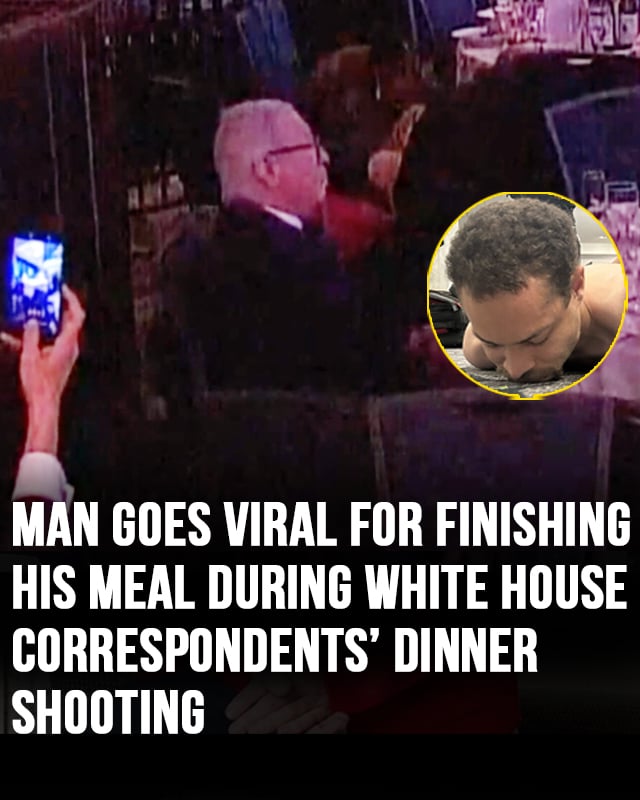
Seated near the stage, a man remained almost entirely still. While others scrambled for cover or rushed toward exits, he continued eating. His posture barely changed. His focus seemed fixed on the plate in front of him, as if the surrounding noise belonged to another world.
It was not just his stillness that drew attention it was the contrast. In a room defined by sudden movement and urgency, his calmness felt almost surreal. It stood out not because it was loud, but because it was so completely quiet.
Someone captured it on video.
In the hours that followed, that clip began to circulate. First in small circles, then wider, then everywhere. On platforms like X, it spread rapidly, gathering millions of views. The footage was short, almost deceptively simple: a room in disarray, people moving with urgency, and one man continuing his meal as if nothing had changed.
The reaction was immediate and intense.
People tried to explain what they were seeing. Some interpreted it as composure, even courage a refusal to give in to panic, a kind of control that others wished they had in moments of fear. Others saw something else entirely. They called it shock, a psychological freeze response where the mind struggles to process what is happening. A few went further, suggesting resignation or detachment, projecting deeper meanings onto a moment captured without context.
In reality, no one outside that moment could fully know what was going through his mind. Human responses to crisis are rarely uniform. Some run, some hide, some act, and some remain still not out of choice, but because the brain, overwhelmed, defaults to stillness.
Yet the internet does not wait for nuance.
The image became a canvas for interpretation. Commenters layered their own fears, beliefs, and experiences onto that solitary figure. The man himself became almost secondary to what he represented. He was no longer just a guest at a disrupted dinner; he was a symbol of calm, of denial, of something people could not quite define but felt compelled to explain.
Meanwhile, details about the incident itself continued to emerge. Authorities confirmed that a suspect had been apprehended, that weapons had been involved, and that a rapid response had prevented further harm. Investigations moved forward, focusing on evidence, intent, and the sequence of events that led to the moment.
But for many watching from a distance, the facts of the case were not what held their attention.
It was the image.
There is something deeply human about focusing on a single, unexpected detail in the middle of chaos. It provides a point of entry into an event that might otherwise feel too overwhelming to grasp. In this case, the man who did not move became that point a way for people to process what had happened by narrowing it down to something they could see, replay, and question.
As the days passed, the broader narrative of the night continued to take shape. The dinner would be rescheduled, officials said. The tradition would continue. The structure that had been disrupted would, eventually, be rebuilt.
But the memory of that moment would not fade so easily.
Long after the official reports are filed and the immediate shock has passed, the image remains. A room unraveling in seconds. A sudden collapse of certainty. And in the middle of it all, one person who did not follow the pattern.
It is a reminder that in moments of crisis, there is no single way to react. That fear does not always look the same. That stillness can be as revealing as motion.
And perhaps most of all, it is a reminder of how quickly everything can change. One sound, one moment, one break in expectation and an ordinary evening becomes something else entirely, remembered not just for what happened, but for how people responded when it did.