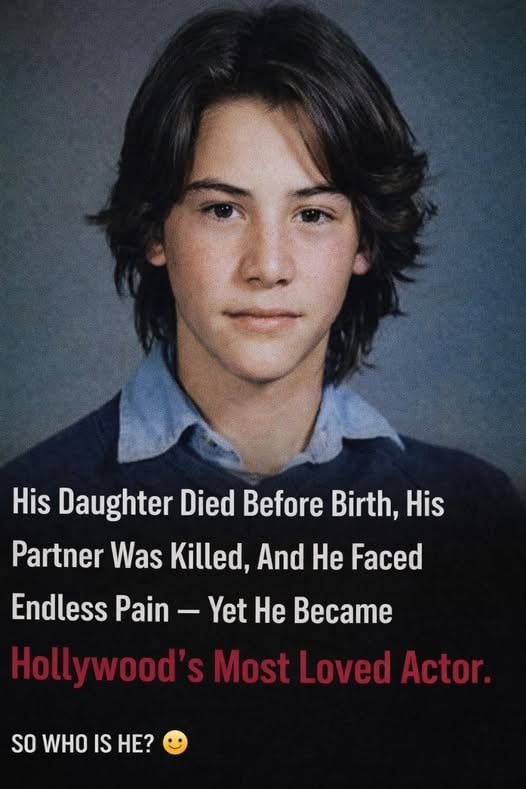
Long before the world knew his name, Keanu Reeves was already learning how to carry weight that most people never have to face so early in life.
His childhood was marked by constant movement, a restless existence shaped by instability rather than choice. Cities changed, schools changed, and with each transition came the quiet challenge of starting over again. Beneath it all lingered the absence of his father, a gap that left questions without answers and a sense of distance that would follow him into adulthood.
In the classroom, things were no easier. Words didn’t come easily to him. Dyslexia turned reading into a struggle and made traditional education feel less like an opportunity and more like a barrier. While others moved forward with ease, he found himself falling behind, misunderstood, and often underestimated. By the time he left school at seventeen, it may have looked like he was stepping away from his future. In reality, he was stepping toward the first thing that ever felt right.
Acting wasn’t just an interest; it was a place where the confusion of everyday life seemed to quiet down. It gave him structure, expression, and a sense of belonging he hadn’t found elsewhere. But finding that path didn’t mean it would be easy. He worked wherever he could odd jobs that paid little but kept him moving forward. Auditions came with rejection more often than success. Doors closed before they ever opened. Yet something in him refused to disappear. Slowly, almost quietly, he began carving out a space in an industry known for its harshness.
Fame, when it arrived, did not come with the peace many assume it brings. Instead, it unfolded alongside moments that would shape him far more deeply than any role ever could. One of the earliest and most devastating losses came with the death of his close friend River Phoenix. Their bond had been rooted in shared experience and mutual understanding, and his sudden passing left a wound that success could not touch. It was a reminder that even at the height of rising recognition, life could still take without warning.
Years later, another loss would strike even closer. The stillbirth of his daughter was not something the world saw in headlines at the time, but it was a moment that reshaped everything. It wasn’t just grief it was the collapse of a future that had already begun to feel real. The anticipation, the hope, the quiet plans all gone in an instant. And as if that loss were not enough, tragedy followed again.
His partner, Jennifer Syme, died in a car accident not long after. The weight of that sequence of events is difficult to put into words. Loss layered upon loss, each one cutting deeper than the last. For many, such experiences might harden something inside, turning grief into distance or anger. But that is not the path he chose.
Instead of closing himself off, he seemed to move in the opposite direction. There was no dramatic declaration, no attempt to turn pain into spectacle. It happened quietly, almost invisibly. Stories began to surface not from him, but from others. People who had crossed his path in ordinary moments, only to find themselves met with unexpected kindness.
He became known not for grand gestures, but for small, consistent ones. Anonymous donations to children’s hospitals and cancer research foundations. Sharing his earnings with crew members behind the scenes, recognizing the work that often goes unnoticed. Taking public transportation without fanfare, sitting among strangers without seeking attention. Listening truly listening to people who never expected a conversation, let alone one with someone of his stature.
There is something striking about the way he carries himself. It is not the absence of pain, but the presence of something else alongside it. His grief has not disappeared; it has simply changed form. It exists in the quiet spaces, in the pauses between words, in the way he moves through the world without demanding anything from it. And yet, rather than letting that weight define him in a negative way, he has shaped it into something softer.
Those who have worked with him often describe a sense of calm around him, a grounded presence that doesn’t shift with status or expectation. In an industry where ego can easily take center stage, he remains understated. There is no need to prove anything, no urgency to dominate a room. Instead, there is a kind of steadiness, as if he has already faced enough to understand what truly matters.
It would be easy to frame his story as one of endurance alone, but that would miss something essential. What makes it remarkable is not just what he has survived, but what he has chosen to become in response. Loss did not make him louder or harder. It made him more attentive, more present, more willing to extend kindness in ways that often go unnoticed by the wider world.
There is a quiet philosophy in the way he lives, one that doesn’t rely on words or explanations. It suggests that pain does not have to be passed on, that it can be held, reshaped, and even transformed into something that helps others rather than harms them. It is not an easy path, nor is it one that draws constant attention. But it is a powerful one.
For those who look closely, his life offers a different kind of narrative than the one often associated with fame. It is not about perfection or escape. It is about carrying what cannot be undone and still choosing how to move forward. Each act of kindness, no matter how small, becomes part of that choice.
In the end, what stands out is not just the tragedies he has endured, but the way he has refused to let them define his relationship with the world. The shadow of loss may follow him, but it does not consume him. Instead, it seems to guide him toward something quieter and far more enduring a life shaped not by what was taken, but by what he continues to give.