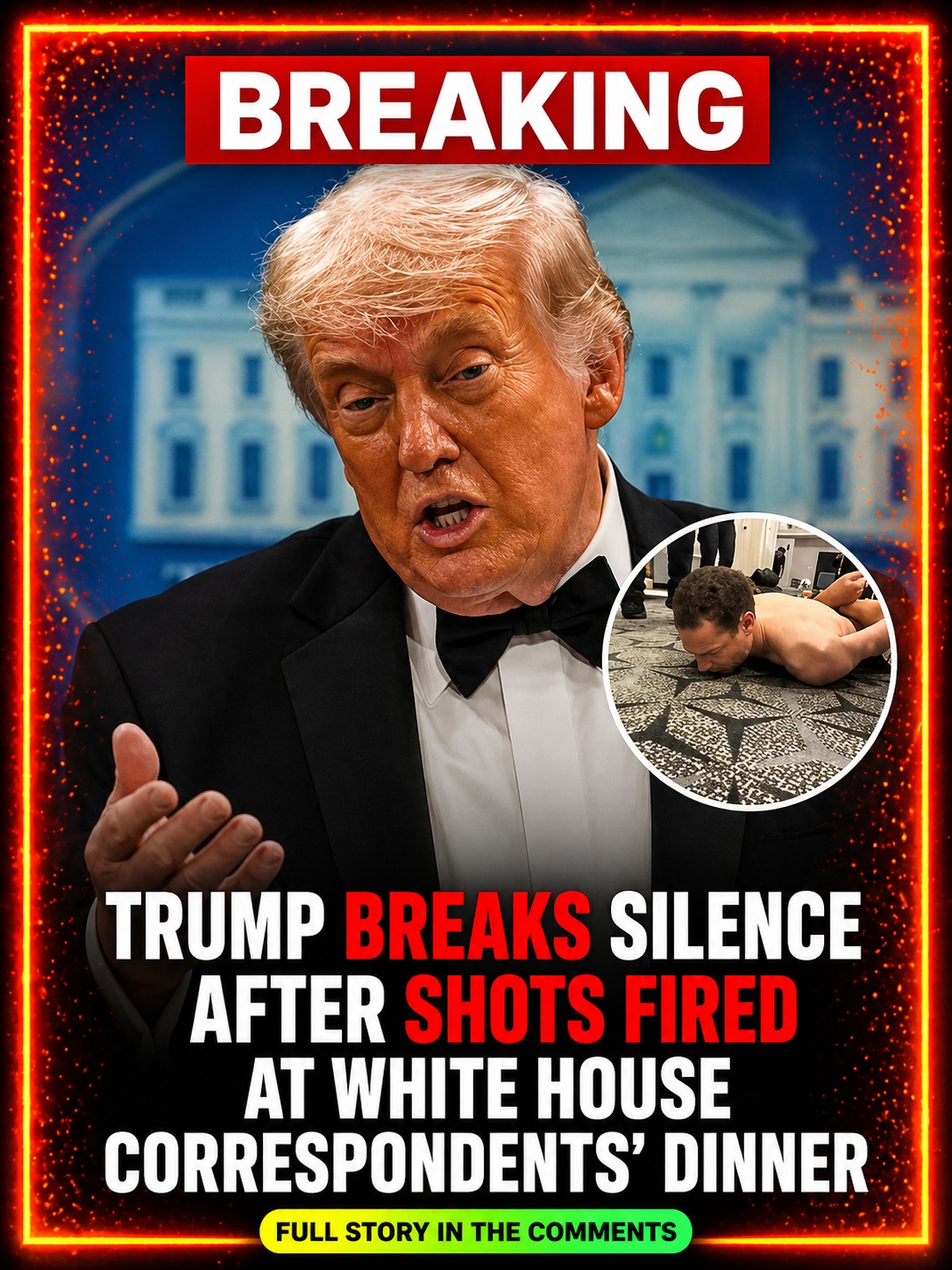
The evening was supposed to follow a familiar script. Inside the Washington Hilton, the White House Correspondents’ Dinner had gathered its usual mix of political power, media influence, and carefully measured humor.
Donald Trump sat among senior officials, with Melania Trump beside him, preparing for a speech expected to carry his trademark sharpness and confrontation. The room was set for spectacle, not disruption.
Then, in an instant, the tone shifted.
What first sounded like something harmless a dropped tray, a stray noise easily dismissed in a crowded ballroom quickly revealed itself to be something far more serious. The sound carried a different edge, one that cut through the atmosphere and forced attention. Within moments, the realization spread: it wasn’t an accident. It was gunfire.
Trump later described that transition as surreal, a jarring movement from routine to uncertainty. The room, filled with anticipation just seconds earlier, became tense and reactive. Conversations stopped. Eyes shifted toward the source of the sound. And then the response began.
According to his account, Melania was among the first to sense that something was wrong. She reportedly identified it simply as “a bad noise,” but in that understated phrase was a recognition that the situation had already crossed into something dangerous. That awareness came just before Secret Service agents moved decisively into action.
Their response was immediate and controlled. Agents closed in around the president and other key officials, forming a protective barrier that moved as one. There was no hesitation, no visible uncertainty only the execution of protocols designed for precisely this kind of moment. Trump, Melania, and those closest to them were quickly escorted out of the ballroom, guided through secure routes that had been planned long before they were ever needed.
Inside the room, guests reacted in waves. Some dropped to the ground, seeking cover beneath tables that had been arranged for elegance rather than protection. Others froze briefly, caught between disbelief and the need to act. The carefully orchestrated environment of the dinner dissolved into something far more instinctive, where survival replaced ceremony.
Outside the immediate center of the event, law enforcement moved to contain the threat. The suspect was apprehended before reaching deeper into the secured area, a detail Trump later emphasized when speaking about the incident. He insisted that the attacker had not breached the core of the protected space, pointing to the speed and discipline of the response as critical factors in preventing a far worse outcome.
In the hours that followed, Trump’s tone balanced acknowledgment of the danger with a firm refusal to let it define the moment. He praised the actions of law enforcement and the Secret Service, highlighting their coordination and readiness. For him, the response was not just effective it was proof that the systems in place had functioned under pressure.
At the same time, his remarks carried a message of defiance. He spoke about not allowing what he described as “sick people” to dictate how public life is conducted. The interruption of the dinner, the fear experienced by those in attendance, and the abrupt end to the evening were not, in his view, reasons to retreat. Instead, they reinforced the need to continue.
The speech he had prepared for that night remains unheard in its original form. It was intended to be part of the evening’s rhythm, another contribution to the ongoing dialogue sometimes tense, sometimes theatrical between the presidency and the press. But the events that unfolded rendered it irrelevant in that moment. The words were replaced by something far more immediate and unplanned.
For the attendees, the experience left a lasting impression. What had begun as a night of controlled interaction ended in uncertainty, with guests leaving under heightened security and carrying with them the memory of how quickly the atmosphere had changed. The contrast between expectation and reality could not have been sharper.
The broader significance of the incident extends beyond the event itself. The White House Correspondents’ Dinner has long symbolized a kind of balance a space where political leaders and journalists coexist, if only briefly, within a shared framework. That balance was disrupted, revealing how fragile it can be when confronted with external threats.
Security will undoubtedly be reviewed, protocols examined, and procedures adjusted. Questions about access, timing, and response will shape the conversation in the days ahead. But beyond those practical considerations lies something less tangible: the shift in perception.
For many, the night served as a reminder that even the most carefully managed environments are not immune to disruption. The sense of control that often defines such events can dissolve in an instant, replaced by unpredictability. That realization lingers, shaping how similar gatherings may be viewed in the future.
Yet alongside that awareness is another element one reflected in Trump’s insistence that the dinner will return. The idea that public life, with all its complexities and tensions, cannot simply be paused or abandoned in response to fear. The event may come back changed, carrying the memory of what happened, but still intact in purpose.
In the end, the night will not be remembered for the speech that wasn’t delivered or the routine that was interrupted. It will be remembered for the moment when everything shifted for the sound that broke through expectation, for the rapid movement of those tasked with protection, and for the response that followed.
What remains is a story of contrast: between preparation and unpredictability, between fear and control, between disruption and determination. And in that contrast lies the lasting impact of a night that began in familiarity and ended in something no one in that room had expected to face.