What was meant to be an evening of polished speeches, carefully timed humor, and rare proximity between power and press unraveled in seconds into something far more primal.
Inside the Washington Hilton, the annual White House Correspondents’ Dinner had gathered an audience that represented the heart of American public life politicians, journalists, advisors, and cultural figures seated shoulder to shoulder beneath bright lights and practiced smiles. It was a ritual as much as an event, a night designed to momentarily soften the edges of politics. But outside those ballroom doors, something far darker was already in motion.
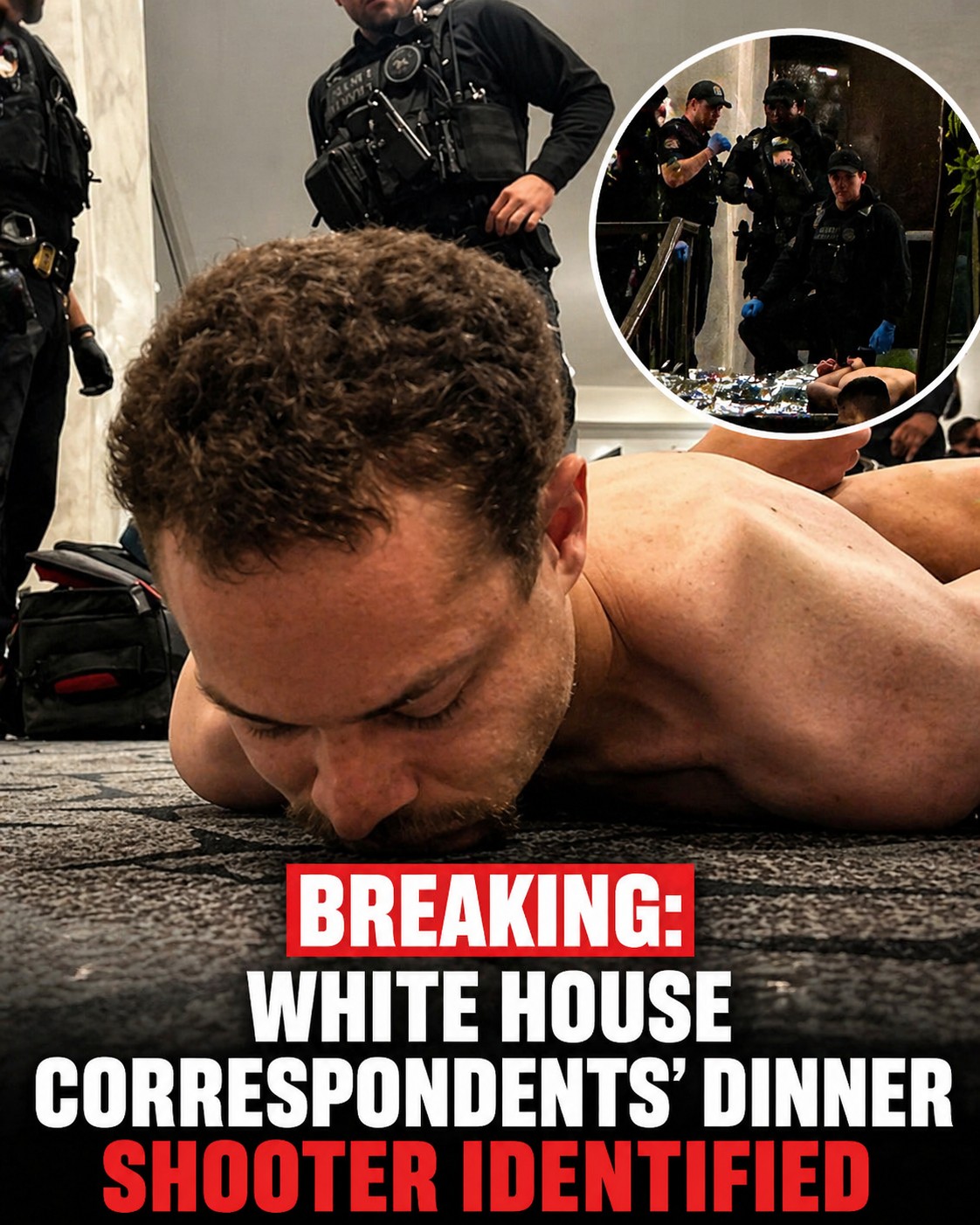
Witnesses later described a man moving with urgency, slipping past a security checkpoint with alarming speed. He was not just another guest running late or a staff member rushing between tasks. According to authorities, the suspect, a 31-year-old teacher from California named Cole Tomas Allen, was heavily armed carrying a shotgun, a handgun, and multiple knives. His destination appeared unmistakable: the ballroom where the country’s most visible figures had gathered.
The first sounds that broke the evening were sharp and disorienting. Some guests initially mistook them for something benign a dropped tray, a malfunctioning speaker, even part of the program itself. But confusion quickly gave way to fear as the unmistakable reality set in. Up to six shots echoed through the space outside the ballroom, sending a ripple of panic through the crowd.
Inside, the transformation was immediate and visceral. Chairs scraped loudly against the floor as people stood abruptly or dropped low. Conversations dissolved into gasps and shouted warnings. Some guests dove under tables draped in white linen, their formal attire suddenly irrelevant against the instinct to survive. Others froze momentarily, caught between disbelief and the need to act.
Security personnel moved with trained precision, cutting through the chaos with a singular focus. Within seconds, agents closed in on the threat. Outside the ballroom, Allen was confronted and tackled to the ground in a violent but controlled struggle. The speed of the response likely prevented a far worse outcome, yet the damage both physical and psychological had already begun to take hold.
During the confrontation, a Secret Service agent was struck by gunfire. The shot, fired at close range, could have easily turned fatal. Instead, the agent’s ballistic vest absorbed the impact, transforming what might have been a tragedy into a narrow escape. Even so, the image of an agent hit in the line of duty underscored just how close the evening had come to something far more catastrophic.
Inside the ballroom, the evacuation unfolded in a blur. The president was quickly surrounded and escorted out, agents forming a moving shield as they navigated the uncertain environment. Witnesses described a momentary stumble during the exit, a small but human detail in an otherwise tightly controlled operation. Alongside him, senior officials and members of the administration were rushed away, guided through secure routes that had been planned but never hoped to be used.
In the immediate aftermath, the room was left suspended in a strange in-between state. Some guests remained hidden, unsure if the danger had fully passed. Others began to emerge cautiously, checking phones, calling loved ones, or simply trying to process what had just happened. The elegant setting once filled with laughter and conversation now felt hollow, almost unrecognizable.
Outside, law enforcement quickly secured the scene. Allen, now in custody, became the center of an intense and rapidly expanding investigation. Authorities began piecing together his background, searching for any indication of motive. Early reports painted a puzzling picture: a well-educated individual with no known criminal record, someone who, on the surface, did not fit the profile of a person capable of such an act.
Investigators turned their attention to his personal history, digital footprint, and any connections that might explain the events of that night. His home was searched, devices were seized, and those who knew him were questioned. Yet even as information accumulated, a clear explanation remained elusive.
In the hours that followed, the narrative began to take shape in public statements. Officials confirmed that the suspect appeared to be acting alone, describing him as a lone actor rather than part of a broader network. The president, having returned to the White House, addressed the incident with a mix of relief and condemnation. He praised the swift actions of law enforcement and the bravery of the agents who intervened, while also expressing outrage at the attack itself.
Legal proceedings moved quickly into focus. Prosecutors indicated that Allen would face serious federal charges, including firearms violations and assault. Additional charges were expected as the investigation continued, reflecting the severity of the incident and the potential consequences of what had unfolded.
For those who had been present, however, the official responses did little to erase the memory of those few chaotic minutes. The sounds, the sudden shift from normalcy to fear, the sight of people scrambling for safety these details lingered in ways that no statement could fully address. What had been intended as a night of controlled spectacle had instead revealed how fragile that control truly was.
The incident also cast a wider shadow over the event itself. The White House Correspondents’ Dinner has long been seen as a symbol of a functioning democratic culture, where adversaries share a space, if only briefly, under a shared set of rules. That illusion of stability was shaken, replaced by a stark reminder that even the most carefully planned gatherings are not immune to disruption.
Security protocols, already extensive, would inevitably face renewed scrutiny. Questions would be asked about how the suspect managed to get as close as he did, what gaps may have existed, and how they could be addressed in the future. Each answer would carry implications not just for this event, but for the broader landscape of public safety.
Yet beyond policy and procedure, the deeper impact was more difficult to measure. For many, the night marked a shift in perception a realization that the boundary between order and chaos can be thinner than it appears. The polished surface of public life, with its rituals and routines, can fracture in an instant.
In the end, the evening did not conclude with speeches or applause, but with sirens, lockdowns, and a quiet, unsettled departure. Guests left not with memories of jokes or conversations, but with a shared experience that would follow them long after the lights had dimmed. What remained was not just the record of an incident, but the echo of a moment when everything changed without warning.