
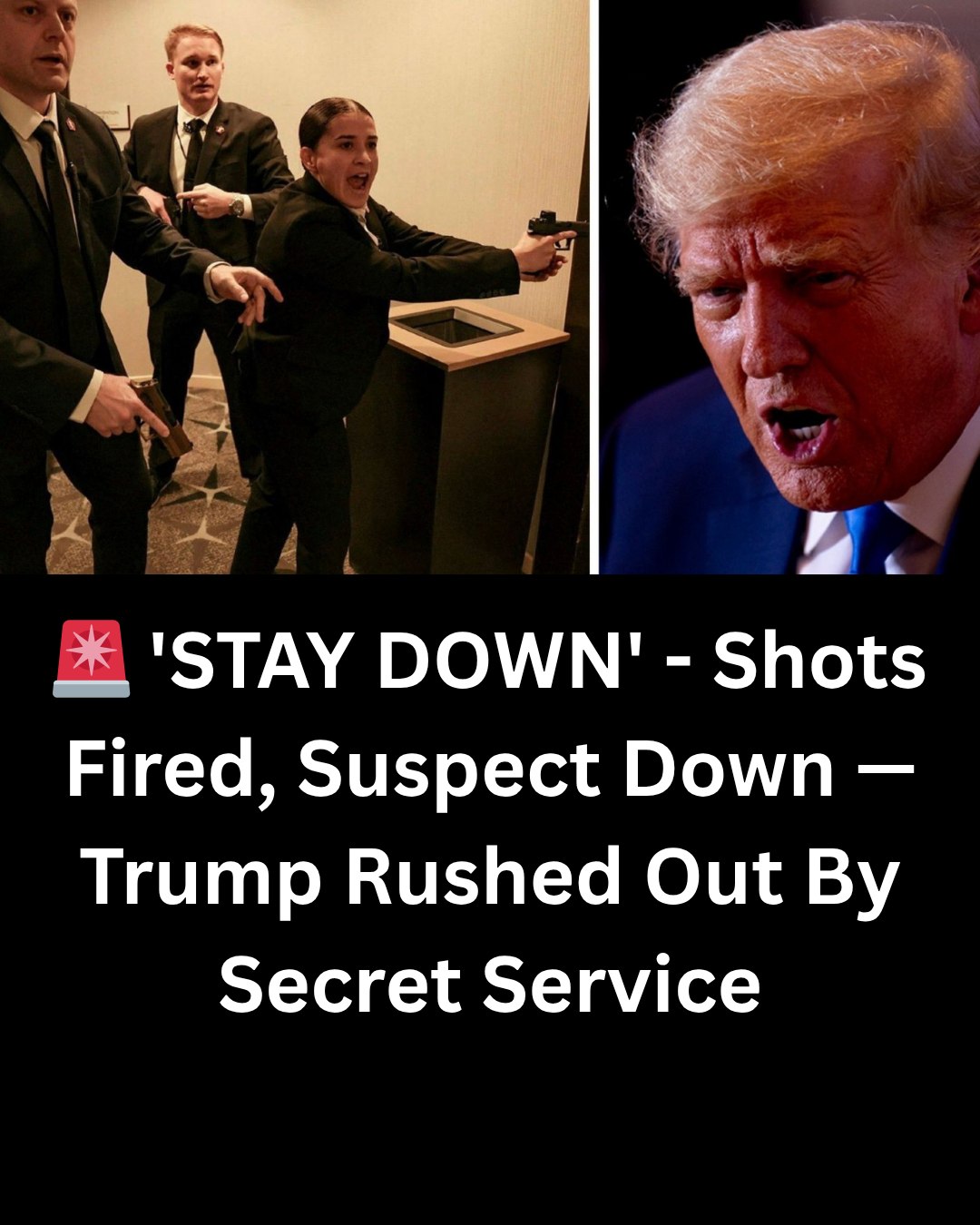
What was meant to be a night of ceremony, humor, and carefully managed political theater took a dramatic and unsettling turn when gunfire erupted during the White House Correspondents’ Dinner in Washington, D.C..
Inside the grand ballroom of the Washington Hilton, where journalists, government officials, and public figures had gathered for one of the capital’s most anticipated events, the atmosphere shifted from polished normalcy to raw urgency in a matter of seconds.
Donald Trump had been on stage, part of the evening’s program, when the first sounds were heard. At first, confusion rippled through the crowd. The sharp noise did not immediately register for what it was. But within moments, recognition set in. The realization that shots had been fired spread quickly, carried by both instinct and the visible reaction of security personnel.
The response was immediate and decisive. Agents from the United States Secret Service moved swiftly, surrounding the President and escorting him off the stage. JD Vance, along with members of the Cabinet and senior staff, was also evacuated in rapid succession. The choreography of the extraction reflected years of preparation for exactly this kind of moment precise, controlled, and executed without hesitation.
Among those present in the room were some of the highest-ranking figures in the administration, including Scott Bessent, Tulsi Gabbard, Sean Duffy, Karoline Leavitt, Steven Cheung, Kash Patel, and Acting Attorney General Todd Blanche. Their presence underscored the scale of the potential risk, turning what might have been an isolated incident into something far more consequential.
As the evacuation unfolded, confusion lingered inside the ballroom. Guests were left processing what had just happened, some remaining in place while others sought guidance from security personnel. The White House press pool, responsible for tracking the President’s movements, reported that he had not immediately departed the hotel, indicating that the situation was still being assessed in real time. At 8:56 p.m., reporters noted that the President remained within the Hilton, a detail that highlighted both the caution and complexity of the response.
Outside the main event space, law enforcement quickly moved to contain the situation. Authorities confirmed that a suspect had been detained, bringing an immediate sense of relief but not fully easing the tension that had gripped the building. Details about the individual and their motives were not immediately clear, leaving investigators to begin the process of piecing together what had led to the incident.
Witness accounts began to emerge, offering glimpses into the moments of chaos. Wolf Blitzer, who was near a stairwell above a lower-level area at the time, described being just feet away from the unfolding situation. He later recounted seeing the gunman on the ground after the shots were fired, a detail that underscored how close the threat had come to those in attendance.
Amid the uncertainty, officials and aides moved quickly to reassure the public. Sources confirmed that Donald Trump was safe, along with the Vice President and Cabinet members. Robert F. Kennedy Jr. was also reported to be unharmed and had left the event, according to his aide. These confirmations helped stabilize the narrative, shifting attention from immediate danger to the broader implications of the incident.
Political reactions followed swiftly. Nancy Mace publicly expressed concern and support, stating that prayers were with the President and those in attendance while acknowledging early reports that the suspect had been detained. Her remarks reflected a broader tone of urgency and solidarity that often emerges in moments of crisis.
As the situation continued to develop, another layer of policy discussion surfaced from within the administration. The Department of Justice had recently outlined plans to expand federal execution protocols, including the reintroduction of methods such as pentobarbital injections and the addition of alternatives like firing squads. The directive, part of a broader effort to reinforce the implementation of capital punishment, emphasized the administration’s commitment to carrying out lawful sentences once appeals are exhausted. While not directly connected to the events at the dinner, the timing of the announcement added to the intensity of an already charged political environment.
Back at the Washington Hilton, the immediate focus remained on security and investigation. Authorities worked to secure the area, gather evidence, and ensure that no additional threats were present. The presence of so many high-profile individuals meant that every aspect of the response would be closely examined in the days ahead.
For those who had been inside the ballroom, the experience left a lasting impression. What began as a routine, even celebratory evening had been interrupted by a moment that exposed the fragility of even the most tightly controlled environments. The sudden shift from normalcy to crisis was not something easily forgotten. Conversations that once revolved around speeches and satire were replaced by reflections on proximity, vulnerability, and the speed at which circumstances can change.
In the aftermath, questions inevitably began to surface. How had the situation developed so quickly? What gaps, if any, had allowed the threat to emerge? And what changes might be necessary to prevent something similar in the future? These are the kinds of questions that follow any incident involving high-level security, particularly one that unfolds in such a public and symbolic setting.
Yet beyond the investigations and policy discussions, there remains a more immediate and human dimension. The people in that room experienced a moment where certainty disappeared, replaced by instinct and reaction. They witnessed firsthand how quickly a controlled environment can become unpredictable, how even the most routine events can carry unforeseen risks.
As the night came to a close, the immediate danger had passed, but the impact lingered. The White House Correspondents’ Dinner, long seen as a fixture of Washington life, had been transformed into something else entirely a reminder that beneath the surface of ceremony and tradition lies a reality that can shift in an instant.
What remains now is not just the record of what happened, but the awareness it leaves behind. A heightened understanding of vulnerability, a renewed focus on security, and a recognition that even in spaces designed to project stability, the unexpected can still break through without warning.