What was meant to be an evening of tradition, humor, and rare political unity unraveled in a matter of seconds, transforming one of Washington’s most carefully orchestrated events into a scene of confusion and fear.
Inside the grand ballroom of the Washington Hilton, more than 2,000 guests had gathered for the White House Correspondents’ Dinner, an occasion known for its polished speeches and lighthearted jabs between politicians and the press. For a brief stretch of time, the atmosphere carried its usual blend of ceremony and satire, a reminder of how power and media can share the same room, if only for a night.
Then the sound came.
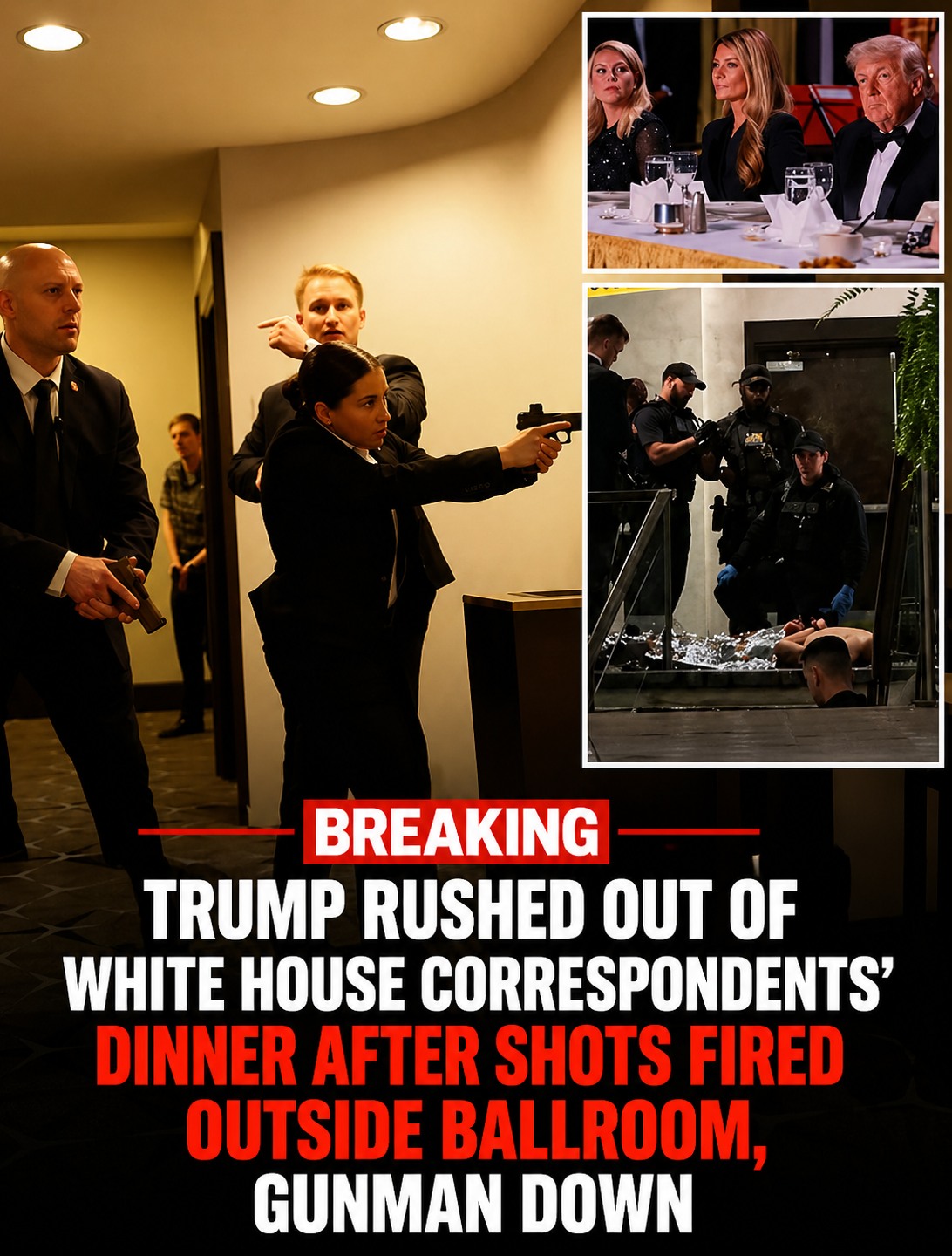
At first, it was uncertain sharp, unfamiliar, out of place in a setting defined by laughter and applause. But within moments, that uncertainty hardened into recognition. Gunfire. The cracks echoed from near the security screening area, cutting through the ballroom with a force that instantly erased the illusion of control. Conversations stopped mid-sentence. Glasses froze in midair. The carefully managed rhythm of the evening collapsed into instinct.
Guests reacted without waiting for instructions. Chairs scraped loudly against the floor as people dropped low or scrambled for cover. Beneath tables draped in white linen, journalists, officials, and guests pressed themselves into tight spaces, their breathing shallow, their thoughts racing. Some clutched phones, sending hurried messages to loved ones. Others simply stayed still, listening, trying to understand how a night designed to celebrate stability had turned into something unrecognizable.
Onstage, the response was immediate and precise. Donald Trump, alongside Melania Trump and JD Vance, had been part of the program moments earlier. Then, almost without warning, they were surrounded by agents who moved with a level of coordination that spoke to years of preparation for exactly this scenario. There was no hesitation, no visible confusion. Within seconds, they were escorted away, shielded by a formation of bodies trained to absorb risk without question.
For those watching, the moment left a lasting image: authority disappearing behind urgency, ceremony giving way to survival.
Outside the ballroom, the situation was unfolding with equal intensity. Witnesses later described seeing a man in a service area assembling what appeared to be a long firearm, a detail that would quickly become central to the unfolding investigation. The suspect, identified as Cole Allen, moved toward the area where the President was located, triggering a response that was both immediate and forceful. Within seconds, security personnel engaged, tackling him and bringing him to the ground before he could advance further.
During the confrontation, a Secret Service agent was struck at close range. The outcome could have been catastrophic, but for the presence of a ballistic vest that absorbed the impact. What might have become a defining national tragedy instead became a narrow escape a reminder of how thin the margin can be between crisis contained and crisis realized.
Even after the suspect was subdued, the sense of danger did not immediately fade. Inside the hotel, confusion lingered. Guests were moved into secure areas, instructed to remain in place as the situation was assessed. In back rooms and corridors, small groups formed, people speaking in hushed tones or sitting in silence, trying to steady themselves. Phones lit up continuously as messages were sent and received, each one carrying a mixture of reassurance and disbelief.
For many, the emotional impact was immediate and overwhelming. This was not a distant event viewed through a screen; it was something they had lived through, something that had unfolded just steps away. The sounds, the movement, the sudden shift from normalcy to fear these details would not easily fade.
As law enforcement secured the scene, attention turned to understanding what had happened and why. Early information about the suspect added a layer of complexity. Allen was described as a teacher from California, someone whose background did not immediately suggest the kind of threat he had posed. Investigators began the process of examining his history, searching for motives, connections, or warning signs that might explain how the situation had escalated to this point.
Back in Washington, D.C., the broader implications were already being discussed. The United States Secret Service faced renewed scrutiny, not for failing to respond, but for how close the threat had come to its target. The speed and effectiveness of the response were undeniable, yet the incident raised difficult questions about access, prevention, and the evolving nature of security risks in high-profile environments.
When Donald Trump later addressed the incident, his tone reflected both relief and gravity. He spoke of the room as “totally unified” in the face of danger, emphasizing the shared experience that had briefly erased divisions. At the same time, he issued a call for an end to political violence, acknowledging the deeper currents that events like this bring to the surface.
Plans to reschedule the dinner were announced, a practical step toward restoring normalcy. Yet the question remained whether the sense of normalcy itself could be fully recovered. Events like the White House Correspondents’ Dinner are built on the assumption of safety, on the idea that even in a divided political climate, there are spaces where routine can prevail. That assumption had been shaken.
For those who were there, the memory would not be defined solely by fear, but by the abruptness of the transition. One moment, a room filled with laughter and light. The next, a space defined by uncertainty and instinct. The contrast was stark, almost disorienting, a reminder of how quickly circumstances can change.
In the days that follow, investigations will continue, policies may be reviewed, and public discussions will attempt to draw meaning from the event. But beneath all of that, there remains a more immediate reality. The people in that room experienced something that cannot be fully captured in reports or statements. They felt the shift, heard the shots, and understood in real time how fragile even the most controlled environments can be.
What lingers is not just the fact that the situation was contained, but the recognition of how close it came to becoming something far worse. And in that recognition lies a truth that extends beyond any single night: that safety, no matter how carefully constructed, is never absolute, and that the line between order and chaos can be crossed in an instant.