In a quiet corner of the local cemetery, where time seems to move more slowly and the air carries a stillness that feels almost sacred, there is a grave that stands apart from all the others.
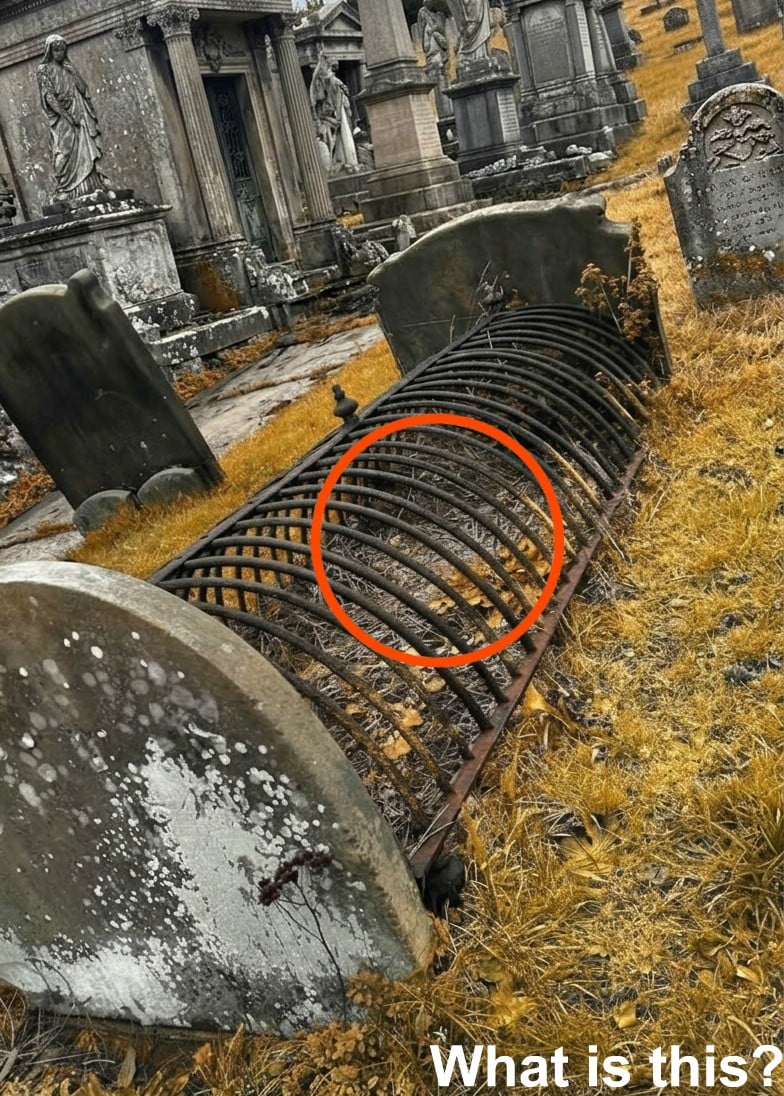
At first glance, it might not seem extraordinary. The headstone is worn, the ground slightly uneven, much like the rest. But what captures attention what unsettles it is the structure that rests over the burial site. A lattice of iron, cold and deliberate, enclosing the earth beneath it as if something within once needed protection long after life had ended.
To modern eyes, the sight can feel confusing, even eerie. It looks less like a memorial and more like a barrier, something meant to keep the outside world away or perhaps to keep something inside. The name attached to these strange constructions only deepens the sense of unease: mortsafes. It sounds almost unreal, like a word invented for a story, something meant to evoke curiosity or discomfort. But the reality behind it is far more grounded, and far more unsettling, than fiction.
These iron structures began to appear in the eighteenth and nineteenth centuries, during a time when the boundaries between science and morality were being tested in ways that many found deeply disturbing. Medical knowledge was advancing, and with it came an urgent demand for human bodies. Surgeons and students needed cadavers to study anatomy, to learn, to push the limits of what was understood about the human body. But there was a problem very few bodies were legally available.
The shortage created a shadow economy, one that operated quietly under the cover of darkness. Individuals known as resurrection men began to emerge, drawn not by grief but by opportunity. They moved through cemeteries at night, targeting fresh graves where the soil was still soft and the bodies beneath still intact. What they sought was not valuables or jewelry, but the body itself. Once retrieved, it could be sold to medical institutions for a significant sum, far more than most honest work could provide.
For families, the thought was unbearable. Burial was meant to be an act of closure, a final gesture of respect and love. But in this climate, even that sense of peace was threatened. The idea that a loved one could be taken, disturbed, and sold without consent created a fear that lingered long after the funeral had ended. Grief was no longer the only burden—they also had to guard against violation.
It was out of this fear that mortsafes were born. These iron cages were not decorative, nor symbolic. They were practical, heavy, and designed with a single purpose: to protect the body beneath from those who might try to take it. Constructed from thick metal bars and secured firmly over the grave, they made it nearly impossible for anyone to dig without significant effort and time two things resurrection men could not afford.
The presence of a mortsafes was a clear message. This grave was defended. This body was not available for theft. It was a line drawn by the living, an assertion that even in death, dignity would be preserved. These structures were often temporary, left in place only until the body had decomposed to the point where it no longer held value for medical study. After that, they would be removed and reused, passed from one grieving family to another, each one hoping to protect their own.
Standing before such a grave today, it is difficult not to feel the weight of that history. The iron no longer serves its original purpose, but it carries the memory of why it was placed there. It transforms the cemetery from a quiet resting place into something more complex. Beneath the calm surface lies a past shaped by fear, necessity, and resistance.
What makes this even more striking is how ordinary the setting appears. Birds still move through the trees. The wind still passes softly over the grass. From a distance, nothing seems out of place. But the closer you get, the more the illusion shifts. That iron structure is a reminder that peace was once something that had to be defended, not assumed.
It also reveals something deeper about the people who lived during that time. Faced with a system that offered them little protection, they created their own. They did not accept that their loved ones could be taken without consequence. Instead, they responded with whatever means they had, turning grief into action, fear into resolve.
There is something profoundly human in that response. It speaks to a universal instinct the need to protect, to honor, to ensure that even in death, those we love are not reduced to something disposable. The mortsafes is not just a structure of iron; it is a symbol of that instinct, made visible and enduring.
As you stand there, looking at the bars that once served as a shield, it becomes clear that this is not just a relic of a distant past. It is a story, preserved in metal and earth. A story of a time when the boundaries between respect and exploitation were uncertain, and when ordinary people found ways to defend what mattered most.
The cemetery, in that moment, feels different. Not darker, but deeper. It holds more than silence it holds memory. And among the rows of graves, this one stands as a quiet testament to a truth that is easy to forget: that even in the stillness of death, there were battles fought, not with weapons, but with will.
And the iron remains, long after its purpose has passed, reminding anyone who stops to look that peace is not always given. Sometimes, it is something that had to be protected with everything people had, even when all they had left was steel and determination.