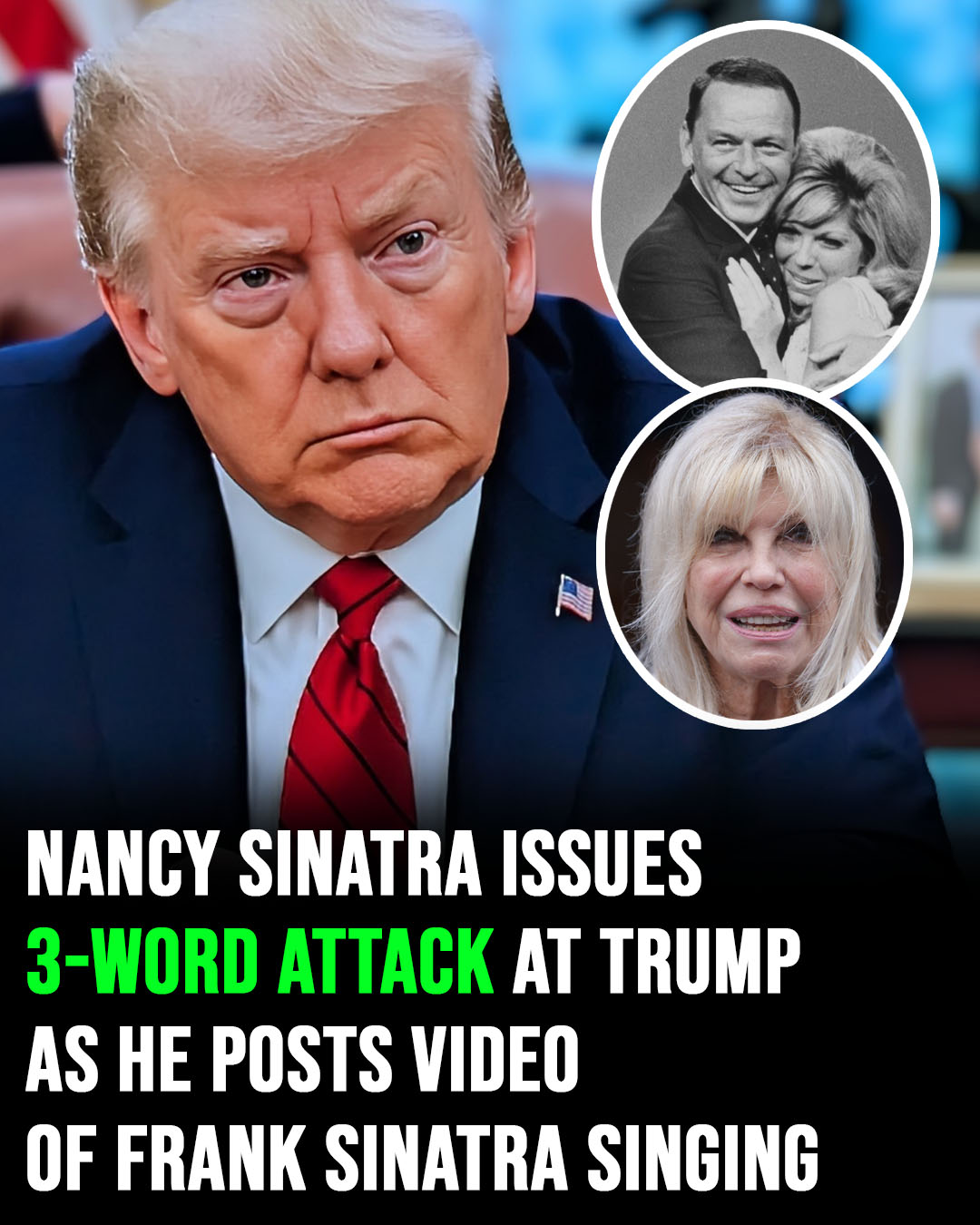
When Nancy Sinatra spoke out, her words immediately cut through the noise of political commentary and social media debate.
What might have seemed like just another viral post quickly turned into something far more personal and emotionally charged. At the center of it all was the legacy of her father, Frank Sinatra, and a video shared by Donald Trump that reignited long-standing tensions about art, ownership, and political symbolism.
The controversy began when Trump posted a clip featuring one of Frank Sinatra’s most recognizable performances. For many viewers, it may have appeared to be a simple nod to a legendary figure in American music. But for Nancy Sinatra, the moment carried a very different meaning. Her reaction was immediate and unmistakable, describing the use of her father’s work as something deeply inappropriate. With a single word, she reframed the situation not as admiration, but as something she believed crossed a line.
To her, the issue was not just about music being shared online. It was about context, intention, and the message attached to it. Frank Sinatra’s voice, she suggested, represented more than entertainment. It stood for a set of values and beliefs that she feels are incompatible with the figure now using it. By placing that voice within a political narrative she strongly opposes, she saw the act as a distortion rather than a tribute.
Her response quickly gained attention, drawing reactions from both supporters and critics. Some agreed with her perspective, arguing that artists and their families should have a say in how their work is used, especially in political contexts. Others pushed back, suggesting that once music becomes part of the cultural landscape, it takes on meanings beyond the control of any single individual.
Nancy Sinatra did not stop at her initial reaction. She continued to clarify her position, emphasizing that her father’s legacy was built on principles she believes would not align with the message being conveyed. She pointed out that admiration for an artist does not necessarily imply alignment of values, and she made it clear that, in her view, the connection being implied was misleading.
At the same time, she acknowledged the limitations she faces in addressing the situation. While she has a strong personal connection to her father’s work, the legal rights surrounding music usage are complex. She openly admitted that she does not have the authority to prevent such use, highlighting a broader issue that many artists and their families encounter in the modern media landscape.
This tension between legal rights and moral ownership lies at the heart of the controversy. On one hand, music is protected by laws that govern how it can be distributed and used. On the other, it carries emotional and cultural significance that goes far beyond those legal frameworks. For Nancy Sinatra, the latter seems to hold greater weight, shaping her response and the message she wants to convey.
The situation also underscores the evolving role of social media in shaping public discourse. A single post can quickly become a focal point for larger debates, drawing in voices from across the political and cultural spectrum. In this case, what began as a video clip turned into a broader conversation about legacy, identity, and the intersection of art and politics.
For Trump and his supporters, the post may have been intended as a celebration of an iconic figure or a way to connect with audiences through familiar cultural references. Music has long been used in political contexts to evoke emotion, build identity, and create a sense of shared experience. However, as this situation demonstrates, such choices can also carry unintended consequences, particularly when they involve figures whose legacies are closely guarded by those who knew them best.
The reaction from Nancy Sinatra highlights how deeply personal these issues can become. For her, this is not an abstract debate about intellectual property or political messaging. It is about her father, his life, and the meaning attached to his work. Her response reflects a desire to protect that meaning, even in the face of limited control over how it is used.
Public response to the situation has been mixed, reflecting broader divisions in society. Some see her comments as a necessary defense of artistic integrity, while others view them as an attempt to impose restrictions on how cultural icons are interpreted. This divide mirrors larger conversations about who gets to define the legacy of public figures and how those legacies are shaped over time.
What makes this situation particularly compelling is the way it brings together multiple layers of meaning. It is about music, but also about memory. It is about politics, but also about personal identity. It is about the past, but also about how that past is used in the present.
As the discussion continues, it raises important questions about the relationship between art and power. Can a song remain neutral once it is placed within a political context? Does its meaning change depending on who uses it and why? And who has the authority to make those determinations?
In the end, the controversy surrounding Nancy Sinatra’s reaction is about more than a single video. It is about the ongoing struggle to define the boundaries between public and private, between admiration and appropriation, and between legacy and interpretation.
For Nancy Sinatra, the answer is clear. She believes her father’s voice represents something specific, something that should not be detached from the values he held. Whether others agree or not, her response ensures that this perspective remains part of the conversation.
As for the public, the debate continues to unfold, shaped by differing views on art, politics, and the ways in which they intersect. What began as a simple post has become a reminder that even the most familiar songs can carry new and unexpected meanings when placed in a different context.
And in that sense, the story is far from over.