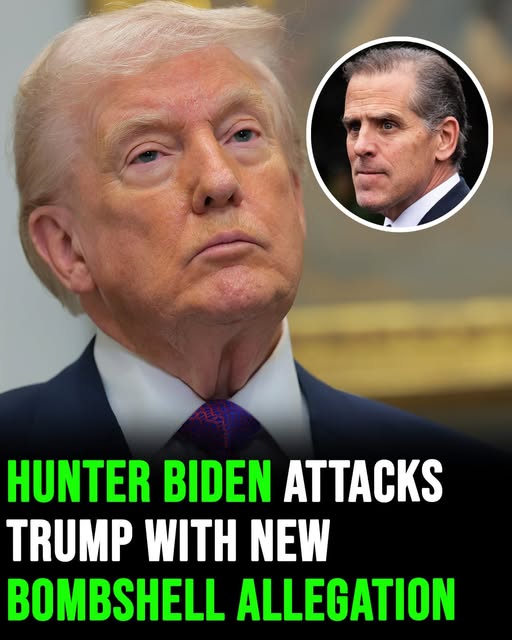
Hunter Biden s comments land in a uniquely volatile moment, because his own legal troubles once defined the Republican narrative about corruption.
After being convicted on gun and tax charges, then pardoned by his father, he became a symbol conservatives used to question Joe Biden s integrity. That history makes his attack on Donald Trump s alleged conflicts of interest far more charged than a typical partisan jab. It forces people to confront whether standards are being applied consistently or only when politically convenient. The man who was once the target of relentless congressional investigations is now pointing fingers, and the irony is not lost on anyone watching.
His criticism focuses on the Trump family s business deals tied to political power. Crypto ventures leveraging insider credibility. Massive defense contracts awarded to companies with ties to the former president s circle. Real estate projects in geopolitically sensitive regions where access and influence are currency. Hunter argued that while he was being dragged through hearings and headlines for his own foreign business dealings, the Trump family was operating on an entirely different scale, with far fewer consequences. His point was not to defend his own actions, but to highlight what he sees as a double standard. One family faces prosecution. The other faces no consequences at all.
Supporters of Trump insist he sacrificed business opportunities to serve. They point to documents he signed handing over control of his companies to his children. They argue that his wealth, which existed long before he entered politics, is a product of decades of deal making, not corruption. To them, Hunter s allegations are a distraction, a desperate attempt to deflect attention from his own legal baggage. They note that the president pardoned his son, a move they call an abuse of power. They ask why anyone should believe a man who has admitted to addiction, financial mismanagement, and tax evasion.
Critics see something different. A sprawling ecosystem of self enrichment. Foreign governments staying at Trump hotels. Foreign officials purchasing condos in Trump buildings. Business ventures launched while the former president was in office, leveraging his name and his connections. They argue that the line between public service and private profit has never been blurrier. And they point to Hunter s allegations as further evidence that the system protects the powerful while punishing the connected. Whether Hunter is the right messenger is a separate question. But the message itself is resonating with those who have long believed that the rules are not the same for everyone.
The timing of his comments is significant. The former president is running for office again. His legal troubles are mounting. His business practices are under scrutiny. And Hunter, despite his own baggage, has a platform that reaches millions. His words will be dissected, debated, and dismissed by some. But they will also be heard. And in a close election, even a small shift in perception can matter. The question is whether voters will see his allegations as credible or as the rantings of a bitter man who was caught and pardoned.
Hunter s own history complicates everything. He cannot escape it. Every time he speaks, his past follows him. The addiction. The laptop. The trials. The pardon. For his critics, that past is disqualifying. He is a liar, they say. A grifter. A man who traded on his father s name for profit. Why should anyone believe him now. For his supporters, his past makes him more credible. He has been through the wringer. He has faced the consequences. He knows how the system works from the inside. That experience, they argue, gives him a perspective that others lack.
The truth likely lies somewhere in between. Hunter is neither a saint nor a villain. He is a flawed man who has made mistakes and been held accountable for some of them. His allegations against Trump may be motivated by genuine belief, or by political calculation, or by a desire for relevance. It is difficult to know. What is clear is that the conversation he started is not going away. The questions he raised about conflicts of interest, about the intersection of business and politics, about who gets prosecuted and who does not, are questions the country has been wrestling with for years.
In the end, Hunter s outburst is not just about Trump. It is about a country wrestling with whether public office is a duty, or simply the most profitable brand extension in American life. The answer to that question will shape not just the next election, but the future of governance itself. If voters believe that both sides are corrupt, they may disengage entirely. If they believe that one side is worse, they may turn out in droves. The stakes are high. The allegations are serious. And the man making them is, for better or worse, impossible to ignore. Whether his words will change any minds remains to be seen. But they have already changed the conversation. And in politics, that is often the first step toward something larger. Whether that something is justice or chaos depends on who is watching, and what they are willing to believe. For now, the country watches. And waits. And wonders what comes next. Because in this story, no one is innocent. And everyone has something to lose. That is the uncomfortable truth at the heart of it all. And it is not going anywhere.