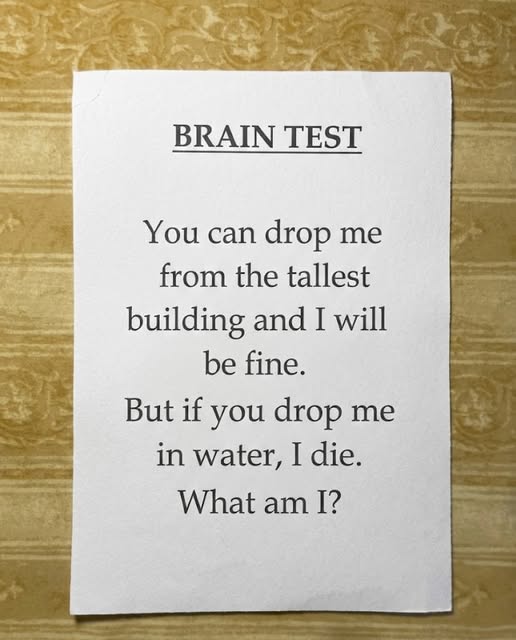
The riddle s genius is how it quietly hijacks your assumptions. It opens like a physics problem about force and impact, steering you toward hard, unbreakable objects.
You chase metal, stone, rubber, anything that could endure a deadly fall. Your mind races through materials, testing each one against the conditions. Steel can survive a drop, but it does not die in water. It just sits there, unchanged, unaffected. Rubber bounces, but water does not kill it. Stone cracks or does not, but water is not its enemy. The more you think, the further you drift from the truth.
But die in water does not belong to those things. It belongs to something alive only as long as it is fed. Something that breathes air and consumes fuel. Something that can be carried, dropped, or tossed from any height and still burn, as long as its conditions are met. The answer, of course, is fire. A flame can fall from a skyscraper and still burn on the pavement below. It can be dropped from an airplane and continue to consume whatever it touches. It does not shatter. It does not dent. It does not break. It simply burns, indifferent to the distance it has traveled.
Yet a splash of water ends it instantly. No dramatic explosion. No lingering embers. Just a hiss, a wisp of steam, and then nothing. The fire is gone, as if it had never been there at all. That is the second half of the riddle, the part that misdirects even the cleverest solvers. They focus on the fall, imagining something that can survive impact. They forget that dying in water is just as specific a condition. Fire is the only common thing that fits both. A piece of paper can fall and survive, but water destroys it too. However, paper does not survive a fall from great height in the same way. It flutters, drifts, lands softly. The riddle implies a hard fall, a drop that would destroy most things. Fire does not care. Fire burns regardless.
What feels satisfying is not the difficulty of the solution, but the realization that you were misled by your own expectations. You assumed the answer was physical, tangible, something you could hold in your hand. You thought in terms of objects, not elements. You forgot that fire, though not solid, is as real as stone. It has weight in its own way. It has power. It has a kind of life. And like all living things, it can be killed. Water is its executioner. The fall is irrelevant. The flame does not die from hitting the ground. It dies from hitting the water.
Classic riddles endure because they expose how we think, not what we know. They remind us that the right answer often sits in plain sight, disguised by the questions we never thought to ask. We complicate things. We overthink. We look for hidden meanings when the meaning is right there on the surface. The riddle does not ask for a scientific explanation. It asks for a word. A simple word. And that word is fire. But getting there requires letting go of assumptions. It requires thinking differently. It requires remembering that not every problem is solved by adding complexity. Sometimes the simplest answer is the correct one.
The satisfaction of solving a riddle like this is not just intellectual. It is emotional. There is a small thrill when the answer clicks into place, when the misdirection falls away and the truth becomes obvious. You almost want to slap your forehead. Of course, you think. Of course it is fire. How did I not see it. But you did not see it because you were looking in the wrong places. The riddle led you there on purpose. That is what good riddles do. They are not tests of knowledge. They are tests of perception.
In a world flooded with information, where answers are a search away, riddles offer something different. They offer the joy of discovery. The pleasure of figuring something out on your own. The satisfaction of a light bulb moment. That is why they have survived for centuries. That is why people still share them, still argue over them, still feel a rush of triumph when they solve one. The riddle of what survives a huge fall but dies in water is a perfect example. Simple. Elegant. Deceptively tricky. And ultimately, deeply satisfying.
So the next time someone asks you that question, do not rush to answer. Let your mind wander. Let it chase the wrong answers. Let it struggle. And when you finally arrive at fire, enjoy the moment. You earned it. Not because you are smart, but because you were willing to think differently. That is the real lesson of the riddle. Not the answer itself, but the process of getting there. The journey matters more than the destination. And the destination, in this case, is a flame. A flame that can fall from any height and keep burning, until water decides otherwise. That is the answer. That is the beauty of it. And that is why some riddles never get old. They work on the same minds, generation after generation, because human nature does not change. We still overcomplicate. We still assume. We still miss what is right in front of us. And then, with a little help from a well crafted riddle, we learn to see again. That is the magic. That is the gift. And it is free for anyone willing to pause, think, and wonder.