For most of her childhood, Mariska Hargitay never questioned who her father was.
Mickey Hargitay was the man who raised her, protected her, guided her, and remained a steady presence through some of the most difficult years of her life. To Mariska, fatherhood was never something she needed to explain. It was simply something she felt.
But years later, a deeply personal family revelation would force her to reconsider a part of her identity she had always taken for granted.
The discovery was not merely about biology.
It was about belonging.
It was about the difference between the person whose blood runs through your veins and the person who actually stays when life becomes difficult.
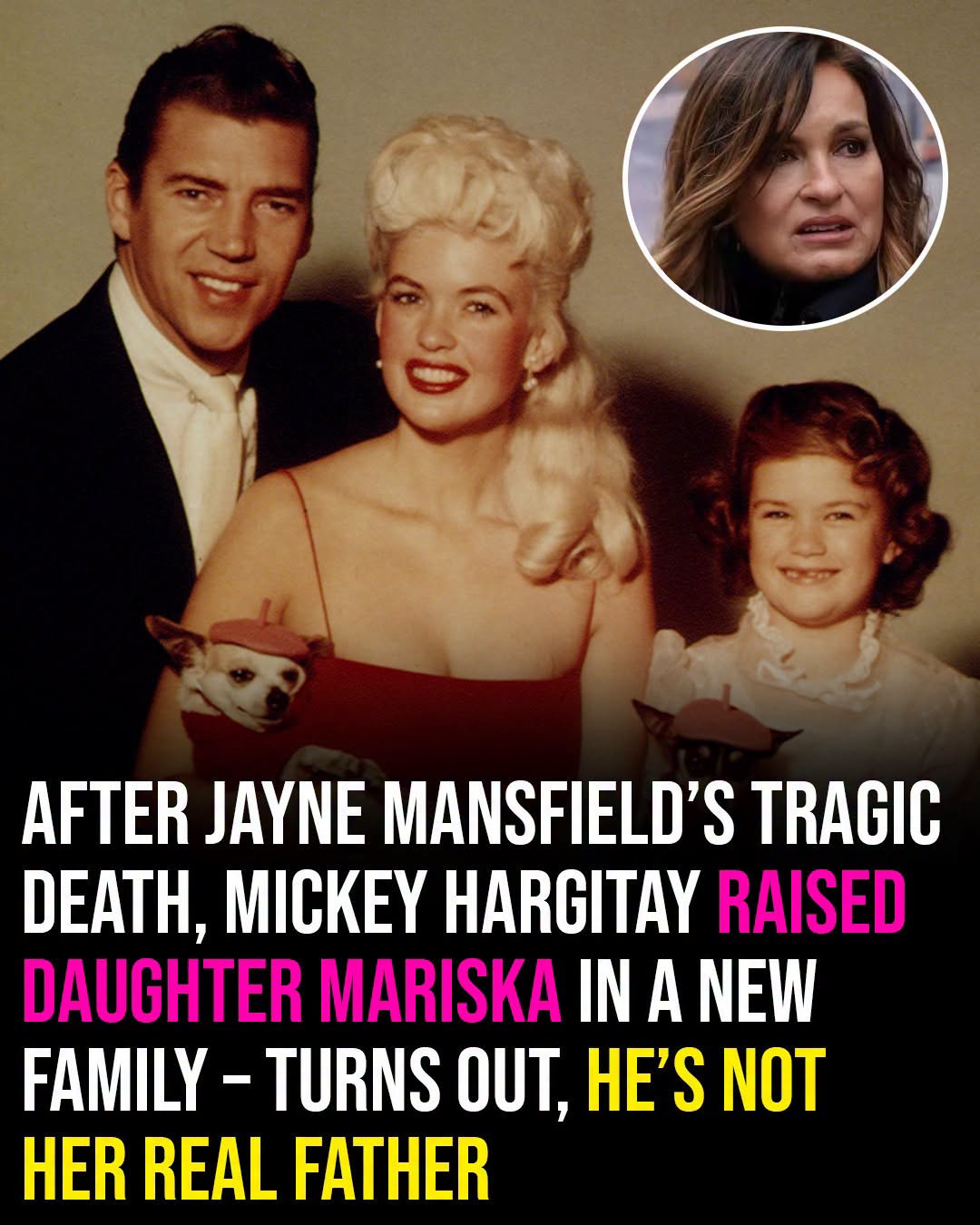
Mariska was born into one of Hollywood’s most famous families. Her mother, Jayne Mansfield, was an iconic actress whose beauty and larger-than-life personality made her one of the most recognizable stars of her generation. Mickey Hargitay, a former Mr. Universe and actor, was Jayne’s husband and Mariska’s father figure.
Her childhood, however, was marked by tragedy.
In 1967, when Mariska was only three years old, Jayne Mansfield died in a devastating car accident. The loss left a young family facing an unimaginable future without the woman at its center.
Mickey became the parent who remained.
He helped raise Mariska and worked to provide her with stability despite the enormous grief surrounding their family. For Mariska, he was not simply the man who appeared in family photographs. He was her dad.
That relationship would eventually become one of the most important parts of her life.
Then came a revelation that changed the way she viewed her own history.
Mariska learned that the man who raised her was not her biological father.
Her biological father was Nelson Sardelli, an Italian singer and entertainer who had been involved with Jayne Mansfield before Mariska’s birth.
Discovering this information was emotionally complicated.
It is one thing to learn an interesting detail about your family tree when you are an adult. It is something entirely different to discover that an important part of your biological identity has been different from what you believed.
Suddenly, questions that had never existed before appeared everywhere.
Who was she?
Where did certain characteristics come from?
What did her biological heritage mean?
Why had she not known?
And perhaps most painfully, what did this discovery mean for Mickey?
The revelation could easily have created distance between Mariska and the man who had raised her.
Instead, it ultimately forced her to confront something much deeper.
Mickey was hurt by the circumstances surrounding the revelation, but Mariska also understood something that could not be erased by a DNA connection.
He had been there.
He had held her when she was grieving.
He had helped guide her through childhood.
He had remained after she lost her mother.
He had given her the kind of love that cannot be measured in a laboratory.
Biology could explain where someone came from.
It could not explain who stayed.
That distinction became increasingly important as Mariska processed the truth.
Meeting Nelson Sardelli brought another layer of complexity to the story.
For the first time, Mariska had the opportunity to know the man whose biological connection to her was undeniable. There was curiosity, emotion, and understandable uncertainty surrounding that relationship.
She had spent her entire life with one definition of family.
Now she was being asked to make room for another.
There was no simple way to do that.
Family relationships rarely fit neatly into categories of right and wrong. People carry their own memories, regrets, fears, and expectations. Mariska’s situation was no different.
She had not asked for the circumstances that surrounded her birth.
She had not chosen to lose her mother at such a young age.
She had not chosen to discover decades later that her biological father was someone else.
What she could choose was how she responded to the truth.
Instead of allowing the revelation to destroy the family bonds she already had, she gradually began viewing her story through a wider lens.
Mickey remained her father.
That was not something a biological discovery could change.
At the same time, learning about Nelson gave her an opportunity to understand another part of herself.
It allowed her to explore her heritage and acknowledge a relationship that had always existed biologically, even if it had not been part of her everyday childhood.
That process was not necessarily easy or immediate.
There were emotions to work through.
There were difficult conversations.
There were questions that could never receive perfect answers.
But eventually, the revelation became less about choosing between two men and more about accepting that both could occupy different places in her story.
Mickey represented the fatherhood she experienced.
Nelson represented a biological connection she had only discovered later.
Neither truth had to erase the other.
That realization is perhaps the most powerful part of Mariska’s story.
People often talk about family as though DNA is the final authority.
But real life is far more complicated.
A parent can be the person who shares your genetics.
A parent can also be the person who wakes up when you’re sick, teaches you how to navigate the world, protects you when you’re frightened, and remains beside you when circumstances become unbearable.
Sometimes those people are the same person.
Sometimes they are not.
Mariska’s experience demonstrates how complicated identity can become when those two definitions separate.
Her story has also become part of a broader conversation about family secrets and the emotional impact of discovering unexpected truths later in life.
Secrets can protect people for a time, but they can also create questions that eventually demand answers.
When those answers arrive, they do not always provide instant relief.
Sometimes they create another chapter of uncertainty.
Yet truth can also be freeing.
By eventually speaking publicly about her family history and allowing people to see the emotional complexity behind it, Mariska transformed something deeply personal into a story about acceptance.
She did not have to reject the man who raised her in order to acknowledge the man whose DNA she inherited.
She did not have to pretend the revelation never happened.
And she did not have to choose between gratitude and curiosity.
She could hold all of those emotions at once.
That may be what makes her story so powerful.
The discovery changed what she knew about her origins, but it did not change the love that had shaped her childhood.
Mickey Hargitay was still the man who had been there.
He was still the father whose presence helped carry her through the devastating loss of her mother.
And Nelson Sardelli became another piece of the complicated story behind her identity.
In the end, Mariska did not simply discover that her biological father was someone else.
She discovered that family cannot always be reduced to a name on a birth certificate.
Sometimes family is built through years of ordinary moments.
Through protection.
Through sacrifice.
Through grief.
Through forgiveness.
Through choosing to remain.
Her story began with a shocking revelation about where she came from, but it ultimately became something much more meaningful about who she became.
DNA answered one question.
Love answered another.
And for Mariska Hargitay, the most important truth was never simply who gave her life.
It was who helped her live it.