A brief encounter between Donald Trump and several U.S. service members has ignited a much larger argument about respect, appearances, and what Americans expect from public figures when they interact with those who serve in uniform.
The moment itself lasted only seconds.
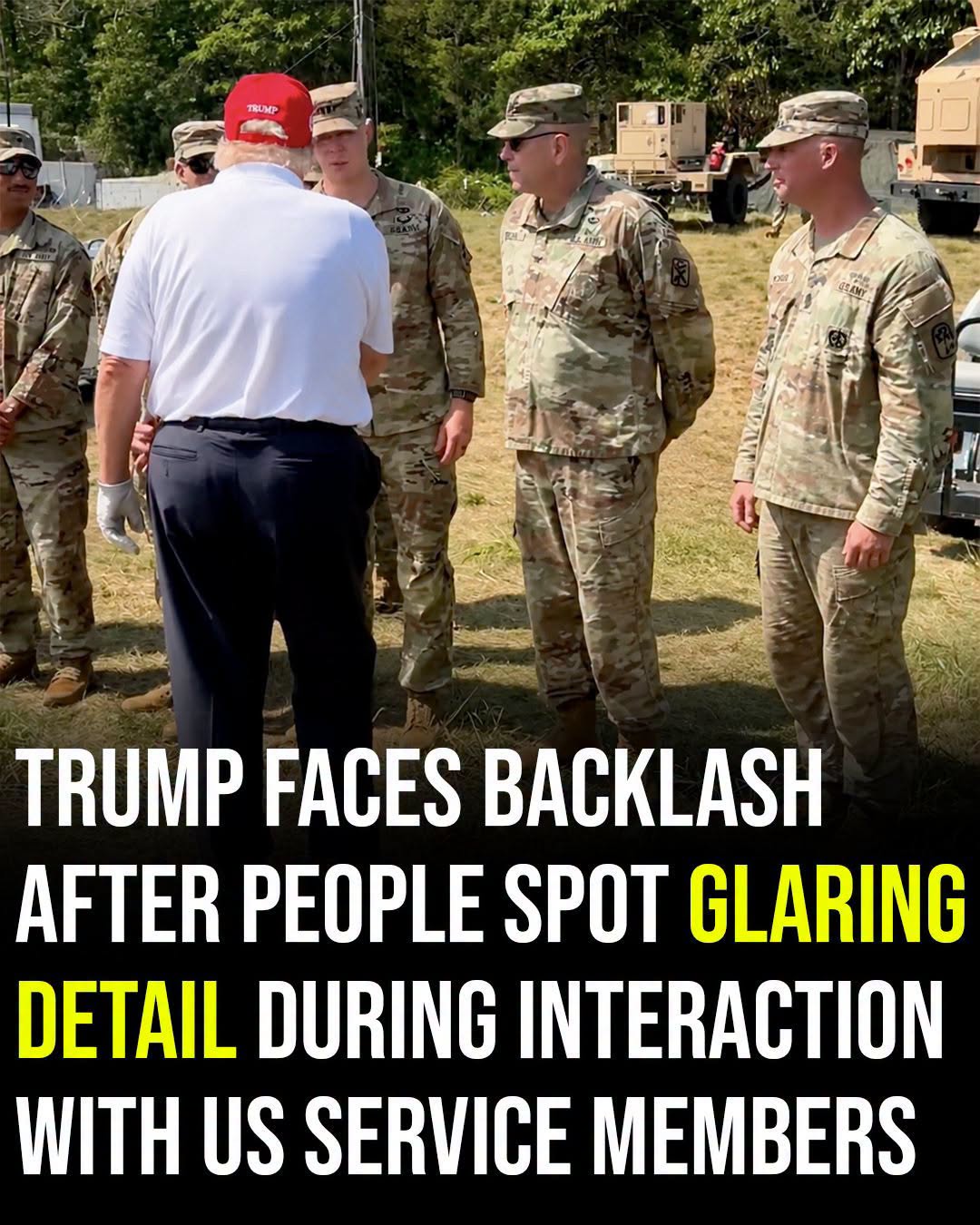
Trump emerged from a golf course in New Jersey wearing his familiar red MAGA hat, with a golf glove still on one hand. Nearby were members of the U.S. military, and Trump stopped to greet them, shaking hands and exchanging a few words before continuing on.
To some viewers, it appeared completely ordinary.
To others, the setting and timing made the encounter impossible to ignore.
The interaction came in the aftermath of a solemn ceremony connected to the transfer of the remains of four fallen U.S. service members. For critics, seeing Trump move directly from a recreational setting into an encounter with uniformed personnel created an image they considered uncomfortable and disrespectful.
The golf glove quickly became one of the most discussed details.
Critics argued that Trump could have removed the glove before shaking hands with members of the military, particularly given the seriousness surrounding the events taking place nearby. His red campaign-style hat also drew attention, with opponents saying that a political symbol had no place in a moment involving military service and sacrifice.
For those already critical of Trump, the clip seemed to reinforce longstanding concerns about the way he approaches public appearances involving the armed forces.
For supporters, however, the controversy represented something very different.
They argued that the interaction was being exaggerated and that there was nothing inherently disrespectful about greeting service members while wearing a golf glove or a familiar hat. To them, the important part was that Trump stopped to acknowledge the troops rather than ignoring them.
That disagreement reflects something larger than one brief encounter.
Military symbolism has always carried enormous emotional weight in American politics. Presidents, candidates, and other political figures regularly appear alongside service members, visit military bases, attend memorial ceremonies, and participate in events honoring fallen troops.
Because of that tradition, even small gestures can become politically significant.
A handshake can be interpreted as sincere respect by one person and as a staged photo opportunity by another.
A hat can be viewed as personal clothing by one audience and political messaging by another.
Even a golf glove can become symbolic when the person wearing it is a former president and current political figure meeting military personnel during a sensitive period.
Trump’s relationship with the military has been closely scrutinized throughout his political career.
His supporters frequently point to his administration’s emphasis on defense spending, military readiness, and support for veterans as evidence of his commitment to the armed forces.
His critics, meanwhile, have repeatedly questioned aspects of his rhetoric and behavior around military service.
His history of receiving draft deferments during the Vietnam era has remained part of that discussion for decades. Although the circumstances surrounding those deferments are well documented, opponents continue to reference them when questioning his relationship with military sacrifice.
That history helps explain why seemingly minor moments can generate such intense reactions.
For many veterans and military families, respect is not measured only by policy.
It can also be expressed through posture, language, attention, and small acts of courtesy.
That is why the golf glove became more than a glove in the online debate.
The criticism was not really about leather or fabric.
It was about symbolism.
Critics essentially asked whether someone who is standing before members of the military should take an extra moment to show that the encounter matters.
Supporters responded that respect should be judged by the totality of a person’s actions rather than a single frame captured on camera.
They pointed to Trump’s long history of appearing with military personnel and speaking publicly about the armed forces. From their perspective, treating the glove as evidence of disrespect ignores the broader context.
The controversy also demonstrates how dramatically political images can change depending on who is watching.
The same video can produce completely opposite interpretations.
One viewer sees a politician casually greeting American troops.
Another sees a political figure treating a solemn situation like another stop on a busy public schedule.
Neither interpretation can necessarily be established from a few seconds of footage alone.
There is also the unavoidable presence of Trump’s political identity.
The red MAGA hat is not simply a piece of clothing to millions of Americans. It has become one of the most recognizable symbols of the modern Republican movement and Trump’s political brand.
That means an image of Trump wearing the hat while meeting service members is almost guaranteed to be interpreted politically.
Supporters may see it as a reminder of his political movement and his promises to strengthen the military.
Critics may see it as evidence that campaign imagery follows him into places where they believe it should not.
The argument therefore extends beyond the handshake itself.
It becomes a debate over where politics should end and ceremony should begin.
Should political leaders be expected to completely separate their political identities from public appearances?
Should small gestures of etiquette carry greater significance when military personnel are involved?
Or has social media created an environment in which every ordinary interaction is transformed into evidence for a political argument?
The answer depends heavily on personal perspective.
What is clear is that the encounter struck a nerve.
Within a short period, the footage became another piece of a much larger conversation surrounding Trump, military culture, and the expectations placed on public figures.
The incident also illustrates how little context is sometimes required to create a national controversy.
A few seconds of video.
A red hat.
A golf glove.
A handshake.
And suddenly, viewers are debating patriotism, military respect, political branding, and presidential character.
That is the reality of modern political media.
Images no longer disappear when the moment ends. They are clipped, reposted, slowed down, analyzed, criticized, defended, and turned into competing narratives.
For Trump’s critics, the encounter was another example of a politician they believe too often treats serious moments casually.
For his supporters, it was simply another manufactured controversy surrounding a man they believe is unfairly scrutinized.
Somewhere between those interpretations is a much simpler reality: a brief encounter happened, and millions of people brought their own expectations to it.
Perhaps that is why the controversy has lasted longer than the interaction itself.
Military service carries enormous emotional significance in the United States, particularly when fallen troops are involved. People expect solemnity, gratitude, and respect when the subject is sacrifice.
At the same time, public figures remain human beings moving through ordinary moments, and not every imperfect gesture necessarily reveals someone’s true feelings.
The debate over Trump’s golf course encounter ultimately says as much about the country’s political divide as it does about the man at the center of the footage.
For some Americans, respect must be visible in every detail.
For others, intention matters more than appearances.
And in an era when a few seconds of video can become a national argument overnight, even the smallest gesture can suddenly carry the weight of something much bigger.