What began as a simple collection of photos quickly transformed into one of the internet’s most heated parenting debates.
Within hours, thousands of comments appeared beneath images featuring two celebrity children who have spent much of their lives growing up in the public eye.
People weren’t simply discussing fashion.
They weren’t just talking about Halloween costumes or hairstyles.
Instead, they began making sweeping assumptions about parenting, family life, and what they believed those children represented.
It was a conversation that revealed far more about social media than it did about the families involved.
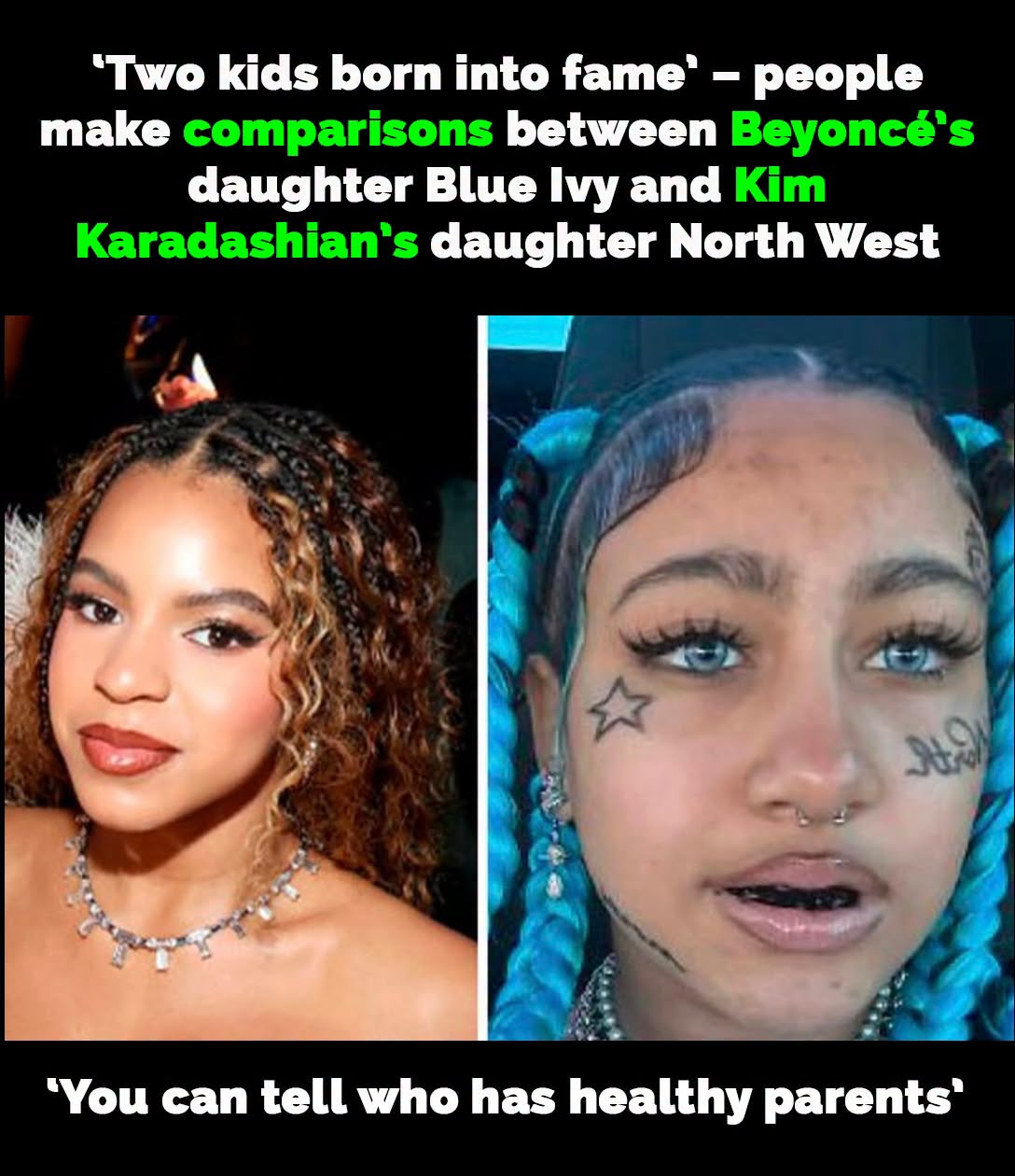
The comparison centered on Blue Ivy Carter, the daughter of Beyoncé and Jay-Z, and North West, the daughter of Kim Kardashian and Kanye West.
Both children have become familiar faces despite their young ages.
Every public appearance generates headlines.
Every new photograph attracts attention.
Every outfit becomes a topic of discussion.
This time, however, the reaction reached another level.
One image showed North embracing a bold Halloween-inspired style, complete with dramatic clothing and an eye-catching look designed for the occasion.
Another image highlighted Blue Ivy with a more understated appearance.
Almost immediately, many online users began placing the two girls side by side.
What followed was less about fashion and more about judgment.
Some commenters praised one child while criticizing the other.
Others argued that one appearance reflected “good parenting,” while the other supposedly revealed deeper problems inside a family.
Without knowing either child personally, strangers confidently analyzed their personalities, emotional well-being, and home lives.
A costume became evidence.
A hairstyle became a statement.
A single photograph became the foundation for conclusions that no image could possibly support.
Perhaps the most troubling aspect of the discussion was how quickly childhood disappeared from the conversation.
Neither girl had asked to become the center of a cultural debate.
Neither had written the headlines.
Neither had posted the comments.
Yet both found themselves discussed as though they represented competing philosophies of parenting.
Many people forgot one very important fact.
They are children.
Children naturally experiment with clothing.
They play different characters.
They imitate musicians, actors, athletes, and fictional heroes.
One week they want colorful hair.
The next they prefer simple clothing.
Their interests constantly evolve as they discover who they are.
This kind of exploration has always been part of growing up.
The only difference today is that celebrity children experience those ordinary stages under extraordinary public attention.
For families outside the spotlight, a child wearing an unusual costume usually becomes a funny memory stored inside a family photo album.
For celebrity families, that same moment may become international news.
Millions of people see it.
Thousands feel entitled to evaluate it.
Hundreds confidently explain what it supposedly reveals about parenting.
The pressure placed upon famous children has grown significantly with the rise of social media.
In previous generations, celebrity children might occasionally appear in magazines or newspapers.
Today, nearly every public outing can become global content within minutes.
A simple walk through an airport.
A family vacation.
A birthday party.
A shopping trip.
Each moment has the potential to become another internet discussion where complete strangers debate decisions made by parents they have never met.
As criticism spread online, many voices began pushing back.
Numerous commenters reminded others that children deserve space to grow without constant judgment.
They questioned why adults felt comfortable assigning labels to young people based on isolated photographs.
Some pointed out that Halloween has always encouraged imagination and creative expression.
Others emphasized that fashion experimentation during childhood is entirely normal.
Most importantly, many argued that parenting cannot be measured through snapshots shared online.
A photograph captures only a fraction of a second.
It cannot reveal what happens before or afterward.
It cannot show bedtime conversations.
Family traditions.
Acts of kindness.
Daily routines.
Support during difficult moments.
Encouragement after failure.
Laughter around the dinner table.
Those experiences shape childhood far more than any public appearance ever could.
The discussion also raised broader questions about how society views different family structures.
Some individuals attempted to connect children’s appearances with their parents’ relationships, suggesting that one family model naturally produced better outcomes than another.
Others strongly rejected those claims.
Families exist in countless forms.
Some children grow up with two married parents.
Others are raised by single parents.
Some divide time between two households.
Others are cared for by grandparents, adoptive parents, or extended family members.
Love, stability, guidance, and emotional support are not determined by a single family structure.
They are created through everyday actions.
Reducing a child’s entire identity to their parents’ relationship status ignores the complexity of real life.
Children should never become symbols used to support arguments they had no part in creating.
Experts in child development have long emphasized the importance of allowing young people opportunities to explore identity safely.
Clothing.
Music.
Hairstyles.
Art.
Creative expression.
These are common ways children begin discovering who they are as individuals.
Most eventually outgrow many of those interests.
Others develop lifelong passions.
Either outcome is perfectly natural.
What matters most is having supportive adults who provide guidance while allowing healthy independence.
Celebrity children face an additional challenge.
Unlike most young people, their exploration often happens before millions of observers.
Every stage of growing up becomes permanent online.
Mistakes become headlines.
Fashion experiments become debates.
Ordinary childhood becomes public entertainment.
It is an unusual burden for anyone, especially someone still learning about themselves.
The internet often encourages quick judgments because strong opinions generate attention.
Balanced conversations rarely spread as rapidly as controversial ones.
A thoughtful observation may receive little notice.
An extreme accusation can circulate around the world within hours.
That environment rewards certainty even when certainty is impossible.
Fortunately, many people chose compassion instead.
Rather than comparing children, they encouraged others to remember what truly matters.
Confidence.
Kindness.
Curiosity.
Emotional security.
Respect.
Those qualities develop over years through relationships, not through isolated photographs posted online.
Perhaps the greatest lesson from the entire controversy has little to do with celebrity families themselves.
It concerns how society chooses to respond when children appear in public.
Adults have enormous influence over the conversations surrounding young people.
Every comment contributes either to protection or unnecessary pressure.
Every judgment either respects childhood or turns it into public spectacle.
The viral debate eventually faded, replaced by the internet’s next trending topic.
As always, another headline arrived.
Another controversy appeared.
Another discussion captured public attention.
Yet the questions raised by this moment remain important.
Can children simply enjoy childhood without becoming symbols for adult arguments?
Can society resist the temptation to analyze every photograph as evidence of something larger?
Can compassion become louder than criticism?
Ultimately, neither Blue Ivy nor North West needed strangers deciding what their appearances meant.
They needed exactly what every child deserves.
The freedom to explore.
The space to grow.
The opportunity to make ordinary childhood memories without carrying the weight of millions of opinions.
Perhaps the real measure of good parenting cannot be found in photographs at all.
Perhaps it is found in something much quieter.
Creating an environment where children feel safe enough to become themselves.
And perhaps the greatest responsibility belongs not only to parents, but also to everyone watching from the outside.
Sometimes the kindest thing we can do is stop turning children into headlines and simply allow them to be what they already are.
Children discovering the world one day at a time.