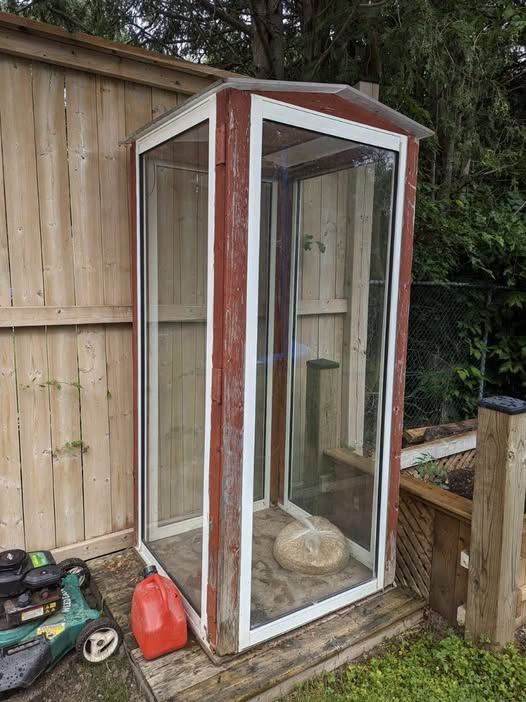
Hidden behind old houses, tucked away in forgotten corners of gardens, there was once a simple backyard structure that represented something much bigger than its purpose.
It was not a greenhouse filled with exotic plants.
It was not an expensive outdoor project.
It was not a modern invention designed to save time.
It was a small mushroom fruiting house.
To many people today, the idea sounds unusual, almost like something from another era.
But for those who remember them, these quiet little spaces carried a special kind of magic.
They were places where patience mattered.
Where nature moved at its own pace.
Where a child could step outside one morning and discover that something had changed overnight.
A tiny mushroom pushing through the growing medium.
A new cluster appearing in a shaded corner.
A small reminder that life was always happening, even when nobody was watching.
In a world now dominated by instant results, fast deliveries, and constant digital distractions, the return of the backyard mushroom house represents something surprisingly meaningful.
It is not simply about growing food.
It is about reconnecting with time.
It is about remembering what it feels like to create something slowly and watch it develop through care and attention.
For many older generations, these structures were part of everyday life.
They were often built from whatever materials were available.
Old windows that had been replaced.
Scrap pieces of wood.
Unused boards from previous projects.
A shaded area behind the home where temperatures stayed cooler.
Nothing about them was luxurious.
Their beauty came from their simplicity.
A small enclosed space could become its own miniature ecosystem.
Inside, humidity could be maintained.
Temperature could be controlled.
Mushrooms could grow away from direct sunlight, protected from harsh weather and changing conditions.
What looked like an ordinary backyard corner became a place full of quiet activity.
The process itself required a different mindset.
Unlike many modern hobbies where results appear immediately, mushroom growing rewards patience.
There is no button to press.
No shortcut that guarantees success.
You prepare the space.
You create the right environment.
You check conditions carefully.
Then you wait.
That waiting is often the most valuable part.
In those days of waiting, people learned something modern life often forgets.
Not everything meaningful happens quickly.
Growth takes time.
Progress is sometimes invisible before it becomes obvious.
A garden, a plant, or a mushroom culture does not respond to impatience.
It responds to consistency.
This simple lesson is one reason these forgotten backyard structures deserve attention again.
They offer a chance to slow down in a world that rarely allows people to pause.
Building a mushroom fruiting house today does not require recreating an old-fashioned farm.
It can be a small personal project.
A wooden frame.
A few recycled materials.
A shaded location.
A little research and care.
The structure itself becomes part of the experience.
There is something deeply satisfying about creating a space with your own hands.
Modern life often separates people from the things they consume.
Food appears packaged in stores.
Products arrive at the door with a few clicks.
The effort behind creation becomes invisible.
A mushroom house reverses that process.
It brings people closer to the origin of what they eat.
It allows them to see the work involved.
The waiting.
The mistakes.
The adjustments.
The eventual reward.
And the reward is not only the harvest.
It is the connection created along the way.
Walking into a small fruiting house can feel surprisingly peaceful.
The air is cooler.
The environment is quieter.
The outside world seems distant.
There is no endless stream of notifications.
No constant demand for attention.
Just a simple space where something is growing.
For many people, that feeling alone is valuable.
The structure becomes more than a growing area.
It becomes a place for reflection.
A place to escape the speed of everyday life.
A place where people can reconnect with their surroundings.
Families especially can benefit from experiences like this.
Children growing up surrounded by technology often have fewer opportunities to witness slow natural processes.
A mushroom house offers a different kind of education.
It teaches observation.
Responsibility.
Patience.
A child who checks a growing space every day learns that care creates results.
They learn that not every reward arrives immediately.
They discover that nature follows its own schedule.
Those lessons extend far beyond mushrooms.
They shape how people understand effort, responsibility, and persistence.
Adults benefit from the experience as well.
Many people spend their days working indoors, surrounded by screens and artificial environments.
Creating something physical provides a different type of satisfaction.
There is a unique feeling that comes from building, planting, repairing, and maintaining something with your own hands.
The final result carries a personal story.
Every piece of wood has a purpose.
Every improvement reflects attention.
Every harvest represents time invested.
This is one reason older traditions often return.
People eventually begin searching for experiences that technology cannot replace.
They want activities that feel real.
They want hobbies that produce memories rather than simply consume attention.
A backyard mushroom house fits perfectly into that desire.
It combines sustainability, creativity, learning, and connection.
It also represents a more thoughtful relationship with resources.
Using recycled materials gives old objects new life.
Turning forgotten spaces into productive areas changes how people view their homes.
A small backyard corner that once served no purpose can become a place of discovery.
The mushrooms themselves are only one part of the reward.
The deeper harvest is something harder to measure.
Confidence.
Calm.
Connection.
The satisfaction of knowing you created something meaningful.
Perhaps that is why this forgotten backyard structure feels so relevant today.
It reminds people of a slower rhythm that many have lost.
A time when creating something did not require perfection.
When simple projects brought families together.
When waiting was not considered wasted time.
When the joy came not only from the final result, but from the process itself.
A mushroom fruiting house may appear small and ordinary.
But sometimes the most valuable things are hidden in simple places.
Behind an old fence.
Under a shaded corner.
Inside a handmade structure built from leftover materials.
There, something remarkable happens.
People slow down.
They pay attention.
They reconnect with nature and with themselves.
And in a world constantly asking everyone to move faster, perhaps the greatest comeback of all is the return of patience.