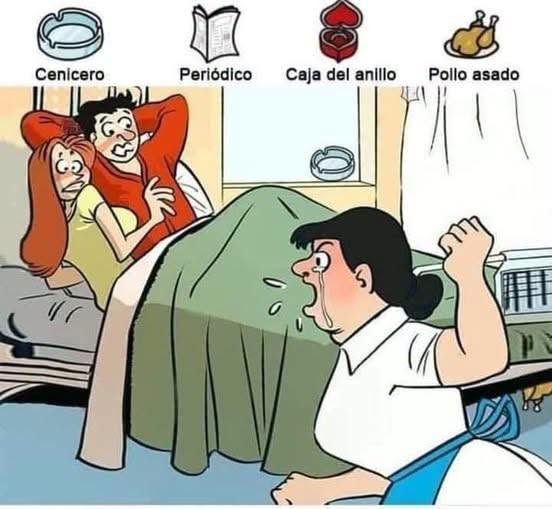
At first glance, this cartoon appears to be nothing more than a chaotic and funny scene filled with dramatic expressions, unusual characters, and a surprising situation unfolding in the middle of the room. Your eyes naturally follow the main action: the people, their reactions, and the story happening right in front of you.
But hidden inside the image are four cleverly disguised objects that most viewers completely overlook.
Somewhere within the scene are an ashtray, a newspaper, a ring box, and a roast chicken. They are not sitting in obvious places waiting to be discovered. Instead, they have been carefully blended into the artwork, using shapes, colors, shadows, and patterns to trick your brain into ignoring them.
That is exactly what makes this type of puzzle so addictive.
The challenge is not simply about having good eyesight. It is about understanding how your brain works. When you look at a picture, your mind automatically searches for important information first. Faces, movement, emotions, and familiar objects receive your attention before small details that seem irrelevant.
Hidden object puzzles take advantage of this natural habit.
They place unusual items in locations where your brain does not expect them to exist. Because you are focused on the obvious story, the hidden clues quietly disappear into the background.
Many people who attempt this puzzle make the same mistake. They search for objects exactly where they would normally appear in real life.
They look for the ashtray on a table.
They expect the newspaper to be lying on furniture.
They imagine a ring box sitting inside someone’s hand.
They search for the roast chicken on a plate.
But this puzzle does not follow ordinary logic. The objects are hidden where they blend in, not where they belong.
That is why even people with excellent observation skills often miss at least one.
The first hidden object is the ashtray.
Many viewers immediately scan the furniture around the room, assuming the ashtray must be sitting somewhere obvious. They check the bedside area, shelves, and surfaces, but nothing seems to stand out.
The trick is to stop looking for the object itself and start looking for unusual shapes.
The ashtray is cleverly disguised within the folds of the curtain beside the bed. The circular shape blends with the fabric’s curves and shadows, making it appear like nothing more than a natural part of the curtain design.
Your brain sees the folds, recognizes them as normal, and moves on.
That is why it is so easy to miss.
Once someone points it out, however, the illusion disappears. Suddenly, the shape seems obvious, and you wonder how your eyes ignored it in the first place.
The second hidden object is the newspaper.
This one might be the most surprising because it is placed in a location where almost nobody thinks to search.
Instead of being on a table or held by one of the characters, the newspaper is hidden in the man’s hair.
The lines and patterns created in his hairstyle mimic the appearance of folded newspaper pages. The shading gives the impression of printed sections, while the shape blends naturally with the rest of his appearance.
Because people are not used to seeing newspapers connected with someone’s hair, the brain rejects the possibility before it even considers it.
This is a common trick in visual puzzles. The artist uses something familiar but places it somewhere unexpected, forcing the viewer to question what they are actually seeing.
The third hidden object is the ring box.
This object is hidden near the woman lying in the scene, disguised as part of her hairstyle.
The small red shape in her hair looks like a decorative accessory at first. Many viewers assume it is simply part of her appearance and never investigate further.
But when examined carefully, the details reveal another story.
The shape, edges, and small clasp-like feature give away that it is actually a ring box cleverly integrated into the design.
This is what makes hidden object puzzles so fascinating. The answer is often visible from the beginning, but your brain labels it as something else.
You are not failing to see the object.
You are simply interpreting it differently.
The final hidden object is the roast chicken, and it may be the strangest hiding place of all.
Unlike the other objects, which are blended into characters or nearby objects, the roast chicken is hidden higher up in the scene near the curtain area.
At first, many people mistake it for a shadow, decoration, or random part of the background. The unusual shape does not immediately register as food because it is placed somewhere completely unexpected.
But once you focus on the outline, the familiar shape begins to appear.
The curved body, the recognizable shape of the drumsticks, and the overall silhouette reveal the hidden roast chicken hiding in plain sight.
Finding all four objects requires more than simply staring harder. The secret is changing the way you look.
Instead of focusing only on the main characters, examine the background.
Instead of searching for realistic placement, look for things that feel slightly out of place.
Ask yourself questions like:
Why does that shape look different?
Why does that shadow seem unusual?
Why is that pattern slightly strange?
Those small moments of curiosity are often where the hidden answers are waiting.
The reason these puzzles continue to attract millions of people is because they reveal something interesting about human perception. We like to believe we notice everything around us, but our brains constantly filter information to avoid becoming overwhelmed.
Every second, we are surrounded by countless details. If our minds paid equal attention to everything, everyday life would become impossible.
So the brain creates shortcuts.
It focuses on what appears important and ignores what seems ordinary.
Hidden object puzzles challenge those shortcuts.
They remind us that sometimes the things we overlook are not invisible. They are simply waiting for us to slow down and pay attention.
Whether you found all four objects immediately or needed a few hints, the real fun comes from the discovery itself. These puzzles turn a simple cartoon into a mental workout, encouraging patience, concentration, and a willingness to look beyond the obvious.
The ashtray hidden in the curtain, the newspaper disguised in the hair, the ring box blended into the hairstyle, and the roast chicken hidden in the background all prove the same thing:
Sometimes the hardest things to find are the ones sitting right in front of us.
A second look can reveal an entirely different picture.