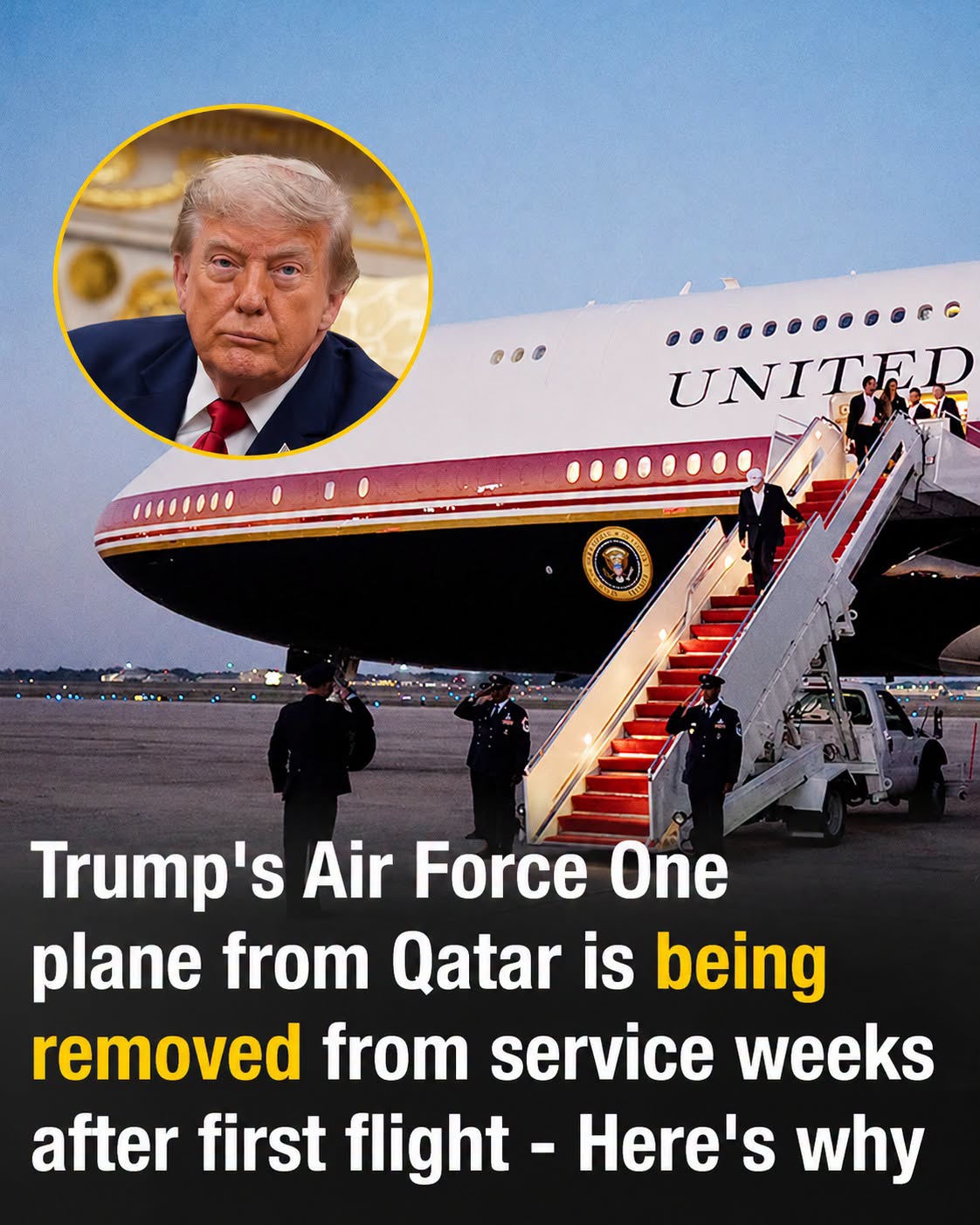
When Donald Trump unveiled the luxurious Boeing 747 that had quickly become known as his new Air Force One, the aircraft was presented as far more than just a presidential airplane. It represented power, prestige, and technological superiority, becoming one of the most talked-about symbols of his presidency almost overnight.
The enormous jet, reportedly valued at around $400 million, was originally provided by Qatar before undergoing extensive work to prepare it for presidential use. Its arrival generated headlines around the world, with supporters praising it as an extraordinary addition to the presidential fleet while critics questioned both its origins and the speed with which it entered service.
For a brief moment, the aircraft seemed destined to become one of the defining images of Trump’s time in office.
Then, only weeks after its first official flight, everything changed.
The aircraft was quietly removed from active service.
The announcement surprised political observers, aviation experts, and many Americans who had expected the aircraft to remain in regular use for years.
Instead, the jet disappeared from public view almost as quickly as it had arrived.
Naturally, speculation exploded.
Why would an aircraft that had received so much attention be withdrawn after such a short period?
Was something seriously wrong?
Had a mechanical failure been discovered?
Or was there a deeper story unfolding behind closed doors?
The aircraft first entered public service during Trump’s July 1 trip to North Dakota, where the gleaming Boeing immediately attracted attention.
Trump himself appeared genuinely impressed by the aircraft.
He publicly praised its appearance, comfort, and engineering, describing it as one of the finest airplanes ever built.
Television cameras captured dramatic images of the massive jet sitting on the runway while photographers documented nearly every angle.
Its polished exterior, upgraded interior, and enormous size reinforced the image of presidential power.
For many supporters, the airplane symbolized American strength.
For critics, however, the celebration raised uncomfortable questions almost immediately.
Unlike previous presidential aircraft built specifically through long-established government procurement programs, this plane carried unique political baggage.
Its connection to Qatar sparked immediate constitutional debate.
Legal scholars, ethics experts, and political commentators questioned whether accepting such an expensive gift from a foreign government could create conflicts of interest or violate long-standing constitutional principles regarding gifts from foreign states.
The debate became increasingly heated.
Supporters argued that the aircraft ultimately belonged to the United States government and represented a valuable asset for taxpayers.
Opponents argued that the symbolism alone created unnecessary ethical concerns.
Before those questions could fully settle, another issue emerged.
Security.
Unlike ordinary commercial aircraft, Air Force One is far more than a luxury airplane.
Every presidential aircraft functions as a highly secure flying command center capable of operating during national emergencies.
Its communications systems, defensive technologies, and classified equipment are designed to protect both the president and national security under extraordinary circumstances.
Transforming an existing commercial airplane into a true presidential aircraft is an incredibly complex process.
Many of the modifications remain classified.
However, aviation specialists understand that they include encrypted communications, electronic warfare capabilities, missile defense systems, hardened electrical infrastructure, secure command facilities, and numerous other technologies unavailable on civilian aircraft.
Reports soon suggested that some of these highly specialized upgrades were either incomplete or still undergoing installation.
Although officials declined to discuss classified capabilities publicly, the reports generated immediate concern.
Questions centered on whether the aircraft had entered service before every required security enhancement had been fully completed.
Government officials responded carefully.
They emphasized that withdrawing the aircraft did not indicate failure.
Instead, they described the decision as part of an ongoing modernization process intended to ensure the aircraft eventually meets the highest operational standards expected of a presidential transport.
According to official statements, additional work remained necessary before the aircraft could permanently join the presidential fleet.
The explanation sounded straightforward.
Yet it did little to slow public speculation.
Many observers wondered why the airplane had been introduced so publicly if further significant modifications were still required.
Others viewed the temporary withdrawal as evidence that preparing presidential aircraft is even more complicated than most people realize.
In reality, converting any Boeing 747 into Air Force One is an enormous engineering challenge.
Every modification must satisfy military specifications while maintaining exceptional reliability.
Even seemingly minor systems require extensive testing before receiving final approval.
Unlike ordinary passenger jets, presidential aircraft cannot afford uncertainty.
Every communication system must function perfectly.
Every defensive system must operate immediately if needed.
Every backup system must remain available under virtually any circumstance imaginable.
Achieving that level of readiness takes time.
Sometimes much more time than initially expected.
As work continued behind the scenes, Trump reportedly returned to using an older presidential aircraft already familiar to government crews.
While less glamorous than the newly modified Boeing, the existing aircraft had undergone years of testing and operational use.
Its capabilities were already fully integrated into presidential security procedures.
For practical purposes, it represented the safest available option while additional work proceeded on the newer plane.
Still, the contrast proved striking.
Only weeks earlier, cameras had celebrated the arrival of the luxurious new aircraft.
Now it had disappeared almost entirely from public attention.
Its hangar doors remained closed while technicians continued their work away from television cameras.
The entire episode highlighted an interesting reality about presidential transportation.
Most people focus on luxury.
They imagine spacious cabins, elegant furnishings, conference rooms, and comfortable seating.
Those features certainly exist.
But they represent only a small portion of what makes Air Force One extraordinary.
Its true purpose has always been security.
The aircraft exists to ensure that the president can govern, communicate with military leaders, and remain protected under nearly any circumstance.
Comfort comes second.
Security comes first.
Every modification, inspection, and delay ultimately reflects that priority.
Political symbolism inevitably became part of the conversation as well.
For Trump, whose public image has long emphasized grand displays of success and confidence, the aircraft represented another powerful visual statement.
Its arrival fit naturally into a presidency often associated with dramatic presentation and carefully managed public imagery.
Its temporary disappearance, however, reminded observers that symbolism cannot replace engineering.
No matter how impressive an aircraft appears, it cannot fulfill its mission until every critical system performs exactly as required.
That reality extends beyond politics.
Modern presidential aircraft operate under standards unlike those applied to any commercial airline.
Every decision undergoes extraordinary scrutiny because the consequences of failure are simply too great.
As modifications continue, government officials maintain that the aircraft remains part of long-term planning rather than being permanently abandoned.
Once every required system has been installed, tested, and certified, it is expected to return to presidential service.
Until then, much of its work will remain hidden from public view.
Classified upgrades rarely generate dramatic headlines.
Technicians working inside secure hangars seldom attract television cameras.
Yet those quiet efforts ultimately matter far more than ceremonial first flights or polished photographs on airport runways.
In the end, the story of Trump’s $400 million presidential aircraft is not simply about an expensive airplane.
It reflects the complicated intersection of politics, national security, diplomacy, engineering, and public perception.
For a few weeks, the aircraft dominated headlines as a symbol of prestige.
Then it became something entirely different.
A reminder that beneath every display of presidential power lies an enormous network of experts working behind the scenes to ensure that appearance never comes at the expense of safety.
Long after the headlines fade, that invisible work will determine whether the aircraft ultimately earns its place among the most secure and sophisticated airplanes ever built.