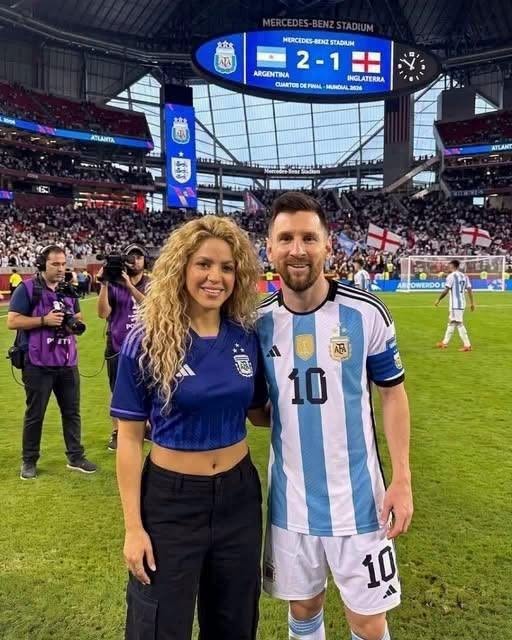
For a few seconds, it looked like one of the biggest football moments imaginable had just happened.
The image appeared to show Lionel Messi standing inside a packed stadium after a dramatic World Cup quarterfinal, surrounded by flashing lights, roaring fans, national flags, and a scoreboard displaying what seemed like a historic result.
The scene felt perfect.
Too perfect.
Millions of people who saw the image immediately reacted as if they were witnessing a genuine sports memory being created in real time. The atmosphere looked authentic. The details appeared convincing. Everything seemed carefully designed to capture the emotion of a legendary football night.
But there was one problem.
The moment never happened.
What spread across social media was not a leaked photograph from the future or a hidden image from an unforgettable match.
It was a carefully created piece of synthetic media designed to look like reality.
And that is exactly why so many people believed it.
The image succeeded because it used all the visual ingredients our brains associate with a major sporting event.
A legendary player.
A huge stadium.
Bright floodlights.
A dramatic scoreboard.
A sea of supporters celebrating.
Every element worked together to tell a story before anyone even questioned whether the story was true.
Our minds are naturally drawn to complete narratives.
When we see Lionel Messi in a football stadium, surrounded by the symbols of competition and victory, our brains immediately begin filling in the gaps.
We do not just see an image.
We imagine the match.
The goals.
The celebration.
The emotions.
The history.
That emotional reaction is what makes realistic fake images so powerful.
They do not need to convince everyone.
They only need to create enough realism that people stop questioning.
However, when the image is examined more carefully, small details begin to reveal the truth.
The lighting does not completely match.
Some shadows appear unnatural.
Certain parts of the image have a polished, almost artificial quality.
The faces appear unusually smooth, lacking the tiny imperfections that naturally appear in real photographs.
Even the expressions seem slightly different from genuine human reactions.
One of the biggest clues comes from the small details that many viewers ignore.
The scoreboard.
The text.
The background elements.
In a real broadcast image, every piece of information follows a consistent style. Graphics, languages, logos, and displays are created by professional production teams following strict formats.
Artificially generated images often struggle with these tiny details.
A word may appear slightly incorrect.
A logo may look almost right but not completely.
A combination of languages may feel unusual.
Individually, these details may seem insignificant.
Together, they reveal that something is not quite right.
That is what makes this type of fake content so fascinating.
The image is not obviously impossible.
It is almost believable.
And “almost believable” is often enough to create confusion.
Synthetic media has entered a new era where technology can create photographs, videos, and audio recordings that appear incredibly realistic.
The challenge is no longer simply identifying something that looks fake.
The challenge is recognizing something that looks real enough to fool our instincts.
A few years ago, obvious mistakes made artificial images easier to spot.
Strange hands.
Distorted faces.
Unusual objects.
But modern technology has improved rapidly.
Now, fake images can capture realistic lighting, detailed environments, and convincing human expressions.
The result is a new kind of uncertainty.
People are beginning to question moments they would have accepted immediately in the past.
A famous athlete appearing somewhere unusual.
A celebrity saying something unexpected.
A political figure caught in a shocking situation.
A viral image claiming to reveal something unbelievable.
The first reaction is often emotional.
The second reaction needs to be critical.
The Messi image became popular because it combined two powerful forces: admiration and imagination.
Messi is one of the most recognized athletes in history.
His career has been filled with unforgettable moments, dramatic victories, and emotional celebrations.
Because fans already know his story so well, they are more willing to believe a new chapter could exist.
The fake image does not feel random.
It feels like something that could happen.
That is the secret behind effective misinformation.
The strongest fakes are not completely absurd.
They are close enough to reality that people want them to be true.
They take existing hopes, expectations, and emotions and build a fictional moment around them.
In this case, the image created a fantasy scenario involving one of football’s greatest icons.
It offered fans a glimpse of a moment they might have loved to witness.
And that emotional appeal helped it spread.
But there is also a deeper lesson behind the viral reaction.
The problem is not only that fake images exist.
The bigger issue is how quickly people share them before checking.
Social media rewards speed.
The first person to post a shocking image gets attention.
The first account to create a dramatic headline gets clicks.
The first reaction often becomes the strongest impression, even if the information later proves false.
That is why digital awareness has become increasingly important.
A surprising image should not automatically be believed simply because it looks realistic.
Taking a few seconds to examine the source, compare information, and look for inconsistencies can prevent false stories from spreading further.
The goal is not to become suspicious of everything.
It is to become more thoughtful about what we accept as reality.
Technology can create incredible things.
It can produce art, entertainment, and creative possibilities that were impossible before.
But the same tools can also create convincing illusions.
The Messi image was not dangerous because it existed.
It was revealing because of how easily people accepted it.
A fictional stadium.
A fabricated scoreboard.
A moment that never happened.
Yet for a brief time, many people experienced it as if it were a real memory.
That is the strange power of modern synthetic media.
It does not just create fake images.
It creates fake moments that feel like they belong to our world.
And as technology continues advancing, the most important skill may no longer be simply seeing.
It may be knowing when to question what we see.