
At first glance, there is nothing unusual about the picture.
It looks like a quiet, familiar moment inside a bedroom. Two people are resting on a bed, the room feels calm, and every object appears to be exactly where it should be. There are no dramatic colors, no obvious tricks, and nothing that immediately suggests a puzzle is waiting to be solved.
That is exactly what makes it so challenging.
The human brain is incredibly good at recognizing familiar scenes. The moment we see a bedroom, our mind quickly creates a complete picture. We identify the bed, the people, the furniture, and the general atmosphere within seconds. Once our brain decides it understands the scene, it begins filtering out details that seem unnecessary.
That natural shortcut helps us move through everyday life efficiently.
But in a hidden-object puzzle, it works against us.
The objects are not always hidden because they are covered or invisible. They are hidden because our brains are not expecting them to be there.
This particular image takes advantage of that weakness perfectly.
Some details are easy to notice once you know where to look, while others are placed so cleverly that even careful observers can stare directly at them and still miss them.
The challenge is simple.
Find four hidden objects.
But the real test is not just your eyesight.
It is your ability to slow down, ignore your first impression, and look beyond what your brain has already decided is normal.
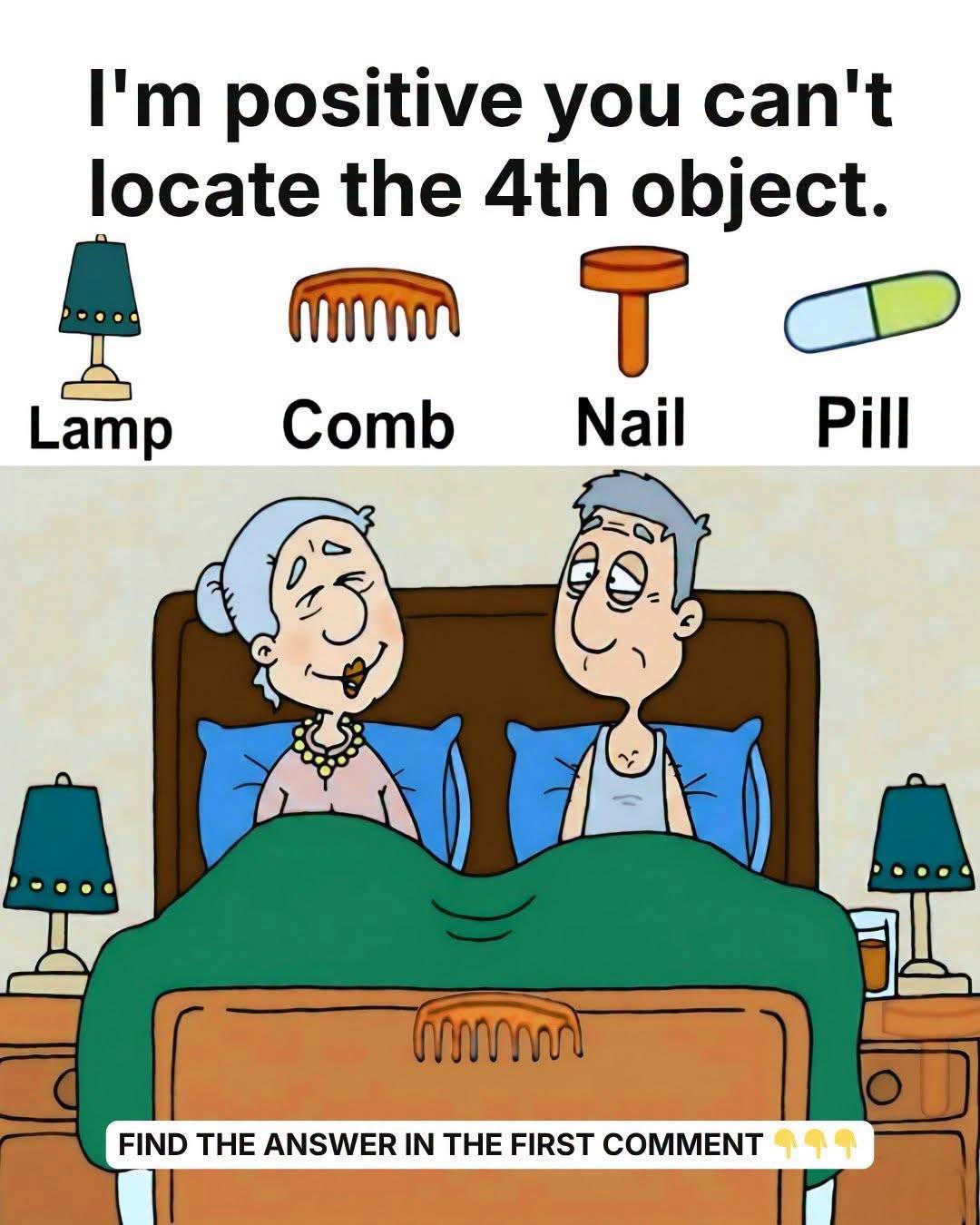
The first hidden object is one that many people discover relatively quickly.
The lamps.
At first, they may appear to be ordinary parts of the bedroom furniture, blending naturally into the background. But once you begin scanning the scene carefully, their placement and shape become easier to identify.
They are not hidden in a complicated way.
Instead, they rely on the viewer moving too quickly.
Many people focus immediately on the people in the image because human faces naturally attract attention. Our eyes are drawn toward expressions, emotions, and familiar features before we examine the environment around them.
That instinct causes us to overlook objects sitting right in front of us.
The lamps are a reminder that sometimes the easiest things to find are the things we never thought to search for.
The second hidden object requires a little more patience.
Somewhere near the foot area of the bed is a comb.
Unlike the lamps, the comb does not immediately match the main elements of the scene. It is smaller, less noticeable, and positioned where the eye does not naturally spend much time looking.
When people search these puzzles, they often concentrate on large areas first.
They examine faces.
They check clothing.
They look around the walls.
But small everyday items can disappear simply because they feel like they belong.
A comb near a bed makes perfect sense.
And because it feels natural, the brain accepts it without questioning whether it is part of the challenge.
That is one of the cleverest tricks used in hidden-object puzzles.
The best hiding places are often not dark corners.
They are places where your mind expects something ordinary to exist.
The third hidden object is even more deceptive.
A nail appears quietly placed within the scene, blending into the surrounding details.
Unlike a bright object that immediately catches attention, the nail depends on shape recognition. It does not announce itself. It simply exists among other lines, textures, and objects.
This is where many people begin to struggle.
Finding hidden objects is not only about seeing more.
It is about seeing differently.
Instead of asking, “Where is the object?” your brain needs to start asking, “What does not quite belong here?”
A strange shape.
An unusual line.
A detail that seems slightly out of place.
These small inconsistencies often reveal the answer.
The fourth hidden object is the one that leaves many people completely surprised.
The pill.
It is hidden inside the old woman’s mouth, positioned so subtly that the brain often interprets it as part of her natural features.
This is what makes it such an effective hiding spot.
Faces are among the first things humans learn to recognize. We are extremely skilled at processing expressions, emotions, and familiar patterns in someone’s appearance.
Because of that, the brain tends to protect the image of a face.
It fills in details automatically.
It ignores tiny irregularities.
A small object placed inside a facial feature can easily be dismissed because the mind assumes it understands what it is seeing.
Many people can search the entire room several times and still fail to notice it.
Then comes the moment when they finally see it.
And everything changes.
The image that once seemed simple suddenly feels different.
A comfortable bedroom scene can develop a strange sense of mystery because the viewer realizes something important:
They were not seeing everything.
They were only seeing what their brain allowed them to notice.
That is the fascinating psychology behind hidden-object puzzles.
They are not just games designed to test eyesight.
They reveal how human perception works.
Every day, people make quick judgments based on limited information. We recognize familiar surroundings, complete unfinished patterns, and ignore details that do not seem important.
Most of the time, this ability helps us.
Without it, the world would feel overwhelming.
Imagine having to consciously analyze every object, every sound, and every movement around you at all times.
The brain saves energy by focusing on what appears meaningful.
But sometimes that same shortcut causes us to miss things hiding in plain sight.
That is why puzzles like this are surprisingly valuable.
They encourage a different type of attention.
They teach patience.
They remind us to pause before assuming we already understand what we are looking at.
The next time you struggle to find something, whether in a puzzle or in real life, the solution may not be looking harder.
It may be looking slower.
Hidden details often reveal themselves when we stop searching for what we expect to find and start noticing what feels unusual.
Four small objects.
One ordinary room.
And one simple lesson:
The world is often filled with details we never notice because our minds are too busy deciding that they are not important.
Sometimes, all it takes is a little extra attention to discover what was there all along.