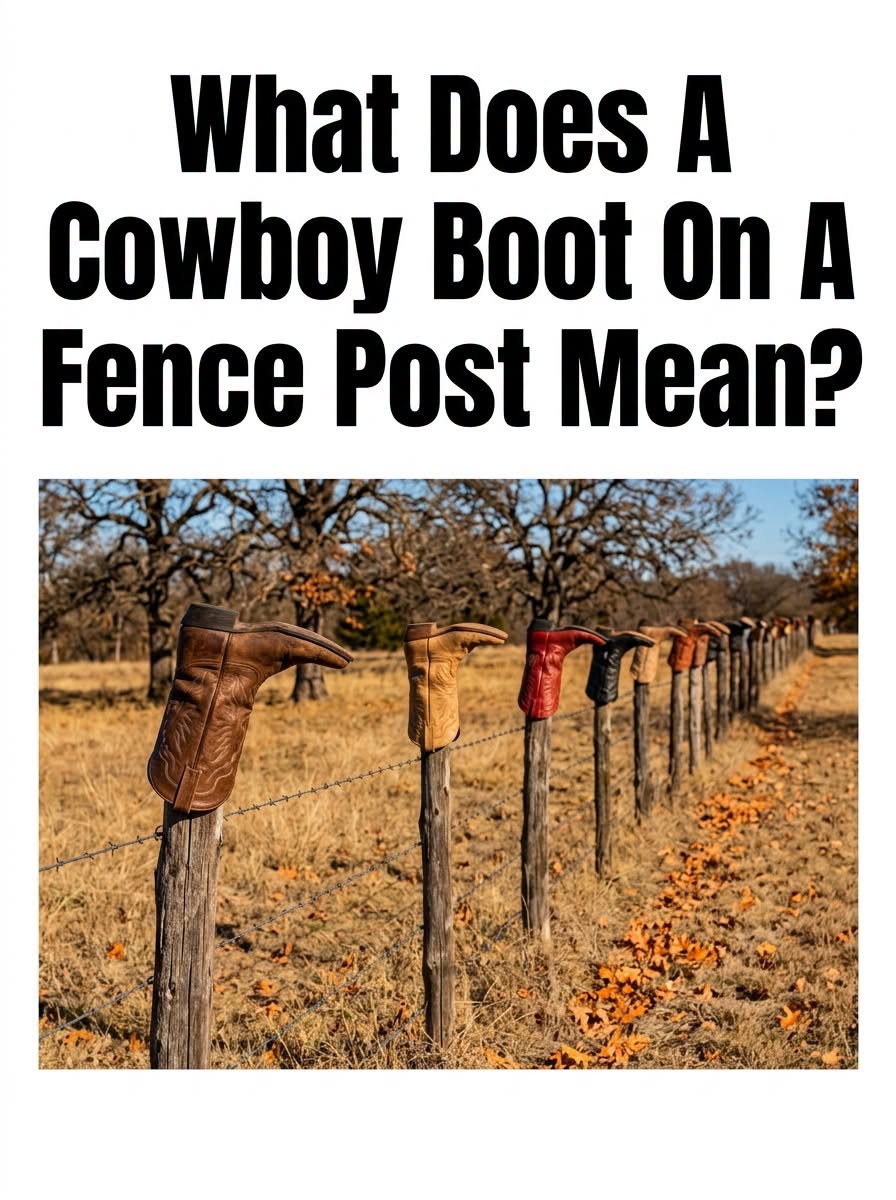
At first glance, it looks like nothing more than an old boot that someone forgot to throw away.
You’re driving along a quiet country road when you notice it.
A single worn-out work boot sits perched on top of a wooden fence post, weathered by years of sun, rain, and wind. Sometimes it’s a pair. Sometimes it’s a bright red cowboy boot that seems completely out of place. Other times it’s an old leather work boot so faded it almost blends into the landscape.
Most people barely give it a second thought.
Others assume it’s litter.
Some think neighborhood teenagers were playing a prank.
But in many rural communities, that lonely boot tells a story.
In fact, depending on where you are, it could carry decades of history, represent a personal tribute, mark an important location, or simply continue a tradition that has quietly survived for generations.
Like many pieces of rural folklore, there is no single explanation.
Instead, every boot has its own story.
For many farmers and ranchers, boots represent far more than footwear.
A good pair of work boots walks countless miles across fields, barns, pastures, and muddy trails. They endure freezing winters, scorching summers, heavy rain, and endless hours of hard labor.
They become part of everyday life.
Over time, the leather softens.
The soles wear thin.
Every scratch and stain reflects years of work.
Eventually, every pair reaches the point where it simply cannot be repaired anymore.
Throwing them into the trash almost feels disrespectful.
Instead, some workers choose to give those boots one final resting place.
Rather than disappearing into a landfill, the boots are placed on top of a fence post overlooking the very land they helped care for.
It becomes a quiet farewell.
A small tradition.
A simple way of honoring years of honest work.
Others see the practice as something even more personal.
Across ranching communities, boots on fence posts have occasionally served as memorials.
Sometimes the boots belonged to a rancher who spent a lifetime working that property.
After their passing, family members place the boots on a fence overlooking favorite fields or grazing land.
The boots remain standing where their owner once walked every day.
Visitors who know the story immediately understand their meaning.
To everyone else, they simply appear forgotten.
In some cases, the tribute extends beyond people.
Horse owners sometimes place old boots or horseshoes near pastures after losing a beloved horse.
For those families, the fence post becomes a place of remembrance rather than sadness.
It quietly acknowledges years of companionship shared across countless rides, competitions, and seasons.
Not every boot carries such emotional significance.
Sometimes, the explanation is much simpler.
Rural roads often stretch for miles with few recognizable landmarks.
Long before GPS navigation existed, people relied on memorable objects to give directions.
Instead of saying “turn left after exactly three miles,” someone might say:
“Drive until you see the boot on the fence.”
Everyone nearby immediately knew the location.
The unusual marker became more reliable than road signs that occasionally disappeared or faded over time.
Even today, longtime residents continue using these familiar landmarks.
A newcomer may wonder why an old boot sits beside the road.
The neighbors simply know that’s where you turn.
In some communities, boots have even become informal property markers.
One ranch may display an old brown work boot.
Another chooses a colorful cowboy boot.
Others decorate fence posts with painted boots that have become local landmarks in their own right.
Over the years, these small details become woven into community identity.
Then there are the pranksters.
Not every boot carries deep symbolism.
Some exist purely because someone wanted to make people smile.
Travel enough through rural America and you’ll occasionally spot boots that seem almost impossible to explain.
A sparkling high-heeled shoe balanced perfectly on a fence post.
A giant rubber boot mounted beside a cornfield.
A brightly painted cowboy boot decorated with flowers.
These unexpected displays often begin as harmless jokes between neighbors.
One person places the boot.
Another leaves it untouched.
Eventually everyone grows accustomed to seeing it.
Years later, nobody even remembers who started it.
The boot simply becomes part of the landscape.
Local residents may even give it a nickname.
Visitors stop to photograph it.
Children ask about it.
The mystery only adds to its charm.
Some ranchers have traditionally used boots as subtle signals.
In isolated farming areas, neighbors once relied heavily on visual communication.
A pair of boots hanging near an entrance could quietly indicate someone was home.
Fresh tire tracks might disappear after rain.
Vehicles could be hidden behind barns.
But the boots remained visible.
In some places, they suggested that someone was out working nearby.
Elsewhere, they hinted that visitors were welcome to stop by.
Coffee might already be brewing inside.
The exact meaning varied from one community to another.
There was rarely an official rule.
Everyone simply understood what the signal meant within their own local culture.
Like many rural traditions, these customs evolved naturally over time rather than being formally established.
Some people believe boots on fence posts also reflect the independent spirit of country life.
Life on farms and ranches has always encouraged practicality.
Rather than throwing something away immediately, people often find another use for it.
Old wagon wheels become garden decorations.
Rusty farm equipment turns into yard art.
Weathered barns become event spaces.
Retired boots simply find a new purpose watching over the land.
Even after they no longer serve your feet, they continue serving your memories.
That quiet practicality appeals to many people.
It reflects respect for hard work rather than unnecessary waste.
Today, social media has introduced these curious boots to entirely new audiences.
Photographs regularly appear online with captions asking:
“What does this mean?”
Thousands of responses usually follow.
Some insist it marks buried treasure.
Others joke that it scares away coyotes.
Many confidently provide explanations unique to their hometown.
The truth is that nearly all of them may be correct.
There isn’t one universal meaning.
A boot on a fence post means whatever the people who placed it intended.
That flexibility makes the tradition even more fascinating.
Every community adds its own interpretation.
Every family creates its own story.
Every old boot carries memories invisible to passing strangers.
Perhaps that’s why these simple objects continue capturing attention.
In a world increasingly filled with digital maps, satellite navigation, and disposable products, an old leather boot quietly reminds us that stories still live in ordinary places.
Not everything needs a sign explaining its purpose.
Sometimes the mystery itself becomes part of the tradition.
The next time you’re traveling through the countryside and notice a boot balanced on top of a weathered fence post, resist the urge to dismiss it as forgotten junk.
Pause for a moment.
Someone may have placed it there after decades of hard work.
It may honor someone deeply missed.
It may guide travelers toward the next turn.
It may simply exist because a neighbor wanted to make people smile.
Whatever the reason, it represents something larger than the boot itself.
It represents memory.
Tradition.
Community.
And the quiet understanding that even the smallest objects can preserve stories long after the people who created them are gone.
A weathered boot standing alone beside an empty road may not say a single word.
Yet for those who understand its meaning, it speaks volumes.