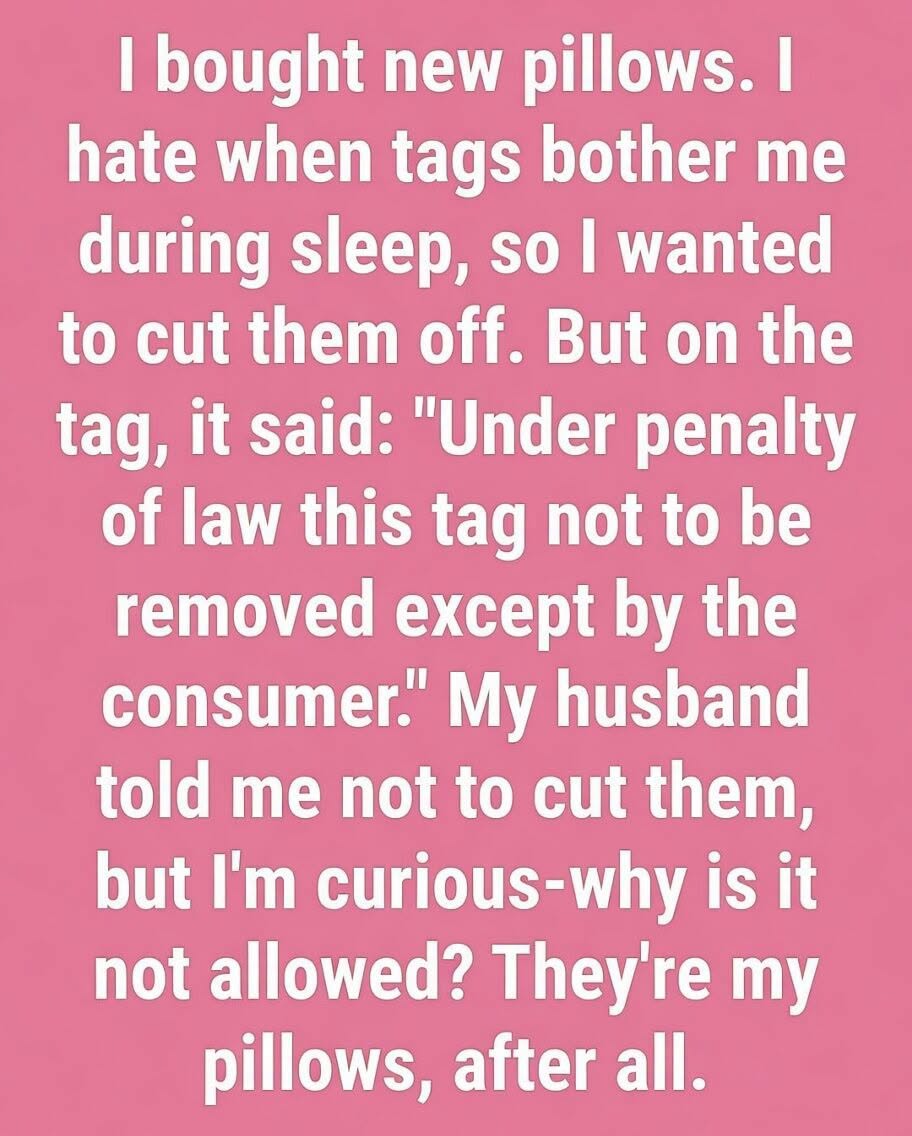
Almost everyone has noticed it.
You buy a brand-new pillow, mattress, or cushion, and hanging from the side is a stiff white tag covered with bold, intimidating words. Somewhere near the top, it usually says something that catches your attention immediately:
“UNDER PENALTY OF LAW.”
For years, those words have frightened countless people into believing that cutting off the tag could somehow get them into legal trouble.
Many children have grown up hearing parents warn them not to remove the label because “it’s against the law.”
Some adults still hesitate before reaching for the scissors, wondering if that tiny piece of fabric is somehow protected by mysterious regulations.
The truth, however, is much simpler—and much more interesting.
The warning was never intended for the person sleeping on the pillow.
It was written for someone else entirely.
To understand why those tags exist, you have to travel back more than a century.
During the late nineteenth and early twentieth centuries, mattresses and pillows were not manufactured under the strict safety standards people expect today.
Many companies were honest businesses using quality materials.
Others were not.
Some manufacturers filled bedding with whatever inexpensive materials they could find.
Old rags.
Dirty fabric scraps.
Animal hair.
Used stuffing.
Even materials taken from discarded or unsanitary products.
Customers often had no idea what they were actually buying.
A mattress might look clean on the outside while hiding low-quality or contaminated filling inside.
Since buyers could not easily inspect the contents, dishonest manufacturers sometimes cut costs by using recycled materials without telling anyone.
The result was growing concern about public health and consumer protection.
Governments eventually stepped in.
Laws were introduced requiring bedding manufacturers to clearly identify exactly what materials had been used inside pillows, mattresses, cushions, and similar products.
Instead of allowing companies to hide the contents, every item had to carry a permanent label describing the filling.
Cotton.
Foam.
Feathers.
Polyester.
Whatever was inside had to be disclosed.
This created greater transparency and helped customers make informed decisions.
But lawmakers faced another problem.
What if manufacturers simply removed the labels before selling the products?
To prevent that, regulations required the tags to remain attached while the item moved through manufacturing, transportation, distribution, and retail.
That is where the famous warning came from.
The phrase warning about legal penalties was directed at manufacturers, distributors, wholesalers, and retailers not the person buying the pillow.
Its purpose was to make sure businesses could not hide or alter information before the product reached its final owner.
Once you purchase the pillow, you become that final owner.
At that point, the law generally no longer requires you to keep the tag attached.
You can remove it if you want.
No fines.
No police.
No secret “bedding inspectors.”
No one is coming to your home because you cut a tag off your favorite pillow.
The misunderstanding has survived largely because very few people actually read the entire label.
Most tags contain small print explaining that the warning applies to people involved in manufacturing and selling the product.
The average customer usually notices only the large, bold words.
That dramatic language leaves an impression.
Parents repeated the warning to children.
Children grew into adults.
The myth continued.
Even today, many people admit they have avoided cutting off pillow tags simply because they were never completely sure whether the old warning was true.
In reality, the label serves several useful purposes beyond its legal history.
Even after purchasing the item, the information on the tag can still be valuable.
It often lists the exact materials used inside the pillow.
That information can be extremely helpful for people with allergies or sensitivities.
Someone allergic to certain fibers, feathers, or latex may need to know precisely what fills the pillow before using it.
The tag may also include cleaning instructions.
Some pillows can safely go into a washing machine.
Others require gentle hand washing or spot cleaning.
Some should never be placed in a dryer.
Removing the tag immediately means losing those care recommendations unless you record them elsewhere.
Warranty information is another reason some people leave tags attached.
Certain manufacturers may request identification details from the original label if a warranty claim becomes necessary.
While this is less common than it once was, it can still happen.
People who donate or resell bedding sometimes find the label useful as well.
A clearly marked pillow showing its materials and manufacturing details provides reassurance to the next owner.
The tag also represents something much larger than fabric and thread.
It tells the story of consumer rights.
Today, shoppers expect companies to disclose ingredients, nutritional information, fabric composition, safety warnings, and manufacturing details.
That level of transparency did not always exist.
The humble pillow tag represents one of the many ways governments gradually required businesses to become more honest about the products they sold.
It reminds us that consumer protections often develop because of problems people faced in the past.
The dramatic wording may seem outdated today.
Modern manufacturing standards are generally much higher than they were a century ago.
Most people never question what is inside a new pillow because they trust the information printed on the packaging.
Ironically, that trust exists partly because those regulations were created long ago.
Without them, consumers would have far fewer guarantees about what they were bringing into their homes.
So should you cut the tag off?
The answer is entirely up to you.
If the label scratches your neck, annoys you while sleeping, or simply gets in the way, removing it is generally perfectly acceptable once you own the pillow.
If you prefer keeping it for future reference, allergy information, care instructions, or warranty purposes, there is nothing wrong with leaving it attached either.
The choice belongs to you not the law.
The next time you notice that stiff white tag sticking out from the edge of a pillow, you may see it differently.
Instead of an intimidating legal warning, it becomes a small reminder of a time when consumers fought for honesty in the marketplace.
It is proof that even everyday household items have stories hidden inside them.
The pillow may help you sleep better.
The tag simply helps you know what you’re sleeping on.
And despite what generations of people have believed, the only thing stopping you from cutting it off is your own decision not the law.