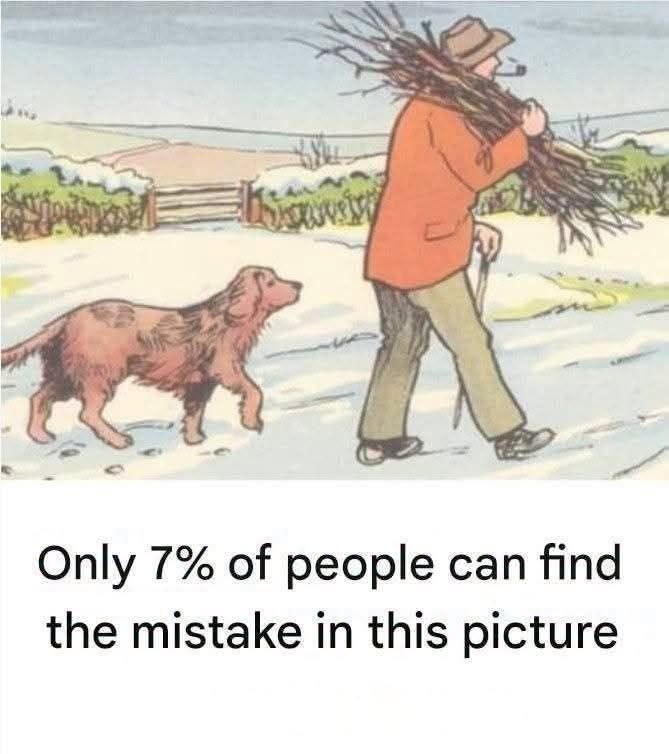
At first glance, it looks like the perfect winter postcard. A peaceful countryside landscape covered in fresh snow. A man taking a quiet walk with his loyal dog. A wooden fence stretching across the background. A calm field disappearing into the distance. Everything about the scene suggests warmth, simplicity, and a peaceful moment away from the noise of everyday life.
But there is something wrong.
Something that does not belong.
Hidden inside this ordinary winter picture is a small mistake that challenges your attention to detail. Most people look at the image and see a beautiful snowy day. They notice the man, the dog, the landscape, and the peaceful atmosphere.
Only a few stop long enough to question whether everything actually makes sense.
That is what makes these puzzles so fascinating.
They are not really testing how quickly you can look.
They are testing how carefully you can observe.
For generations, hidden-object puzzles and “spot the mistake” challenges have entertained people by encouraging them to slow down and notice details they would normally ignore. Many people remember childhood afternoons spent searching through puzzle books, comic pages, and magazines filled with confusing scenes where something was not quite right.
A missing object.
An impossible shadow.
A detail that breaks the rules of reality.
The fun comes from the moment when your brain finally catches the mistake and suddenly everything becomes obvious.
This snowy scene follows the same tradition.
At first, there seems to be nothing unusual.
The setting appears realistic.
Snow covers the ground and bushes, creating the quiet atmosphere of a cold winter morning. The man walks along a rural path, accompanied by his dog. In the distance, a fence separates the open field, adding to the peaceful countryside feeling.
The man appears comfortable in the environment. He carries pieces of wood, perhaps collecting supplies for a fireplace or preparing for a cold evening at home. A cane rests in his hand, and a cigar gives him the appearance of someone enjoying a slow, relaxing walk rather than rushing somewhere.
His dog walks beside him, leaving small marks behind in the snow.
Everything seems natural.
Everything seems believable.
Until you look closer.
The mistake is not hidden in the obvious parts of the picture. It is not the man’s clothing, the snowy landscape, or the objects he is carrying.
The problem is much smaller.
It is something happening on the ground.
Look carefully at the trail behind the dog.
The animal’s paw prints are visible in the snow, showing exactly where it has walked. Each step leaves behind evidence of movement. The snow records the dog’s journey across the landscape.
But something is missing.
The man is walking too.
Yet there are no footprints behind him.
This creates a strange contradiction.
If the dog is heavy enough to leave clear marks in the snow, the man walking beside it should also leave a trail. A person’s footsteps would normally press into fresh snow, creating visible impressions showing where each step was taken.
The environment follows one rule for the dog but ignores it for the man.
And that is the hidden mistake.
It is easy to miss because our brains naturally focus on the larger parts of an image. We notice faces, animals, objects, and scenery before we pay attention to small patterns on the ground.
The puzzle takes advantage of that habit.
The scene feels believable because most of the details are correct. The snow looks realistic. The clothing matches the season. The dog belongs in the setting. The countryside background makes sense.
Only one tiny inconsistency breaks the entire illusion.
That is why these challenges are so effective.
They remind us that seeing something is not the same as truly noticing it.
Our brains are constantly trying to process information quickly. In everyday life, this ability helps us make decisions faster and recognize familiar situations. But it also means we sometimes overlook details that are right in front of us.
A hidden-picture puzzle forces us to slow down.
It asks us to stop assuming.
It encourages us to examine the world with more curiosity.
The missing footprints may seem like a small error, but it reveals something interesting about human perception. We often accept what we see as true without questioning whether all the pieces fit together.
The image works because it creates a story.
A man.
A dog.
A snowy path.
A quiet winter walk.
Our minds fill in the gaps and create a complete picture before we ever analyze the details. We understand the scene emotionally before we understand it logically.
That is why the mistake can remain hidden for so long.
The answer was there from the beginning.
The footprints were the clue.
But many people never looked down.
Spotting the error quickly requires more than good eyesight. It requires patience, curiosity, and the willingness to question something that appears normal.
Those who found it in just a few seconds likely have strong observational skills. They notice inconsistencies, compare details, and do not simply accept the first impression.
For everyone else, the challenge still offers a valuable reminder.
Sometimes the things we overlook are not because they are invisible.
They are because we are not expecting them to be there.
A simple snowy scene becomes a lesson in attention.
A quiet walk becomes a mystery.
A peaceful picture becomes a test of how carefully we truly see the world around us.
The next time you look at an ordinary scene, whether it is a photograph, a painting, or a moment from everyday life, remember this puzzle.
The biggest clues are not always the loudest ones.
Sometimes the smallest missing detail is the thing that reveals the entire truth.