For most of her life, becoming a mother was not just a dream.
It was the future she imagined.
Year after year, however, life unfolded differently than she had expected. Responsibilities, setbacks, changing circumstances, and the relentless passage of time kept pushing that dream further into the distance. While friends celebrated pregnancies, birthdays, and growing families, she quietly wondered whether motherhood would always remain just beyond her reach.
As the years passed, people around her gradually stopped asking if she planned to have children.
Many simply assumed the opportunity had passed.
By the time she reached 58 years old, nearly everyone believed that chapter of her life had already been written.
Medical professionals were honest about the challenges.
Female fertility naturally declines with age, especially after the mid-30s, and the chances of conceiving become dramatically lower over time. Pregnancy later in life also carries greater health risks for both mother and baby, requiring careful medical supervision throughout every stage.
The statistics were not encouraging.
Doctors explained that success would be difficult.
There would be no guarantees.
Every step would require patience, careful planning, and close monitoring.
Yet despite the long odds, she refused to abandon hope.
Supported by experienced fertility specialists, she began a carefully managed treatment plan designed specifically for her unique situation. Every appointment, every blood test, every scan became another small step toward a possibility that many believed was impossible.
Hormone levels were monitored with extraordinary precision.
Medication schedules were followed exactly.
Doctors adjusted treatment based on how her body responded.
Each stage demanded both scientific expertise and emotional resilience.
Nothing happened overnight.
The process required weeks of waiting, uncertainty, and cautious optimism.
Then something remarkable occurred.
Her body responded to treatment in a way few expected.
Instead of releasing a single egg, multiple eggs matured successfully.
For women receiving fertility treatments, this can occasionally happen, increasing the possibility of multiple pregnancies.
Even then, fertilization is only one part of the journey.
The embryos must successfully implant and continue developing.
In her case, they did.
When doctors confirmed the pregnancy, excitement quickly mixed with careful concern.
Given her age, the pregnancy would be considered high risk from the very beginning.
Regular monitoring became essential.
Every ultrasound was important.
Every medical appointment brought new questions.
Would the babies continue developing normally?
Would her body tolerate the physical demands of pregnancy?
Would complications arise?
Throughout those months, physicians carefully watched both mother and babies.
Each milestone brought cautious celebration.
As the pregnancy progressed, another surprise emerged.
She was not carrying one baby.
She was carrying twins.
The news left family members overwhelmed with emotion.
After decades of believing motherhood might never happen, she was preparing to welcome not one child but two.
Twins have always fascinated people.
Throughout history they have inspired legends, traditions, and scientific curiosity.
Although multiple pregnancies are more common today because of fertility treatments, each twin pregnancy remains unique.
Doctors explained that several factors can contribute to twins, including family history, maternal age, fertility medications, and individual biology.
Still, no pregnancy unfolds exactly the same way.
Every mother and every set of twins has their own story.
Months later, the long-awaited day finally arrived.
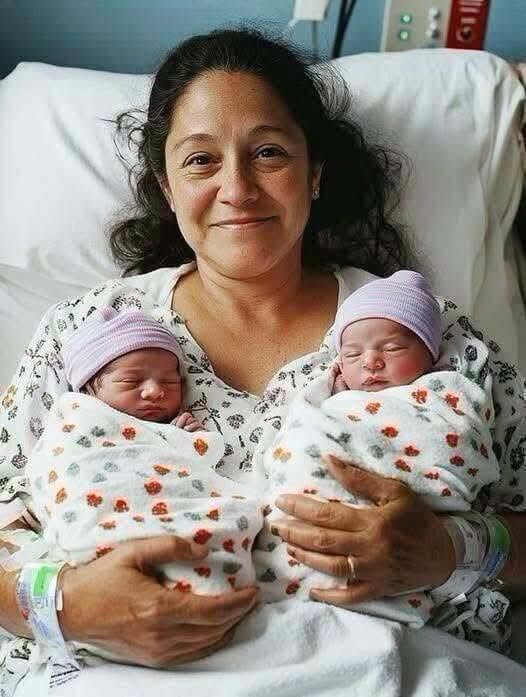
Under the care of an experienced medical team, she gave birth to two healthy babies.
The delivery marked the joyful conclusion of months filled with uncertainty, determination, and hope.
But the surprises were not over.
As doctors reviewed the family’s medical history and genetic information, they noticed something unexpected.
The twins carried the same uncommon genetic marker associated with multiple births that had appeared within their family across previous generations.
Although the exact genetics behind twinning remain complex and are not completely understood, researchers know that inherited tendencies can increase the likelihood of certain types of twin pregnancies in some families.
For her relatives, the discovery felt deeply meaningful.
It connected grandparents, parents, and now newborn twins through a remarkable biological thread stretching across generations.
What had begun as an extraordinary late-life pregnancy now seemed connected to a much longer family story.
The discovery fascinated doctors as well.
Medicine continues learning about the complex relationship between genetics, hormones, and fertility.
Scientists understand many of the biological processes involved in conception, but countless details remain under active research.
Every pregnancy contributes new information to that understanding.
This story also highlights the remarkable advances made in reproductive medicine.
Only a few decades ago, many pregnancies that are now medically possible would have been considered almost unimaginable.
Today’s fertility specialists use sophisticated techniques to evaluate hormone levels, monitor ovarian function, improve embryo implantation, and support pregnancies that once would have faced overwhelming obstacles.
Even with these advances, however, doctors emphasize that fertility treatment can never guarantee success.
Many hopeful parents endure years of disappointment before welcoming a child.
Others never receive the outcome they long for.
Science can improve possibilities, but it cannot completely control biology.
That is why stories like hers resonate so deeply.
They represent perseverance as much as medicine.
Throughout her journey, she often admitted that the hardest part was not the physical treatment.
It was protecting hope.
Hope can become fragile after years of disappointment.
Every setback makes future optimism more difficult.
Yet she continued believing there was still a chance.
Now, instead of wondering what might have been, she spends her days caring for two children whose arrival transformed every expectation she once had about her future.
Her story also reminds people that pregnancies later in life require careful medical guidance.
Doctors continue encouraging anyone considering pregnancy at an older age to seek professional evaluation, understand the potential risks, and receive individualized care throughout the process.
Every situation is different.
Age, overall health, family history, and medical conditions all influence pregnancy outcomes.
For this family, however, the statistics eventually gave way to something far more personal.
Two newborn cries.
Two tiny hands.
Two lives that arrived together against extraordinary odds.
Perhaps that is what makes this story so memorable.
It is not simply about giving birth at 58.
It is not only about twins.
Nor is it solely about genetics or modern medicine.
It is about resilience.
It is about refusing to let difficult odds become the final chapter.
Behind every medical breakthrough are real people carrying dreams, fears, and extraordinary patience.
Science explains much of what happened.
Doctors understand hormones, fertility treatments, embryo implantation, and inherited traits far better than ever before.
Yet every successful pregnancy still carries something that statistics alone cannot fully capture.
Hope.
For this remarkable mother, the greatest miracle was never proving that pregnancy at 58 could happen.
It was holding two healthy babies in her arms and realizing that the dream she had carried for decades had finally become reality.